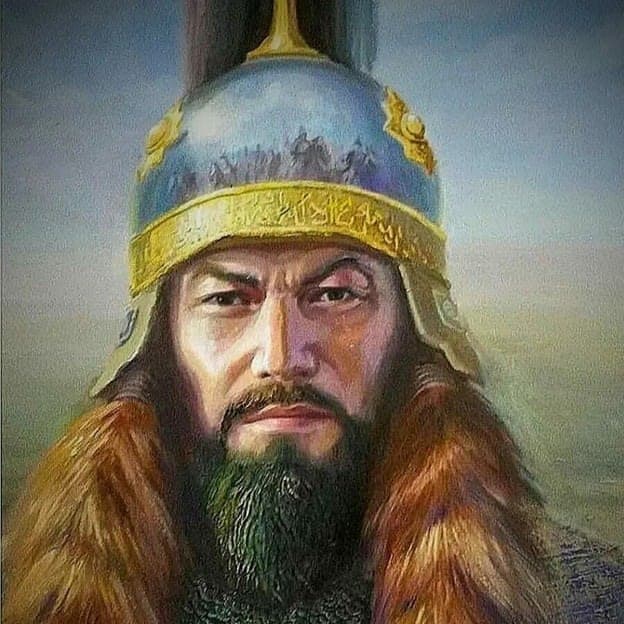

Kasym Khan was the son of one of the founders of the Kazakh Khanate, Janibek Khan, and a descendant of Tuqa-Timur, the thirteenth son of Jochi Khan. In the early years of the khanate, when it was formally ruled by Burunduk Khan, Sultan Kasym already wielded enormous influence. His authority grew rapidly, especially after military successes against the ruler of the Uzbek Khanate, Muhammad Shaybani Khan. By seizing booty and winning victories again and again, he earned the respect of the nobility, which gave him full support.
By the beginning of the 16th century Kasym’s power was so great that, as the historian Muhammad Haydar wrote, no one even remembered the nominal ruler Burunduk. In 1511 Burunduk was driven from the steppe, and Kasym was officially proclaimed khan.
One of the main goals of Kasym Khan’s foreign policy was the struggle with the Shaybanids for control of the cities along the Syr Darya. Fearing the rise of the Kazakh Khanate, Shaybani Khan tried to impose an economic blockade by banning trade with Kazakh merchants. In response, Kasym Khan launched decisive military actions. In 1510 he dealt Shaybani Khan a crushing defeat in the foothills of Ulytau. This setback weakened Shaybani Khan’s authority.
After this the Moghul khan Sultan Said sought Kasym Khan’s help as an ally against the Shaybanids. However, Kasym whose policy was entirely independent refused him, which, in the view of researchers, confirms the full sovereignty of the Kazakh Khanate.
As a result of his military campaigns, Kasym Khan greatly expanded the khanate’s borders. To the south his domains reached the Syr Darya and included most of Turkestan. To the southeast they encompassed Semirechye (Jetysu), and to the north and northwest they extended to the Ulytau Mountains, Lake Balkhash, and the basin of the Zhayyq (Ural) River. Under Kasym, the khanate’s population reached one million.


Under Kasym Khan the Kazakh Khanate first entered the international arena. One of the first states to establish diplomatic relations with it was the Grand Duchy of Moscow during the reign of Vasili III. Historians also mention contacts with the Russian tsar Ivan III, although their nature is unknown.
From 1515 Kasym Khan turned his attention to the western lands, beginning to exert pressure on the Nogais. In 1519 a fierce struggle unfolded with the Nogai murza Shigim. As a result, Kazakh forces under Kasym’s command defeated the Nogais and drove them beyond the right bank of the Volga. They captured the capital of the Nogai Horde, Saraichik, which led to its disappearance from the political map.
Kasym Khan died in 1521 in Saraichik on the Ural River. He was buried in the ancient pantheon of Golden Horde khans.
The reign of Kasym Khan became the golden age of the Kazakh Khanate. He not only secured its borders but also turned it into a powerful state respected by all its neighbors. It was precisely in this period that the Kazakhs, as a distinct ethnos, became known in Western Europe, and their history found reflection in the chronicles of medieval Muslim historians.


