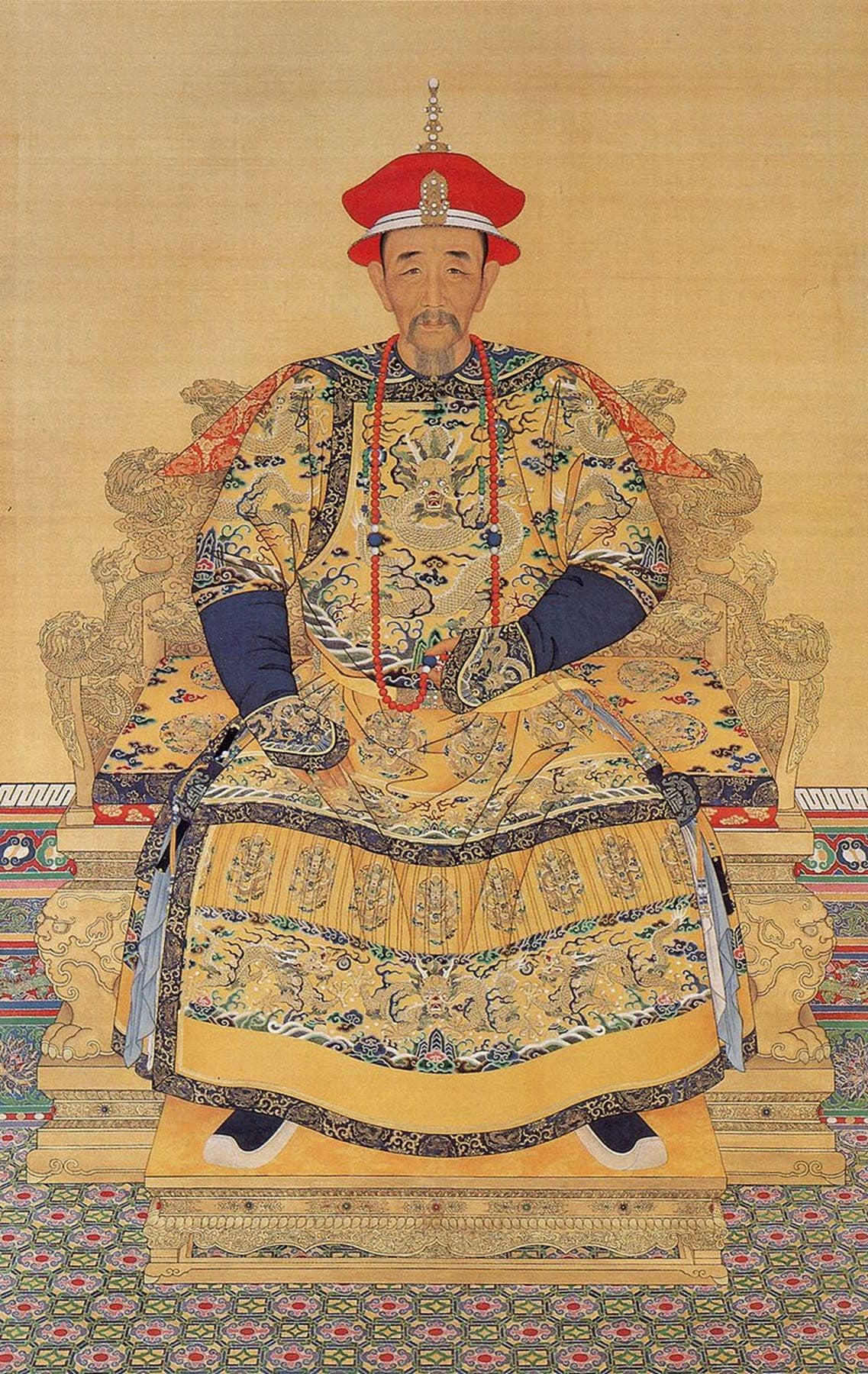

Emperor Kangxi was one of the most remarkable rulers in Chinese history. His reign, which lasted for over 60 years, became a period of stabilization, prosperity, and significant expansion of the Qing Empire.
After the death of his father, Emperor Shunzhi, in 1661, the six-year-old Kangxi ascended the throne. The governance of the state was entrusted to a regency council of four men, headed by the influential prince Oboi. This period was marked by intrigue and factional strife. Oboi quickly seized full control of power, eliminated the influence of eunuchs at court, and began persecuting European missionaries, whose status had been secure under the late emperor. His ruthless rule and desire to destroy all rivals led to chaos at the highest levels of power.
In 1669, the young Kangxi, then fourteen years old, together with his uncle Prince Songgotu, carried out a palace coup. They overthrew Oboi and dissolved his faction. Power passed into the hands of Songgotu, who became the de facto ruler of the empire for the next nine years. During this time, Kangxi, displaying wisdom and patience, accumulated experience and gradually strengthened his position. Songgotu, in turn, made a series of concessions to calm the Chinese population, which had grown increasingly dissatisfied with Manchu rule.
From an early age, Kangxi showed a deep interest in Chinese culture and science. He was a great patron of the arts and craftsmanship, ordering the restoration of the imperial porcelain kilns at Jingdezhen, which led to the flourishing of high-quality porcelain production.


In 1679, Kangxi removed Songgotu from power and took the reins of government into his own hands, marking the beginning of what became known as the “Kangxi Era.” He reduced the influence of the Princes’ Council and senior nobles, taking important decisions personally. This allowed him to effectively complete the pacification and consolidation of China, a process that had begun under his father.
Under his wise rule, the intensity of anti-Qing resistance decreased sharply. While during Shunzhi’s reign there had been, on average, one major rebellion per year, under Kangxi their number fell six- to sevenfold. He focused on rebuilding the country after decades of war repairing roads, canals, and irrigation systems. Kangxi personally supervised major hydraulic projects, demonstrating his commitment to infrastructure development.

In 1683, after the annexation of Taiwan, he permitted coastal navigation and maritime trade along China’s shores. In 1684, he lifted the ban on foreign trade, though it remained under strict state supervision. Kangxi was also a skilled diplomat. He ended the persecution of Christians, reinstated missionaries who had been banished, and even appointed the Jesuit Ferdinand Verbiest as head of the Imperial Astronomical Bureau, where he instructed the emperor in mathematics and science.

As a devoted Confucian, Kangxi sought to strengthen the ideological foundations of his rule. In 1670, he published the “Sixteen Sacred Maxims,” urging the people to observe moral principles, pay taxes, and oppose crime thus blending traditional Confucian ethics with the needs of a centralized state.
Kangxi faced serious challenges on the northern frontier, where Qing interests clashed with the expanding Russian Empire. To counter Russian influence, the Manchus founded the fortress of Jilin in 1674. To protect their “sacred homeland” from Chinese and Mongol settlers, they began constructing the “Willow Palisade” in 1678 a fortified border line over 900 kilometers long that divided southern Manchuria into three zones and served as a barrier against migration and smuggling.

In 1685, a Manchu army under Prince Pengchun captured the Russian fortress of Albazin, but the Russians soon rebuilt it. In 1686, the Manchus besieged the fortress again, but after heavy losses were forced to withdraw. A diplomatic resolution was achieved in 1689 with the Treaty of Nerchinsk, under which Albazin was demolished and part of the territory was ceded to the Qing Empire. This diplomatic victory allowed Kangxi to turn his attention to another major threat the Dzungar Khanate.
Kangxi aimed to weaken Dzungaria and to bring Tibet under Qing control. He skillfully exploited internal conflicts among the Khalkha Mongol khans, waiting for the right moment to act. When, during the 1687–1688 war, the Dzungars under Galdan Boshugtu Khan crushed the Khalkha forces, the defeated Mongols fled under Qing protection. In 1691, at the assembly in Dolonnor, all of Khalkha was formally incorporated into the Qing Empire.
In 1696, Kangxi’s forces dealt a decisive blow to Galdan Boshugtu Khan, who fled and committed suicide the following year. After this victory, the entire region from the Altai Mountains to Khalkha became part of the Qing Empire, which by the end of the 17th century had become the largest state in Asia.
Kangxi actively worked to strengthen the state. In 1712, he implemented a tax reform that unified the fiscal system and improved conditions for the non-agricultural population. He curtailed the abuses of Manchus over Chinese property and land, striving to build an alliance with the Chinese elite. To this end, he expanded their participation in administration and involved them in large-scale cultural projects such as the compilation of multi-volume encyclopedias and anthologies.
However, this cultural activity was closely tied to strict censorship. All literary works underwent careful screening, and any references to resistance against foreign conquerors were removed. Scholars who refused to comply were severely punished.


Kangxi also pursued a policy of religious tolerance. In 1692, he legalized Christian preaching, but when the Vatican attempted to interfere in China’s internal affairs by banning Chinese Christians from blending their faith with traditional rites, the emperor responded sharply, refusing to let foreign powers dictate their terms.
Kangxi continued the policy of integrating non-Han peoples of southwestern China. In 1704, he began replacing traditional local chieftains with the imperial civil administration, seeking to fully assimilate these peoples into the empire.
The war with Dzungaria continued into the 18th century. In 1715, a new conflict erupted with Tsewang Rabtan, the Dzungar khan. In 1717, the Dzungars invaded Tibet, providing Kangxi with a pretext to send troops there. In 1720, the Manchu army expelled the Oirats from Tibet, stationed a garrison there, and strengthened Qing influence in Central Asia.

Emperor Kangxi died in 1722 at the age of 68. Contrary to expectations, he named not his eldest but his fourth son, Yinzhen, as his successor who entered history as Emperor Yongzheng. Kangxi left behind a strong and stable empire, fully prepared for continued development.


