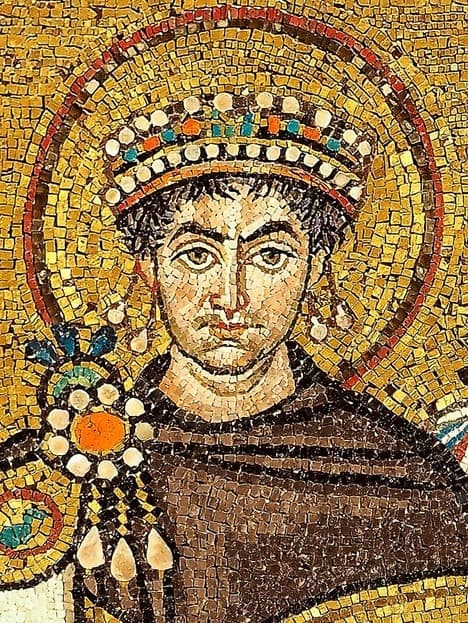

Very little is known about Justinian I’s childhood and youth. He was born in the village of Bederiana in Macedonia, but his uncle Justin (the future Emperor Justin I), by then already a successful soldier in Constantinople, summoned him to the capital to assist him. Justin himself, born around 450, had come to Constantinople on foot, fleeing poverty, and rose to become commander of the palace guard. It is thought that Justinian arrived in the capital at about age 25, where he began his service as an imperial bodyguard to Emperor Anastasius I (a candidatus). At that time his uncle adopted him, and he took the name Justinian.

After Emperor Anastasius died in 518, Justin managed to seize power despite the presence of more influential candidates. He was aided by the support of the Hippodrome factions and by the active involvement of his nephew. Immediately upon his accession, Justin appointed Justinian to the important post of commander of the domestici, the palace guard corps. In 521 Justinian became consul for the first time—an exceptional honor. During that first consulship he staged lavish festivities at great expense, which helped him win popularity. He was then appointed commander of the field army (magister militum in praesenti).

Old, uneducated, and ailing, Justin I in effect handed the reins of government to his energetic nephew. According to the historian Procopius of Caesarea, Justinian was already an unrestricted ruler from 518 onward. In 527, sensing death approaching, Justin—at the Senate’s request—formally proclaimed Justinian his co-emperor. On April 1, 527, Justinian and his wife Theodora were crowned as Augustus and Augusta. He assumed full power four months later, after Justin I’s death on August 1, 527.
In 525 Justinian married Theodora, a woman of scandalous reputation. She had been an actress or dancer—status then deemed unacceptable for marriage into the upper orders. In love with her, Justinian secured a new law abolishing the ban on senators marrying women of low origin. Theodora, who leaned toward Monophysite views, was not only his spouse but a political co-ruler. She wielded enormous influence over him and played an active role in state affairs.
The beginning of Justinian’s reign was marked by mounting political tension that erupted in the Nika revolt in January 532. Popular unrest, sparked by high taxes and official arbitrariness, grew into a full-blown uprising. The rebels, uniting the Hippodrome factions (the “Blues” and the “Greens”), tried to overthrow Justinian and place the senator Hypatius, a nephew of the former emperor Anastasius, on the throne. At first dismayed, Justinian was ready to flee, but Theodora restrained him, uttering the famous words: “Royal power is a splendid shroud.” At her insistence the emperor called upon the army under Belisarius and Mundus, who crushed the revolt, carrying out a brutal massacre in the Hippodrome. The Nika revolt caused massive destruction in Constantinople, giving Justinian an opportunity to rebuild the city and later to erect the magnificent Hagia Sophia.


At the outset of his rule Justinian set himself the ambitious goal of restoring the former might of the Roman Empire. He launched large-scale military campaigns to reclaim territories of the former Western Roman Empire.
The first step was the conquest of the Vandal–Alan Kingdom in Africa in 533. The army under Belisarius, exploiting internal conflicts among the Vandals, defeated them at the Battle of Ad Decimum and captured Carthage. The kingdom was destroyed, and the Vandals were brought to Constantinople to take part in a triumph, where they were put to death.

In 535 Justinian began the Gothic War to recover Italy. Relations with the Ostrogoths, deteriorating after the death of Theodoric the Great, finally collapsed after the murder of Queen Amalasuntha. The war, with fluctuating fortunes, lasted until 554 and ended with Italy’s annexation to Byzantium. These costly wars, however, drained the treasury and weakened the state.

In the east the main opponent was Persia (the Sasanian Empire). Justinian waged wars against it with mixed results, seeking to strengthen the frontiers and protect the eastern provinces. A “Perpetual Peace” was concluded in 532, but war resumed in 540. The Persians, led by Shah Khosrow I, sacked Antioch, one of the empire’s largest cities, exposing Byzantium’s vulnerability. In 561 a new peace treaty was concluded, by which Byzantium recognized the loss of Lazica but obtained peace. In the Balkans the empire was subjected to constant raids by Slavs, Bulgars, and Huns, against whom Justinian pursued a defensive policy.

Justinian’s reign was marked by sweeping legal reforms. In 528 he created a commission headed by Tribonian that, in short order, systematized and codified Roman law. The result was the Corpus Iuris Civilis (Body of Civil Law), consisting of the Codex Justinianus (statutes), the Digest (jurists’ opinions), and the Institutes (a teaching manual). This corpus later became the foundation of many European legal systems.
In economic affairs Justinian continued a policy of centralization, though his grand building projects and wars, together with the catastrophic plague of the 540s—which claimed up to a third of the empire’s population—seriously weakened the economy. The plague was the greatest calamity of his reign, sharply reducing agricultural output and state revenues.
In religious policy Justinian strove for unity within the empire. He combated the remnants of paganism, closing the famous philosophical school at Athens in 529. He was deeply involved in doctrinal disputes, attempting to reconcile Chalcedonians and Monophysites; his efforts failed and provoked new schisms. To strengthen Christianity—and his own majesty—he ordered the construction of the Hagia Sophia, completed in 537, which for a long time was regarded as the most beautiful church in the world.

Justinian died on November 14, 565, six months after his great general Belisarius. Despite successes in expanding the frontiers and in legal reform, his reign left the empire financially exhausted and weakened. Yet his legislative legacy, monumental architecture, and attempts to revive the grandeur of the Roman Empire made him the greatest ruler in Byzantine history.


