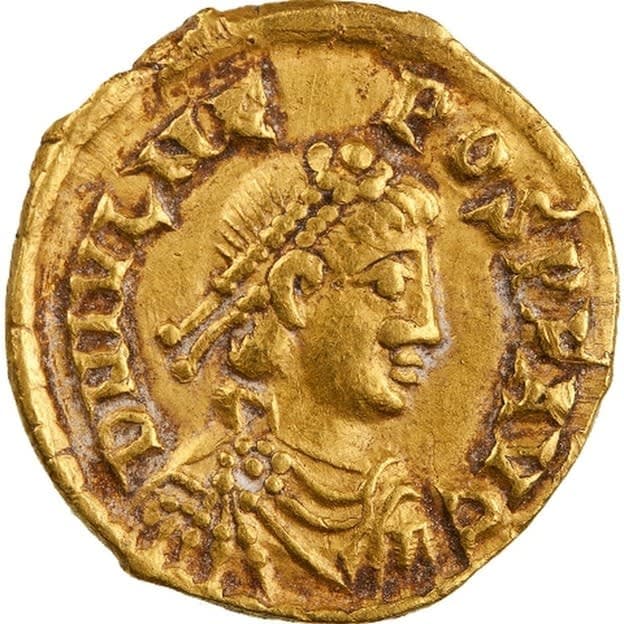

Nepos’s origins firmly connected him with the elite of Dalmatia, a strategically important and wealthy region along the Adriatic coast.
He is generally believed to have belonged to one of the most distinguished families of the province. For a long time, based largely on the writings of the Gothic historian Jordanes, it was believed that Nepos was the son of the well-known military commander Nepotianus.
Nepos’s mother was the sister of the powerful Marcellinus, the general who had effectively created an independent state in Dalmatia.
In 468, Marcellinus was assassinated by hired killers in Sicily, and Nepos, as his lawful heir, inherited both control over Dalmatia and the prestigious rank of magister militum.
Nepos’s greatest political advantage, however, came from his marriage.
He married a niece of Aelia Verina, the wife of the Eastern Roman emperor Leo I Macella.
This union firmly connected the Dalmatian ruler with the imperial court in Constantinople.
Judging from the portraits on his coins, historians have suggested that Nepos was around forty years old when he ascended the imperial throne.
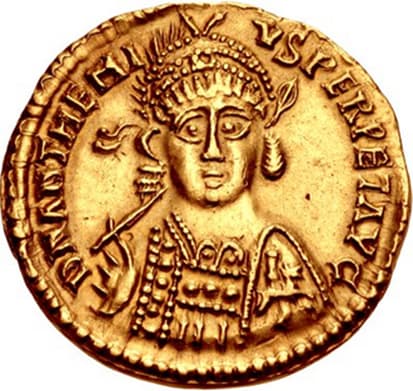
The fateful year 472 claimed the lives of two Western emperors in rapid succession — Procopius Anthemius and Olybrius.
The Eastern emperor Leo I, left as the sole sovereign of the Roman world, gained the authority to appoint a new emperor in the West.
Yet Leo hesitated.
Remembering the tragic fate of Anthemius, who had been brutally killed in Rome by the barbarian Ricimer, and probably lacking a sufficiently reliable candidate, he allowed the Western throne to remain vacant.

The new master of Italy, the general Gundobad, took advantage of this political vacuum.
In March 473, he proclaimed Glycerius, commander of the imperial guard, emperor.
Leo I categorically refused to recognize this barbarian-backed ruler.
At the end of 473, he granted his relative Julius Nepos the supreme honorary title of patrician — and possibly also the rank of Caesar — and entrusted him with the task of overthrowing the usurper.
For Leo I, the situation was ideal.
He was not only restoring imperial influence over the rebellious West but also elegantly removing a powerful relative and potential rival from Constantinople.
Winter storms closed the Adriatic to navigation and forced Nepos to postpone his expedition until spring.
In June 474, his fleet landed at Ostia.
By then Gundobad had left Italy, and Glycerius, deprived of military support, surrendered without a battle.
Nepos showed mercy.
He spared the life of his defeated opponent and exiled him to Nepos’s own homeland, appointing him bishop of the Dalmatian city of Salona.

After coming to power, Julius Nepos reincorporated Dalmatia into the Western Roman Empire.
Most of his solidi, or gold coins, were minted at Mediolanum to meet military expenses, while the mints of Rome and Ravenna primarily produced smaller tremisses for the payment of officials.
Very little is known about his domestic policies.
One surviving example is that Castalius Innocentius Audax, whom Nepos appointed Prefect of Rome, carried out the restoration of several buildings damaged during barbarian sackings.
The emperor’s greatest problems, however, lay outside Italy.
In Gaul, the Visigoths under the ambitious king Euric had openly declared their complete independence from Rome.
The empire still clung to only the region of Arvernia and the city of Augustonemetum, which were heroically defended by Ecdicius Avitus.
Nepos granted Ecdicius the rank of magister militum, but almost immediately began seeking peace with the Visigoths.

The emperor first sent Epiphanius, bishop of Ticinum, modern Pavia, to negotiate.
When this attempt failed, an unprecedented delegation of four Gallic bishops arrived at Euric’s court: Leontius of Arelate, Graecus of Massilia, Faustus of Riez, and Basilius of Aix.
The result of their diplomacy was humiliating for Rome.
The Empire formally surrendered the courageous region of Arvernia to the Visigoths in exchange for the return of Provincia.
After Nepos’s overthrow, however, Euric would immediately seize that territory as well.
Affairs in the south were no better.
Facing renewed attacks by the Vandal fleet, Nepos was forced to formally recognize Vandal rule over Africa, Sicily, Sardinia, Corsica, and the Balearic Islands.
Nepos was therefore effectively acknowledging Rome’s powerlessness.
He had failed to prevent the loss of Gaul.
Only northwestern Gaul, the Domain of Soissons, remained under nominal Roman control, governed by Syagrius, who would eventually be defeated by the Franks in 486.
The policy of appeasing barbarian powers by surrendering territory provoked fury among patriotic Roman circles.
Ecdicius, who disagreed with this policy, was removed from office.
In his place, Nepos appointed Flavius Orestes as magister militum.
Orestes was a dangerous and unscrupulous man who had once served as personal secretary to the Hunnic king Attila.
He was granted the title of patrician and ordered to restore order in Italy.

This appointment proved to be a fatal mistake.
Once he had control of the army, Orestes immediately rebelled and marched his legions toward Ravenna.
The Roman Senate, disappointed with Nepos, sided with the rebel.
On 28 August 475, Julius Nepos, lacking the forces necessary to defend himself, boarded a ship and fled back to Dalmatia.
Orestes then proclaimed his young son Romulus Augustus the new emperor of the West.

Nepos, however, did not surrender his claim to the imperial purple.
From his refuge in Dalmatia, he continued to regard himself as the only legitimate emperor of the West.
Moreover, his authority was still formally recognized in the Domain of Soissons and, most importantly, in Constantinople.
The fate of Italy was decided a year later without Nepos’s participation.
Orestes faced a revolt by Germanic foederati, who demanded one-third of the land in Italy.
When their demand was refused, the soldiers elected Odoacer as their king.
Orestes was defeated and executed, while the young Romulus was sent into exile in 476.

Nepos decided that this was his opportunity.
He sent ambassadors to the Eastern emperor Zeno, who had recently suppressed the revolt of the usurper Basiliscus.
Nepos reminded the emperor of their family connection and requested an army and money for a triumphant return to Italy.
At exactly the same time, envoys from Odoacer arrived in Constantinople.
They swore allegiance to Zeno and asked that their leader be granted the title of patrician and recognized as governor of Italy.
Emperor Zeno proved to be a pragmatist.
He understood that Nepos possessed no real military strength, but he was also bound to him by dynastic ties.
He therefore adopted a Solomonic solution.
After reproaching the Roman Senate for its betrayal of both Anthemius and Nepos, Zeno recognized Odoacer as the de facto ruler of Italy, but on one strict condition:
Odoacer was required to recognize Julius Nepos as his lawful emperor.
This created an unprecedented political illusion.
De facto, Italy belonged to Odoacer and his Germanic followers.
De jure, Julius Nepos, living in exile in Dalmatia, remained Emperor of the West.
Between 477 and 480, coins bearing the portraits of Nepos and Zeno continued to be minted at Ravenna and Mediolanum.
At the same time, however, Zeno blocked every attempt by his relative to restore genuine imperial authority.
In 477, for example, he refused military assistance to envoys from the Domain of Soissons who appealed to him on Nepos’s behalf.
The Constantinopolitan court clearly found it useful to preserve the status quo in order to maintain stability along the western frontiers.
Julius Nepos himself appears to have shown little enthusiasm for returning to the political cauldron of Italy.
Instead, he preferred the relative security of ruling his own well-fortified Dalmatian domain.
Yet the ambitions of the exiled emperor eventually prevailed.
Nepos most likely began secretly preparing a plan to restore full control over Italy, something that could hardly fail to alarm Odoacer.
The final act came in 480.
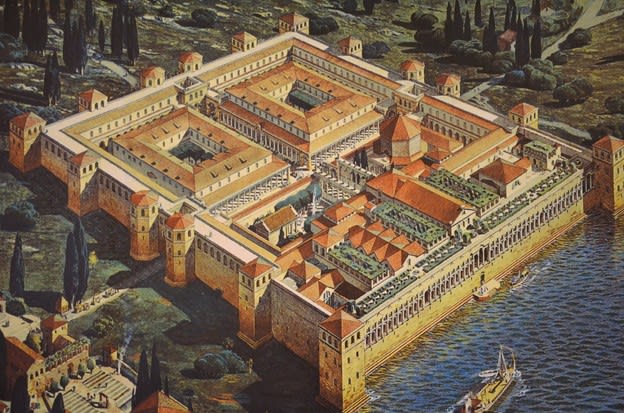
At his luxurious villa near Salona — which some historians have suggested may have been the famous Palace of Diocletian — Julius Nepos was treacherously murdered by two of his own officials, the comites Viator and Ovida.
The sources disagree about the exact date.
Possible dates include 25 April, favored by R. Mathisen, 9 May, or 22 June, proposed by Michael Grant.
The historian Malchus of Philadelphia left a chilling accusation.
According to him, the organizer of the assassination was none other than Glycerius — the former emperor whom Nepos had overthrown and appointed as a local bishop.
After Nepos’s murder, Count Ovida attempted to establish himself as ruler of Dalmatia.
Odoacer, however, cynically used Nepos’s death as a justification for intervention, presenting his invasion as “revenge for the lawful emperor.”
He immediately invaded Dalmatia, defeated Ovida, and annexed the wealthy province to his kingdom.
Julius Nepos became a symbol of the irreversible transformation of the Roman world.
Appointed by Constantinople, he had been doomed by circumstances.
The imperial title in the West had finally lost its practical meaning, while real power passed into the hands of barbarian military leaders.
The collapse of the monetary economy in the West, which would revive only under the Franks in the eighth century, contributed to the isolation of the former Roman provinces.
The surviving fragments of Roman administration now served either Germanic kings or the Church, while Latin increasingly remained the language of religion and official administration.
The Germanic rulers of Italy formally acknowledged the sovereignty of Constantinople while pursuing independent policies.
This situation would later encourage Justinian to attempt the reconquest of the West.
Yet the classical idea of a united and indivisible Roman Empire had disappeared forever.
And its last lawful guardian in the West was a man from Dalmatia — Julius Nepos.


