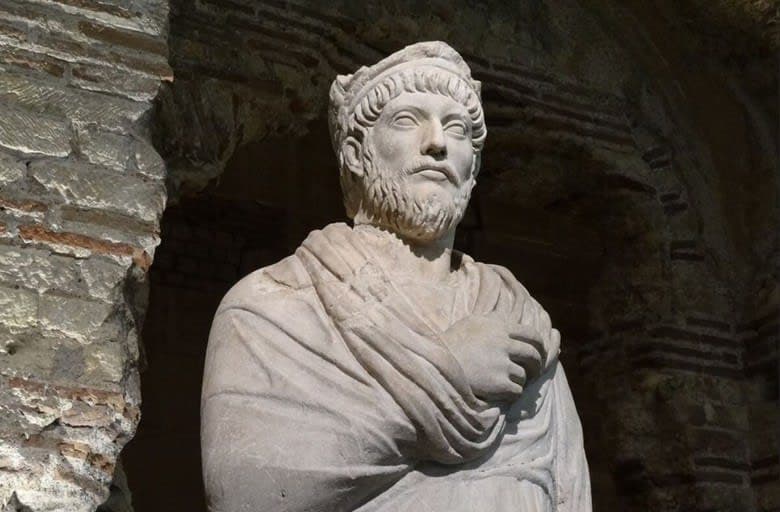

The story of Julian begins with tragedy. Born in Constantinople, he was the son of Julius Constantius, the half-brother of Constantine the Great. When Julian was only six years old, his father perished during a military revolt in 337, which occurred shortly after the emperor’s death. During the bloody massacre possibly initiated by order of Constantius II, Constantine’s son all the closest relatives of the imperial family were slain. Julian survived only because of his young age, and his elder brother Gallus because of serious illness. Thus, in early childhood, both were left complete orphans under the guardianship of Emperor Constantius.

After his father’s death, Julian came under the care of Eusebius, an Arian bishop, and was later placed under the tutelage of the eunuch Mardonius, who instilled in him a deep love for Greek philosophy and literature. From 344 to 345 Julian lived in Nicomedia, where he secretly studied the works of the pagan orator Libanius, and then in Pergamum and Ephesus, where he fell under the strong influence of Neoplatonic philosophers. The greatest impact on him was made by Maximus of Ephesus, a supporter of theurgic Neoplatonism, which perhaps became the reason for his later break with Christianity.
In 355 he went to Athens, where he met his future opponents, the Christian theologians Gregory and Basil.
For six years Julian and his brother were confined in the fortress of Macellum. Despite comfortable conditions, Julian was burdened by the lack of communication and constant supervision, which probably became the cause of his growing aversion to Christianity.
When Emperor Constantius II was left childless, the question of succession arose. He recalled Gallus from exile, gave him the title of Caesar, and appointed him governor in Antioch. However, Gallus failed in his duties and was executed in 354.
Facing the problem of succession once again, Constantius—under the influence of Empress Eusebia—appointed Julian as Caesar, married him to his sister Helena, and sent him to command the armies in Gaul.
A daunting task stood before Julian: to deal with the Germanic tribes that were ravaging the country. He accomplished his mission brilliantly and in the Battle of Argentoratum (Strasbourg) inflicted a crushing defeat on the Germans, driving them back beyond the Rhine. Julian won the love of his soldiers, but his successes aroused envy and suspicion in Constantius and his courtiers, who mocked the young Caesar.


In 360, Constantius, preparing for a campaign in Persia, demanded from Julian part of his best legions. This was perceived as a clear sign of mistrust. The Gallic troops, unwilling to go east, rebelled and in Lutetia (Paris) proclaimed Julian emperor. Constantius refused to recognize this act, and the empire teetered on the brink of civil war. However, on November 3, 361, Constantius suddenly died, and Julian entered Constantinople as the direct and lawful heir, organizing a harsh purge against the late emperor’s supporters.
The Roman historian and Julian’s contemporary Ammianus Marcellinus left a detailed portrait of him. He described the emperor as a man of medium height, with smooth, soft hair, a thick beard, bright expressive eyes, and a straight nose. He was strong and swift.
However, Marcellinus also noted his shortcomings frivolity, talkativeness, a tendency to superstition (he was excessively obsessed with sacrifices), and a thirst for glory and praise. Ammianus criticized some of his decrees, such as the ban on teaching for Christian rhetoricians, as well as the unjust inclusion of people in municipal councils who had no right to such positions.
Having become sole ruler, Julian began to realize his cherished dream—the restoration of ancient Roman religious customs. A convinced pagan, he had concealed his views until Constantius’s death. In the very first weeks of his reign, he issued an edict of toleration, allowing the restoration of pagan temples and the return of their confiscated property.
However, Julian understood that a simple return to the old forms of paganism was impossible. He decided to transform it, borrowing many elements from Christian organization: he created a pagan clergy modeled after the Christian hierarchy, ordered sermons and discourses to be held in temples, introduced singing during pagan services, and demanded moral purity from priests.
One of the key acts of his reign was the “Edict of Toleration” of 362, which restored from exile the disgraced Christian bishops. Yet this step was not an expression of genuine tolerance but a shrewd political calculation. Julian believed that upon returning, representatives of various Christian sects would immediately engage in fierce disputes, weakening the Church and rendering it incapable of resisting him. At the same time, he promised great benefits to those Christians who renounced their faith.
Julian, being a passionate opponent of Christianity, did not limit himself to restoring paganism. He also sought to refute Christian prophecies. One of his main undertakings was the reconstruction of the Jerusalem Temple for the Jews, which, in his opinion, would prove false the words of Jesus that not one stone would be left upon another. He allocated funds for the construction, but work was halted within a few days due to a fire, which some contemporaries regarded as a divine sign.

Another serious blow to Christians came as a result of the school reform. Julian issued a decree stating that teachers of grammar and rhetoric must adhere to the “state doctrine.” He considered it absurd that Christians, who rejected the gods, should teach the works of Homer, Hesiod, and other ancient authors. This decree effectively prohibited Christians from teaching or studying unless they renounced their faith.
During his journey through the eastern provinces, Julian realized how unpopular his ideas were. The population of Antioch, a Christian center, remained indifferent to his sympathies for paganism. The conflict intensified after a fire in a temple, for which Christians were blamed. In response, Julian closed the main church of Antioch. Christians, in turn, actively destroyed pagan images.
Although Julian avoided direct persecution so as not to create new martyrs, many church representatives were tortured and killed during his reign. Among them were bishops and simple believers such as Basil of Ancyra and John the Warrior.

Julian considered war with Sasanian Iran, ruled by Shahanshah Shapur II the Great, to be his chief foreign-policy task. In the spring of 363 he launched a campaign that was initially successful the Roman legions reached the Persian capital Ctesiphon. However, the city proved impregnable, and reinforcements as well as Armenian allies failed to appear.

The situation was worsened by a traitorous guide who led the Romans into a waterless desert. Realizing that his army was in a hopeless position, Julian was forced to begin a retreat, constantly fending off Persian attacks.
On June 26, 363, in the Battle of Maranga, Julian received a mortal wound from a spear. The circumstances of his death remain disputed. According to one version, the wound was inflicted by an enemy warrior; according to another by a soldier of his own army; a third claims it was suicide. His friend, the orator Libanius, believed the killer was a Christian, but the pagan historian Ammianus Marcellinus described the death as an accident caused by the emperor’s carelessness during battle.
Reports of Julian’s last words also vary. Some sources say that, casting his blood toward the sun, he said: “Be satisfied!” Others, later ones, attribute to him the phrase “You have conquered, Galilean!” likely added by church historians to demonstrate the final victory of Christianity.
After his death, Julian was buried in a pagan sanctuary in Tarsus, but later his body was transferred to Constantinople and interred in the Church of the Holy Apostles next to his wife, though without Christian rites.

Libanius, in his Funeral Oration for Julian, noted that the murderer remained unknown, but he was sure it was not an enemy rather someone for whom the emperor’s life had been disadvantageous, implying the Christians.
Despite his short reign, Julian left a significant mark in history. He was the last Roman emperor who attempted to restore paganism. His reign became the final flare of the ancient world, after which Christianity was firmly established as the state religion of the Roman Empire.


