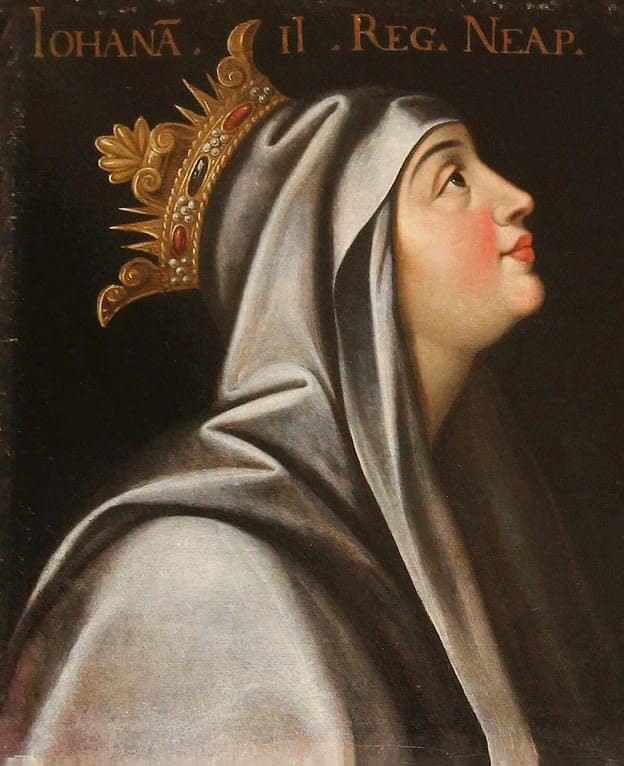

In August 1414, when Naples was shaken by news of the agonizing death of the ambitious King Ladislaus, the kingdom once again found itself on the brink of a dynastic crisis. Since the deceased monarch had left no legitimate heirs, the burden of power fell upon his own sister, Joanna II.
The daughter of King Charles III and a member of the powerful Durazzo branch of the great Angevin-Sicilian dynasty, Joanna ascended the throne at the age of forty-one. For that harsh era, this was considered a rather advanced age, and the crown passed to a woman whose character was already firmly established and whose past had been far from simple.

Joanna's life before ascending the throne had been marked by personal losses and political maneuvering.
Her first husband was William, Duke of Austria, whose marriage to Joanna ended with his death in 1406. Having been widowed and having spent many years in the shadow of her domineering brother, Joanna faced an urgent need to strengthen her position upon receiving the crown.
The Kingdom of Naples, torn apart by internal conflicts, desperately needed strong leadership and reliable allies.
For the sake of political stability, the queen entered her second marriage in 1415. Her chosen husband was a noble French aristocrat, Count James II of Bourbon.
However, this union proved to be a complete failure.
The count, whose ambitions clashed with the realities of the Neapolitan court and the queen's own strong-willed character, was unable to maintain his position of power.
Shortly after the wedding, James of Bourbon ingloriously abandoned Joanna and returned permanently to his native France, leaving the queen alone to confront the approaching threats.

And those threats were not long in coming.
The sinister shadow of an old blood feud once again loomed over Naples.
A new figure emerged on the political stage: Louis III, Duke of Anjou.
He laid claim to the crown on the basis of an old but not forgotten will left by the notorious Joanna I — the very queen whom Joanna II's father, Charles III, had once ordered to be strangled.
According to this ancient document, the Kingdom of Naples was supposed to pass to the grandfather of the current claimant, Louis III of Anjou.
Armed with this legal justification, Louis III launched a large-scale attempt to seize Naples by force.

Finding herself in a desperate position and lacking sufficient military strength to repel the Angevin invasion, Joanna II decided to undertake an unprecedented geopolitical maneuver.
She turned her attention beyond Italy and appealed for assistance to one of the most powerful monarchs in the Mediterranean — King Alfonso V of Aragon.
In 1421, the queen did more than simply conclude a military alliance with him: she officially adopted Alfonso and solemnly proclaimed him her sole legitimate heir.

Upon arriving in Naples, the energetic and authoritarian Alfonso V immediately began imposing strict order on a kingdom that had become deeply destabilized by corruption and anarchy.
However, his methods proved far too harsh for the Neapolitan court.
The fatal mistake of the Aragonese monarch was his interference in the queen's personal life.
Seeking to eliminate the harmful influence of royal favorites, Alfonso ordered the arrest and imprisonment of Caracciolo — a powerful court favorite and Joanna's beloved lover.
This decision provoked an enormous scandal.
For Joanna II, personal resentment proved stronger than the interests of the state.
Blinded by anger and a desire for revenge, the vindictive queen carried out an astonishing political reversal.
In 1423, she publicly annulled her adoption of Alfonso of Aragon and, out of spite, officially recognized as her new heir none other than her recent bitterest enemy — Louis III of Anjou!
This paradoxical alliance proved surprisingly durable.
Relying on Louis's military assistance, Joanna succeeded in expelling the Aragonese, defending the capital, and retaining control of the government.
Fate, however, decreed that Louis III would never live to wear the Neapolitan crown — he died before the queen herself.
Remaining faithful to her commitments to the House of Anjou, the aging Joanna designated his own brother, René the Good, as her final heir shortly before her death.
The life of Joanna II came to an end, leaving behind a tangled web of unresolved conflicts and a succession of wars over the royal inheritance.
Yet the greatest historical significance of her death lay elsewhere.
With Joanna II, the ancient and once-mighty royal House of Naples, founded by Charles I of Anjou, became permanently extinct.
The turbulent era of the direct descendants of this dynastic line had come to an end, giving way to new dynasties and new rulers of Southern Italy.


