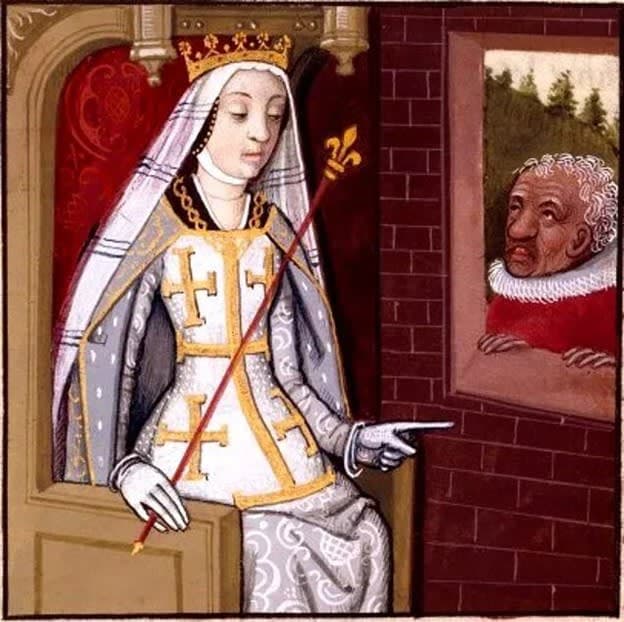

The future ruler was born in 1325 or 1326. Her father, Charles of Calabria, died prematurely in 1328, making the young princess the direct heir to her great-grandfather, King Robert the Wise. When Robert passed away in 1343, the crown fell as a heavy burden upon the shoulders of fifteen-year-old Joanna.
No sooner had she ascended the throne than the inexperienced ruler found herself surrounded by her power-hungry aunts and their favorites. The young queen became deeply immersed in an atmosphere of sophisticated court intrigues, endless festivities, and highly questionable pleasures. The moral standards of the Neapolitan court rapidly deteriorated. According to the bitter and revealing testimony of the contemporary chronicler Domenico da Gravina, "the court of this queen resembled a brothel, to the ridicule of all."

Very soon, the frivolous amusements of the nobility took on a sinister and bloody character.
In 1345, Joanna, together with Catherine de Courtenay, committed a crime of astonishing cruelty and cynicism: they poisoned Agnes of Périgord, widow of John, Duke of Durazzo, using a poisoned enema.
Having successfully eliminated one obstacle, the conspirators turned their attention to the court's greatest problem — the queen's first husband, Andrew of Hungary.
The marriage between Joanna and Andrew was rapidly falling apart.
Her lawful husband categorically refused to remain in a subordinate position. He openly claimed the royal title and firmly demanded that Joanna share the full extent of royal authority with him.
The situation reached a breaking point when Andrew's mother arrived in Naples. Possessing enormous financial resources, she launched a campaign of direct bribery among the Neapolitan nobility, assembling a powerful faction of supporters for her son.
Moreover, Andrew's claims received the official support of Pope Clement VI himself.
The already hostile relationship between the spouses ended in a horrifying catastrophe in 1345. Under the cover of darkness, Andrew of Hungary was brutally strangled in his own bed. According to other accounts, the unfortunate prince was thrown from the window of a high tower.
Public opinion in Naples immediately delivered its verdict: two of the queen's cousins were identified as the murderers, and it was widely believed that they had acted under Joanna's direct secret orders.

Andrew's brutal murder became the spark that set all of Naples ablaze.
Enraged crowds of citizens surrounded the royal palace, filling the air with terrifying cries: "Death to the traitors and the adulterous queen!"
Finding herself on the brink of death, Joanna demonstrated extraordinary political cunning.
She managed to calm the crowd and preserve her authority by solemnly promising to conduct the most thorough investigation and severely punish the murderers.
However, the true value of her promises became clear just one year later. In 1346, she openly married one of the principal suspects in the organization of the murder — Louis of Taranto — thereby confirming the people's darkest suspicions.
Andrew's spilled blood did not remain unavenged.
In 1348, his brother, the powerful King Louis I of Hungary, invaded the Kingdom of Naples at the head of a formidable army, driven by a burning desire for revenge.
Lacking the military strength to resist, Joanna and Louis of Taranto fled in panic to Provence.
They were saved from inevitable punishment only by an unforeseen disaster: a devastating outbreak of plague swept through Italy, decimating the Hungarian army and forcing Louis to retreat to his homeland.

However, the Hungarian monarch had no intention of abandoning his plans.
The following year, in 1349, Louis once again crossed the borders of the kingdom and occupied Naples.
Joanna and her husband were forced to seek refuge behind the formidable walls of Gaeta.
At this critical moment, Pope Clement VI intervened as the supreme arbiter.
Thanks to his mediation, both sides agreed to conduct an impartial investigation into the murder of Andrew of Hungary under strict papal supervision.
The verdict delivered by the pontiff astonished Europe with its hypocrisy.
Joanna was officially recognized as having participated in the murder, yet at the same time was declared completely innocent on the grounds that "she had acted at the instigation of the devil."
Remarkably, Louis I accepted this absurd decision, laid down his arms, recognized Joanna as the legitimate Queen of Naples, and returned to Hungary.
The true reason behind such an astonishingly lenient and seemingly ridiculous papal judgment soon became apparent.
In exchange for her acquittal, Joanna sold Clement VI the city of Avignon — the permanent residence of the popes — for an insignificant, almost symbolic sum.

Following the resolution of the Hungarian crisis, real political power in the kingdom passed into the hands of Joanna's second husband.
For sixteen years, from 1346 to 1362, Louis of Taranto (1320–1362) served as the effective ruler of Naples.
A pragmatic man, he used his firm authority to restrain the endless extravagance and natural frivolity of his royal wife, preventing the kingdom from descending into complete collapse.
However, Louis died in 1362, and Joanna once again regained sole authority.
Under her rule, the royal court attained unprecedented outward splendor. The queen generously patronized literature and the fine arts, although this magnificence stood in a shocking and painful contrast to the desperate poverty and oppressed condition of the common people.
Unwilling to remain alone, Joanna entered her third marriage as early as 1363.
Her chosen husband was Prince James IV, the titular King of Majorca.
The queen imposed a strict condition: her new husband would have no right to claim the royal title in Naples and was under no circumstances permitted to interfere in the government of the kingdom.
James obediently accepted these conditions.
The internal affairs of Naples held absolutely no interest for him. He devoted his entire life to desperate attempts to reconquer his native Majorca, which had been seized by the Crown of Aragon.
During one such military adventure, James was captured by Henry of Trastámara.
Joanna ransomed her husband for an enormous sum, brought him back to Naples, and, having grown tired of his reckless military adventures, placed the prince under strict house arrest.
However, the restless James managed to escape and eventually met his death during his final, hopeless campaign against Aragon in 1375.

As the years passed, a new existential threat emerged over Joanna — the problem of royal succession.
Her only son, born from her marriage to the murdered Andrew of Hungary, had died in early childhood.
Concerned about securing a successor, the queen arranged a marriage between her relative Charles of Durazzo and her niece Margaret, officially proclaiming Charles the legitimate heir to the Neapolitan crown.
Yet Joanna was once again betrayed by her passion for high politics.
When the Catholic world was shaken by the Great Western Schism, the Queen of Naples recklessly sided with the Avignon antipope Clement VII.
Rome's reaction was immediate and devastating.
The legitimate Roman Pope Urban VI promptly excommunicated Joanna from the Church.
Exercising his authority as the supreme feudal overlord of Naples, the pontiff deprived her of the throne and recognized Charles of Durazzo as the new king — the very man whom she herself had recently designated as her successor.

Finding herself in a desperate position, the aging queen made one final, frantic attempt to save herself.
She hastily entered her fourth marriage, choosing the well-known military adventurer Otto of Brunswick as her husband.
At the same time, she hurriedly adopted Louis I, Duke of Anjou, and proclaimed him her new heir.
Louis was a distant relative of the queen: his great-grandmother Margaret was the sister of King Charles II of Naples, Joanna's own great-grandfather.

However, this political gambit came too late.
Before Louis I of Anjou could assemble an army and come to the assistance of his newly adopted "mother," Charles of Durazzo launched a preemptive strike.
He completely defeated the Neapolitan army commanded by the queen's fourth husband, Otto of Brunswick, and placed Naples under a tight siege.
With neither military strength nor allies remaining, Queen Joanna capitulated and surrendered herself to the mercy of the victor.
Charles of Durazzo placed her under arrest and, for six months, subjected her to relentless pressure in an attempt to force her to revoke the decree adopting Louis I of Anjou.
The proud queen, understanding that she had nothing left to lose, responded with an uncompromising refusal.
Having failed to obtain any legal concessions from his prisoner, Charles made his final decision.
On May 22, 1382, acting under his direct orders, mercenaries entered Joanna's chambers and mercilessly strangled her, bringing a bloody and seemingly inevitable end to one of the darkest reigns in Italian history.


