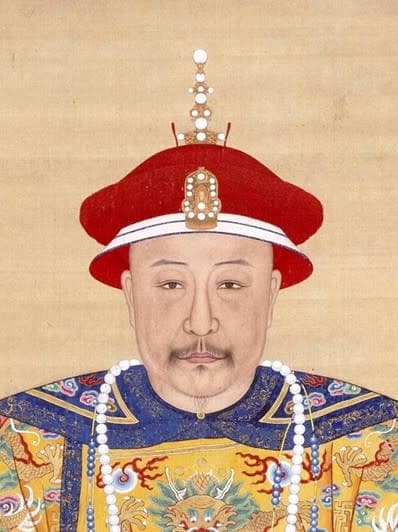

In February 1796, after his father Qianlong’s abdication, Yongyan ascended the throne and adopted the reign title Jiaqing. Along with the crown, he inherited his father’s all-powerful favorite, Heshen. Unwilling to upset the elderly former emperor, Jiaqing was forced to tolerate the court fixer, who in effect ruled the empire until the ex-emperor’s death in 1799.
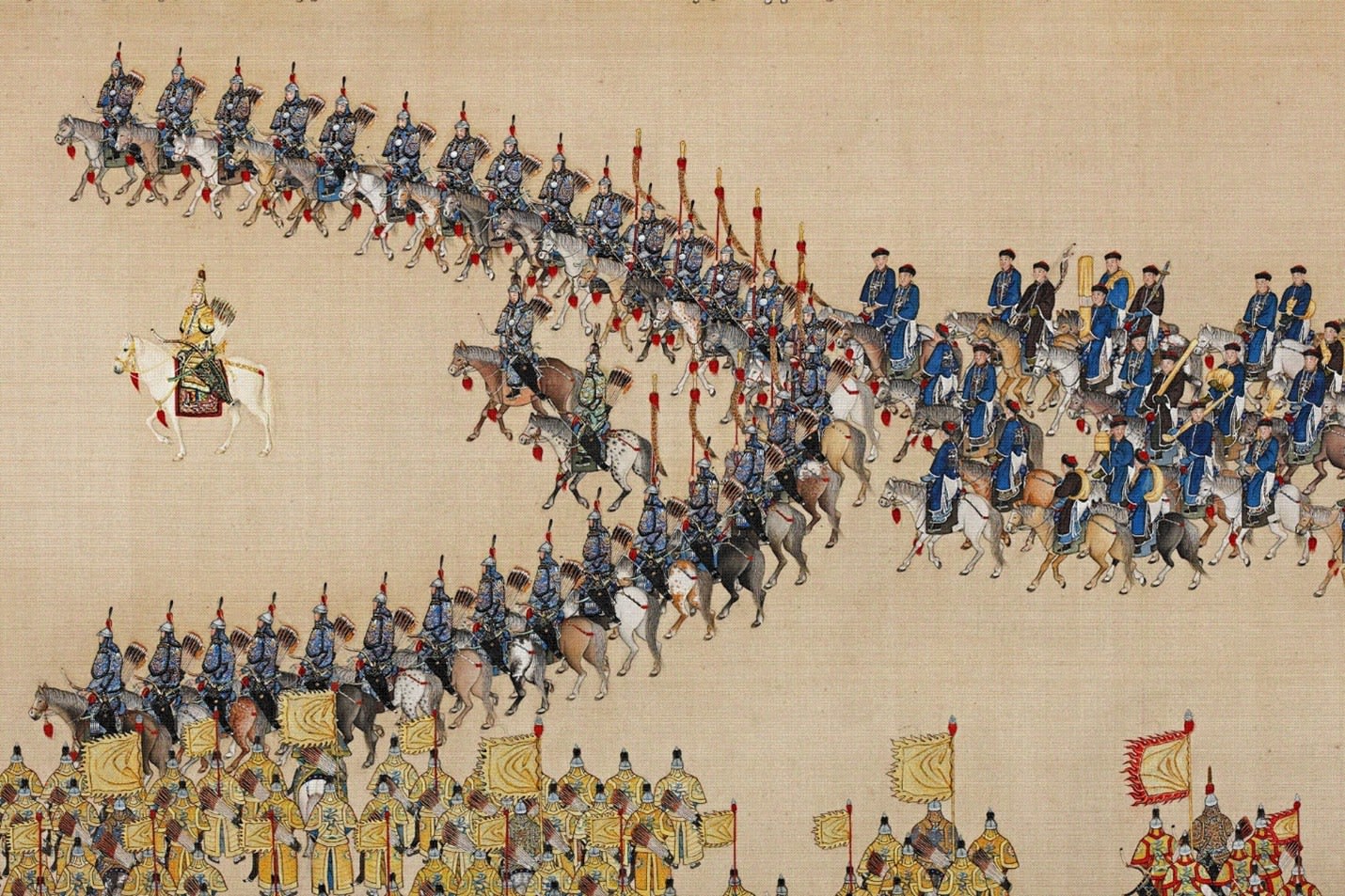
Jiaqing’s reign began amid a major crisis a peasant war organized by the underground sect known as the “Teachings of the White Lotus.” In February 1796 the uprising erupted in Hubei and quickly spread to Sichuan and Shaanxi.
At first, the rebels tried to seize and hold cities, but this tactic brought heavy losses. Realizing their mistake, they shifted to mobile warfare in the countryside, avoiding head-on clashes with superior forces.
Meanwhile, the government camp was in complete disarray. Corruption, embezzlement, and peculation hallmarks of Heshen’s clique had led to the degeneration of the Eight Banner forces. Soldiers went months without pay or rations, turned to looting and banditry, and the incompetent, sluggish commanders promoted by Heshen only worsened the situation.
As soon as Qianlong died in 1799, Jiaqing immediately ordered Heshen’s arrest and trial. The all-powerful courtier was executed and his colossal wealth confiscated. Corrupt officials were replaced with new, more capable commanders such as the Mongol Eledenbao and Yang Yuchun. These measures significantly strengthened the army.
Even so, the last rebel detachments were not crushed until the autumn of 1804. Suppressing the uprising cost the treasury the enormous sum of 200 million taels of silver. After the war, the government faced a new problem: demobilized “volunteers” and “rural militias,” accustomed to easy plunder and violence, rose in revolt. To pacify them, the authorities distributed land.
In the early 19th century, Chinese waters became an arena of Anglo-French rivalry. In 1802 and 1808, British squadrons attempted to seize the Portuguese colony of Macao, but both times were forced to withdraw under threat of a trade embargo by the Chinese authorities. These events gave the Qing government a false sense of omnipotence they believed they could “tame the overseas barbarians” with trade bans alone.


The Russian Empire also sought relations with China. In 1806, Count Yury A. Golovkin’s mission failed because the envoy refused to perform the kowtow (triple prostration). A Russian naval expedition in 1805 likewise came to nothing.

In 1816, the British government sent a new embassy headed by Lord William Amherst, aiming to open China’s market and establish a permanent mission. However, Emperor Jiaqing, treating him as the envoy of yet another tributary, demanded the kowtow. When Amherst refused, the emperor ordered him expelled from the country.

Despite the suppression of the White Lotus rebellion, internal peace did not follow. Uprisings organized by secret societies continued to flare across the provinces, and piracy raged at sea.
In 1813, a major revolt by the “Heavenly Reason” sect broke out; with help from eunuchs, its members even forced their way into the imperial palace in Beijing. The rebellion was crushed, but the incident revealed how vulnerable the regime had become.
At the same time, opium smuggling took root in China. The British East India Company, unable to pay for Chinese goods with silver, began importing the drug from India. From 1800 to 1819, over 4,000 chests of opium were brought in annually. This led to a massive outflow of silver and the disruption of the financial system.
In 1796 and 1800, Emperor Jiaqing issued decrees banning the import and sale of opium, but they had no effect. The Company formally forbade its own employees to trade the drug, yet continued to sell it to private traffickers. By 1817, the Qing government demanded the right to search British ships, but the East India Company ignored the demand, displaying growing arrogance and contempt for Chinese law.
Jiaqing’s reign became a period of deep internal crisis. The suppression of rebellions, the rise of corruption, and the onset of opium dependency all testified that the empire had entered an era of decline one from which it would never recover.


