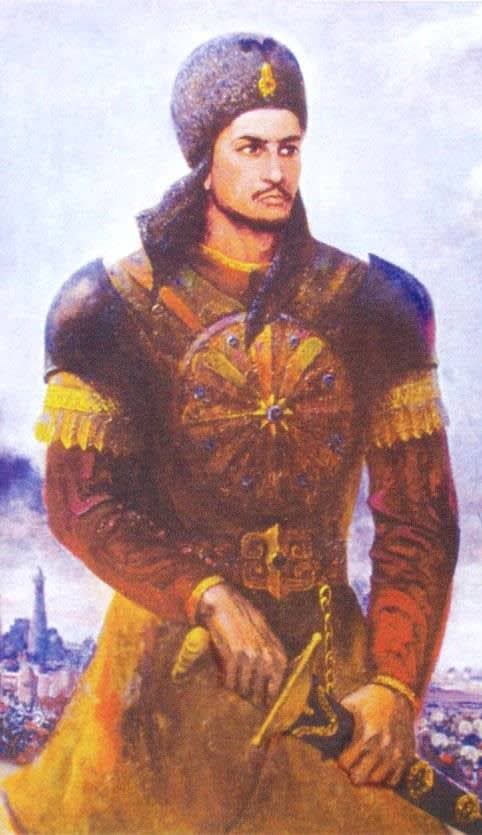
Jalal al-Din was flesh of the flesh of his people and his age. His personal secretary and biographer, Shihab al-Din al-Nasawi, left us a portrait of a man in whom gentleness was combined with the fury of a lion. Dark-skinned and of short stature, he was sparing of words, never allowing himself swearing or anger in ordinary life, yet he was transformed on the battlefield. Jalal al-Din emphasized his происхождение, considering himself first and foremost a Turk; he admitted that the Arabic language came to him with difficulty, whereas he spoke Turkic and Persian fluently. His bravery knew no bounds — al-Nasawi called him a “lion among lions,” the bravest of horsemen, and every one of his battles confirmed it.
February 1221 became a fatal moment. After the death of his father, Muhammad II, on an island in the Caspian Sea, Jalal al-Din took upon himself the burden of power at a time when Khwarazm lay in ruins. He did not wait to perish in besieged cities, but instead led active resistance. Having at his disposal only 300 loyal warriors, he set out for Khorasan. In the district of Nisa, his tiny detachment achieved the impossible: the Khwarazmians attacked and defeated a Mongol force of 700 men.


Genghis Khan, realizing the threat posed by the young sultan, sent punitive forces against him, in clashes with which Jalal al-Din’s younger brothers were killed. Yet the sultan himself advanced relentlessly toward Ghazni. The remnants of shattered armies, governors, and tribal khans such as Khan-Malik and Sayf al-Din joined him. Soon 10,000 warriors had gathered under his banners, and with them he defeated the Mongols near Kandahar. News of the sultan’s victories spread throughout the region, and military commanders began to arrive in Ghazni with their own detachments: Timur-Malik, Amin al-Mulk, and Afghan and Karluk leaders. Jalal al-Din’s army grew to an impressive 70,000 men. Against this force Genghis Khan sent a 30,000-strong corps under the command of his adopted son Shigi Qutuqu.
In the spring of 1221, a historic battle took place in the rocky gorge near the village of Valian on the Gori River. It was a battle in which Mongol tactics clashed with Jalal al-Din’s exceptional ingenuity. On the first day, the sultan ordered Temurmalik and the foot archers to occupy the rocks and fire down upon the Mongols from above. On the following morning, Shigi Qutuqu attempted a deception, placing straw dummies on spare horses to imitate the arrival of reinforcements. But Jalal al-Din saw through the maneuver, calmed his men, and, waiting for the moment when the Mongol attack faltered under a hail of arrows, personally led a cavalry counterattack. The Mongols fled in panic, having lost half their army. The Battle of Parwan became the only major defeat suffered by the Mongols during the entire western campaign of Genghis Khan.

Enraged by the defeat of his commander, Genghis Khan personally led the main forces of the empire. On December 9, 1221, he caught up with the Khwarazmshah’s army on the banks of the Indus River. Jalal al-Din drew up his army in the shape of a crescent, with its back to the river, but the numerical superiority of the Mongols and their ferocious assault on the flanks decided the outcome of the battle. The center of his army was destroyed. To avoid the disgrace of captivity, the sultan ordered his harem to be drowned in the river, after which, before the astonished eyes of Genghis Khan, he spurred his horse from a high cliff into the raging waters of the Indus.

He managed to reach the opposite bank with four thousand surviving horsemen. Watching as the sultan, having climbed ashore, threatened the Mongols with a drawn sword, Genghis Khan forbade anyone to shoot at him and, turning to his sons, uttered the famous words: “Such a son should a father have.” Despite the loss of his family and the execution of his captive relatives, Jalal al-Din did not surrender, but disappeared into the forests of India.
The three years of exile in India became a time of new wars and alliances. Jalal al-Din seized Lahore and Punjab, fighting against local rulers, including the Delhi sultan Iltutmish. Although Iltutmish refused a direct alliance against the Mongols, the Khwarazmshah managed to plunder Sindh and northern Gujarat, creating a base for his return. In 1224, he returned to Iran.

In 1225, Jalal al-Din invaded northern Iran, capturing Maragha and Tabriz. His authority was recognized by the greatest cities of Arran — Ganja and Barda. Soon his gaze turned toward Georgia and Armenia. On August 8, 1225, near the city of Dvin, the large-scale Battle of Garni took place, in which the Khwarazmshah utterly defeated the combined Georgian-Armenian army.
In 1226, Tbilisi fell. The siege ended in brutal reprisals: ten thousand captured warriors were offered the chance to accept Islam, and when they refused, they were executed on the bridge over the Kura River. This episode entered Georgian history as the day of the “one hundred thousand martyrs of Tbilisi” (according to anonymous fourteenth-century chronicles). The religious confrontation reached its peak when the sultan ordered icons to be taken out of Sioni Cathedral and placed on the bridge under the feet of passersby. Those who refused to desecrate the holy images were beheaded. Eastern Georgia was conquered, and the state of the Ildegizids collapsed under the blows of the Khwarazmians.
Despite his military successes, the sultan was unable to create a lasting alliance against the Mongols. In 1227, he defeated a Mongol detachment near Rayy, but now he was forced to fight on two fronts. Against him united the Sultan of Rum Ala al-Din Kayqubad, the Egyptian Sultan al-Malik al-Kamil, and the Cilician king Hetum I. Defeats near Yerevan in 1228 and near Akhlat in 1230 weakened his army.

In 1231, a thirty-thousand-strong Mongol army under the command of Chormaqan, learning of the sultan’s weakened condition, launched a swift offensive. Jalal al-Din retreated to Ganja, and then into the mountains of Mayyafariqin (Kurdistan). There, in August 1231, the great warrior who had for years successfully resisted Genghis Khan met his death. He was killed by an unknown man (according to one version, by a local Kurd taking revenge for his kinsmen).
Jalal al-Din Manguberdi remained in the memory of many peoples as a symbol of the struggle for independence. In modern Uzbekistan, he is revered as a national hero. His image is that of a warrior who defended his land to his last breath, even when hope had already been lost.
In 1999, the 800th anniversary of his birth was widely commemorated. In the Khorezm Region, magnificent monuments and memorial complexes have been erected, the latest of which was opened by President Shavkat Mirziyoyev in 2022.
The Order of “Jaloliddin Manguberdi,” established in 2000, is the highest military decoration of Uzbekistan, awarded for exceptional valor and command talent.


