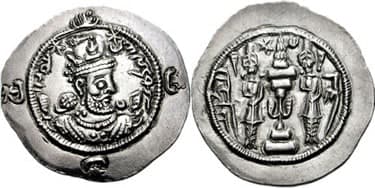

Hormizd IV, the son of the great shah Khosrow I Anushirvan and a Turkic princess, ascended the throne in 579. His origin from a Turkic mother aroused fear and dislike among the Persian nobility. As Firdausi writes, many courtiers were against his accession, considering him “the offspring of the khagan” and unworthy to rule.

Unlike his father and grandfather, who skillfully used religious and social movements to subjugate the nobility, Hormizd IV found himself in a more vulnerable position. The nobility considered the threat of the Mazdakites crushed and raised its head again, seeking to regain lost influence. In response, Hormizd IV continued the policy of centralizing power, but resorted to cruel methods. The sources unanimously speak of his repressions against the nobility and the Zoroastrian clergy. Al-Tabari reports that 3,600 people were executed, and many were thrown into dungeons where they were slowly killed by adding sand and lime to their food.
Despite his cruelty toward the nobility, Hormizd IV, according to Eastern historians, was a just ruler for the common people. He sought to protect the poor from the arbitrariness of the mighty of this world. Al-Tabari describes his order to punish those who damage crops, and even a case when he ordered the ears and tail of his son Khosrow’s horse to be cut off because it trampled the crops. Al-Dinawari put these words in his mouth: “Let not the strong devour the weak and let not the weak deceive the strong!”
In his religious policy he tried to maintain balance, as his father had. He refused the proposals of the Zoroastrian priests to persecute Christians, saying that the state could not stand on two “front legs” without two “hind” ones. He patronized the Nestorians and limited the rights of the Zoroastrian mobeds in judicial matters, which further set the clergy against him.
From the very beginning of his reign Hormizd IV demonstrated an anti-Byzantine orientation in his policy. He refused to send the traditional notice of his accession to the Byzantine emperor Tiberius II, proudly declaring that he would not “send gifts to his slaves.” This led to the resumption of the Romano-Iranian war. The armies of both empires for several years laid waste to the borderlands, turning them into a desert.
In 589 Iran faced a more serious threat from a huge army of Turks led by Sava-shah. The Turks, according to rumors numbering 300–400 thousand men, invaded the territory of Persia. The general Bahram Chobin was appointed to command the defense. He dealt the Turks a crushing defeat near Herat.


However, this victory proved fatal for Hormizd IV. Medieval historians offer several versions of the reasons for Bahram Chobin’s revolt. According to one, Hormizd IV, believing slanderers, humiliated Bahram by sending him women’s clothing and a spindle. According to another, Bahram himself, intoxicated by victory, began to make plans to seize power.
Bahram Chobin refused to obey the shah and marched the army from Khorasan on the capital. He began minting coins in the name of Hormizd’s son, Khosrow, in order to sow discord in the royal family. Conspirators led by the brothers of Khosrow’s mother, Vindoy and Vistahm, took advantage of the situation.
On February 6, 590, Hormizd IV was deposed and blinded. Khosrow was proclaimed the new shah. But his triumph was short-lived. The blinded Hormizd IV was brutally killed, according to one version by the same Vindoy and Vistahm, which served as one of the reasons for his son’s flight to the Romans.
The reign of Hormizd IV, which lasted about 11 years, became a tragic episode in the history of the Sasanians. His attempts to strengthen central authority, relying on the people and on Christians, failed because of the resistance of the powerful nobility, which ultimately overthrew him. His tragic death became a harbinger of further instability in the empire.


