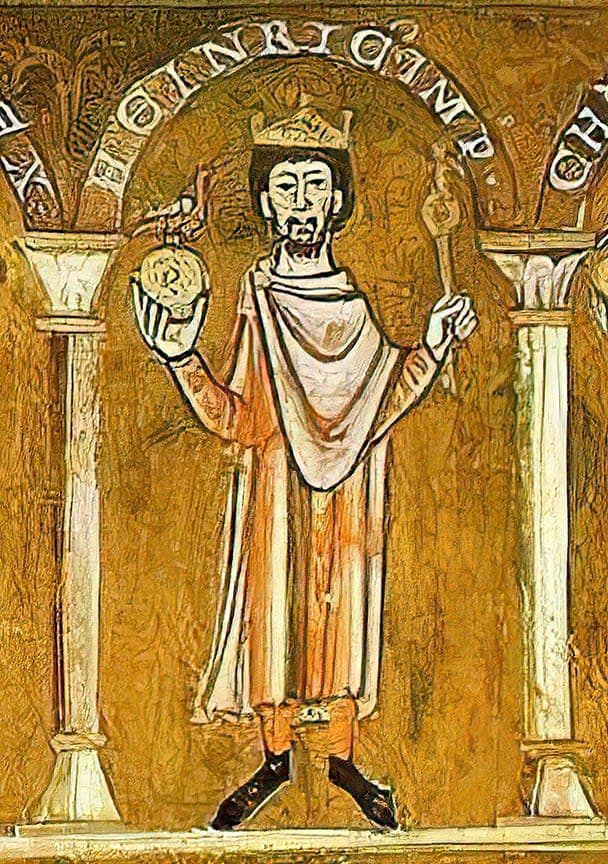
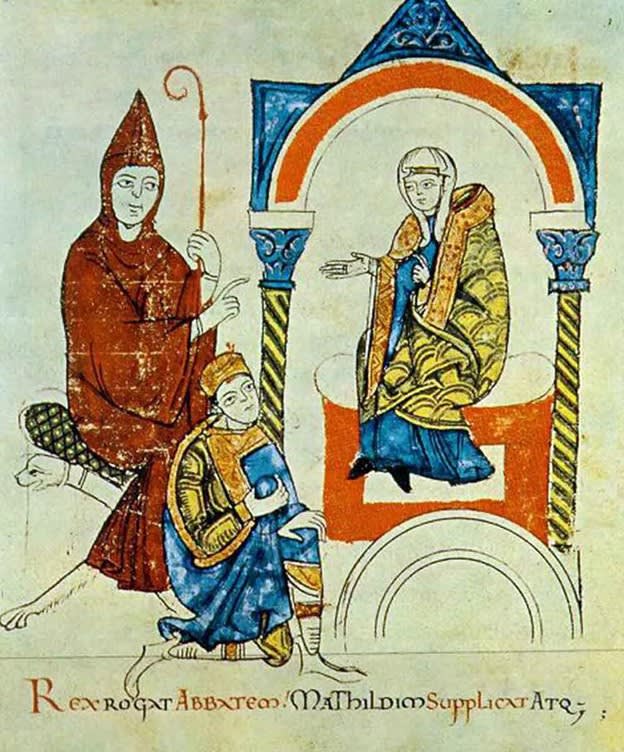
The story of Henry IV, one of the most controversial and powerful rulers of the Holy Roman Empire, began at the imperial palace of Goslar, when the Salian dynasty stood at the height of its power.
His father, Emperor Henry III, and his mother, Agnes of Poitou, were already raising three daughters, but the empire desperately needed a male heir.
Henry III was thirty-three years old when his prayers were finally answered: on 11 November 1050, the long-awaited son was born.
The child was originally intended to be named Conrad, after his grandfather Conrad II. However, under the spiritual influence of a close family friend, Abbot Hugh of Cluny, the boy was instead named Henry.
The solemn baptism took place at Easter 1051 in Cologne, where Abbot Hugh himself — an active supporter of the Cluniac Reform — became the future monarch’s godfather.
The name Conrad was given two years later to Henry’s younger brother, who would later become Duke of Bavaria.
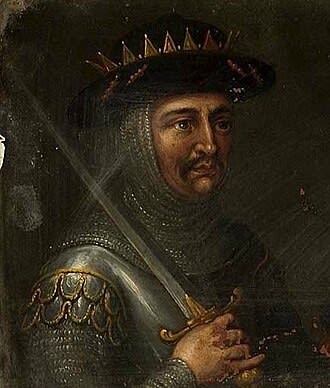
Henry’s political future was secured while he was still an infant.
At Christmas in 1050, the emperor demanded that his subjects swear allegiance to the child, and in November 1053, at the imperial assembly in Tribur, the three-year-old Henry was formally elected king.
Yet even then there was an ominous warning.
The princes pledged loyalty only on the condition that Henry would become a “true ruler.”
His coronation took place at Aachen on 17 July 1054.
In 1055, the five-year-old child was betrothed to Bertha of Turin. The alliance with the Canossan dynasty was intended to counterbalance one of the empire’s most influential enemies, Godfrey the Bearded.
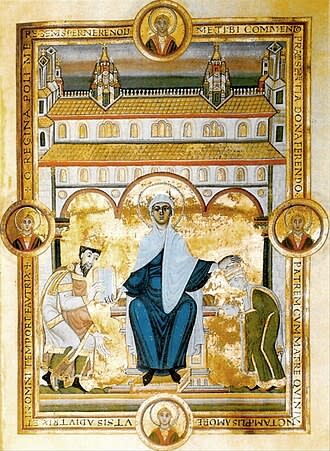
Henry’s world collapsed on 5 October 1056, when his father died.
On his deathbed, Henry III entrusted his six-year-old son to the protection of Pope Victor II.
Thanks to the pope’s diplomacy, the transfer of power was peaceful. Victor reconciled the imperial court with Godfrey the Bearded and secured the loyalty of the southern German princes.
But after Victor II’s death in 1057, the situation deteriorated rapidly.
The regency of Agnes of Poitou proved disastrous.
Lacking the political skill necessary to maintain firm control, she gradually lost her influence by granting key duchies — Swabia, Bavaria, and Carinthia — to men who would later become some of her son’s bitterest enemies.
By 1062, dissatisfaction with Agnes’s government had reached its limit.
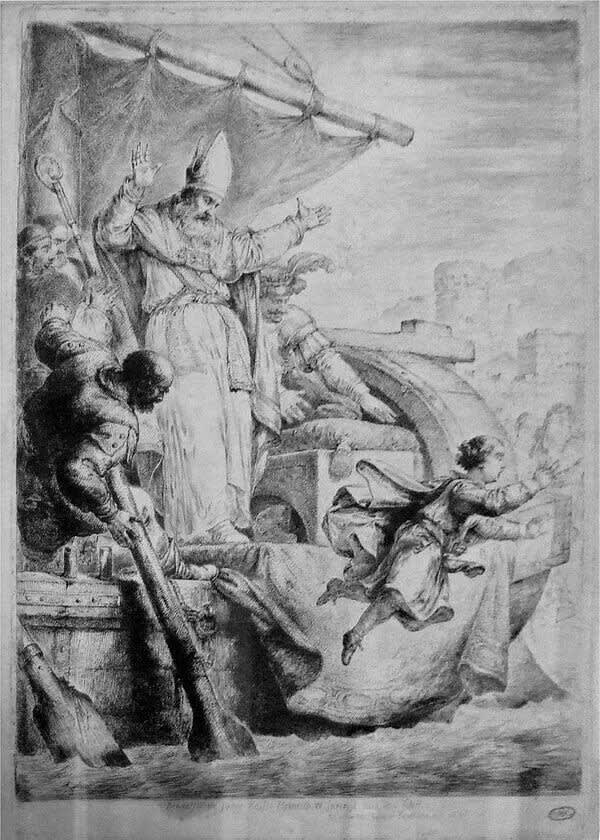
In April, while the imperial family was staying at the palace of Kaiserswerth, Archbishop Anno II of Cologne carried out a daring coup d’état.
He cunningly persuaded the eleven-year-old Henry to board a magnificent ship.
The moment the boy stepped aboard, the rowers suddenly pulled toward the middle of the Rhine.
Terrified and believing that he was about to be murdered, the young king threw himself into the freezing river and nearly drowned.
He was saved only because Count Egbert of Brunswick jumped into the water after him.
The trauma left a permanent mark on Henry’s personality.

Anno II seized the imperial regalia and effectively took control of the government together with his associates, including Adalbert of Bremen and other bishops.
Before the eyes of the growing king, the princes plundered the royal treasury.
This humiliation finally came to an end on 29 March 1065, when Henry, having reached the age of fifteen, was ceremonially knighted.
His first impulse was to draw his sword against the hated Anno of Cologne.
Only the intervention of his mother prevented bloodshed.
Henry now took power into his own hands.
As an independent ruler, Henry IV energetically began recovering lost royal lands, particularly in the Harz Mountains.
There he constructed castles and relied upon loyal ministeriales, provoking the fury of the Saxon aristocracy.
In 1073, a major rebellion erupted under the leadership of Otto of Northeim.
The king was forced to flee from the besieged Harzburg to Worms and temporarily accept humiliating concessions.
However, Saxon looting of imperial possessions gave Henry a pretext for renewed war.
On 9 June 1075, at the Battle of Homburg, he decisively defeated the rebels and temporarily restored his authority.
But the greatest challenge awaited him not on the battlefield, but in the struggle with Rome.
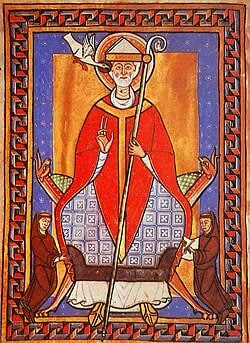
At this time, Pope Gregory VII had launched a radical campaign to free the Church from secular influence — the conflict later known as the Investiture Controversy.
The confrontation entered an acute phase when Henry personally appointed a bishop in Milan in September 1075, ignoring the wishes of Rome.
The pope responded with the famous Dictatus papae, asserting the supremacy of spiritual authority over imperial power, and sent Henry an angry letter demanding obedience.
Henry accepted the challenge.
In January 1076, at the imperial assembly of Worms, he and the German bishops declared the pope deposed.
Henry sent Gregory a furious letter ending with the command:
“Descend, descend!”
Gregory VII responded immediately and with unprecedented severity.
He not only excommunicated Henry, but also declared him deposed and released all of his subjects from their oaths of loyalty.
The excommunication proved catastrophic.
At an assembly in Tribur in October 1076, the princes threatened to depose Henry unless he obtained papal forgiveness before the following February.
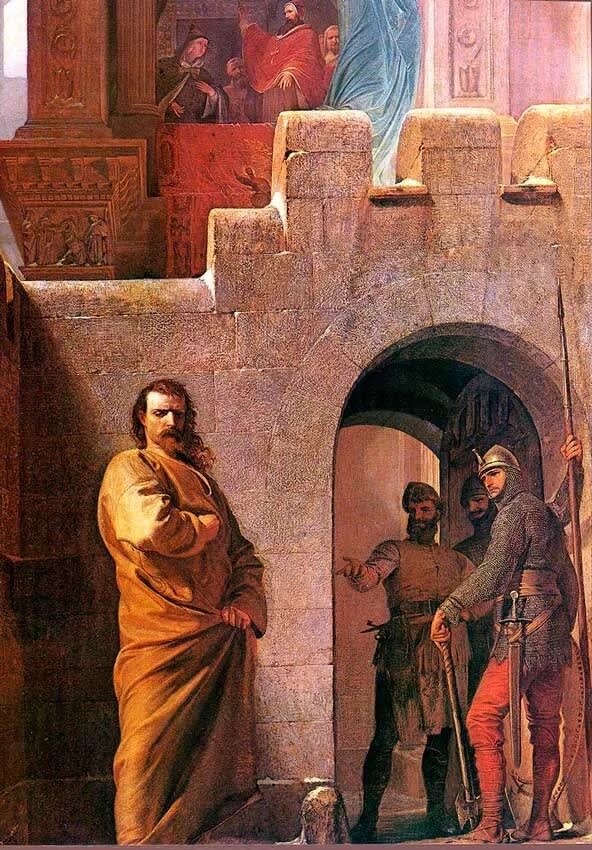
Politically isolated, Henry undertook the most famous and desperate action of his life.
During the winter of 1076–1077, accompanied by only a small group of loyal followers, he crossed the snow-covered Alps and arrived at the fortress of Canossa, where Gregory VII had taken refuge.
For three days, from 25 to 28 January 1077, Henry stood barefoot outside the castle, dressed as a penitent sinner and begging for mercy.
The pope was ultimately forced to lift the excommunication.
It was a tactical victory for Henry, but at the same time a profound symbolic humiliation for imperial authority.
The reconciliation at Canossa did not end the opposition.
On 15 March 1077, Rudolf of Rheinfelden was elected anti-king.
Germany descended into a bloody civil war.
Henry relied increasingly upon the towns and lesser knights, while Rudolf drew support primarily from the great aristocracy.
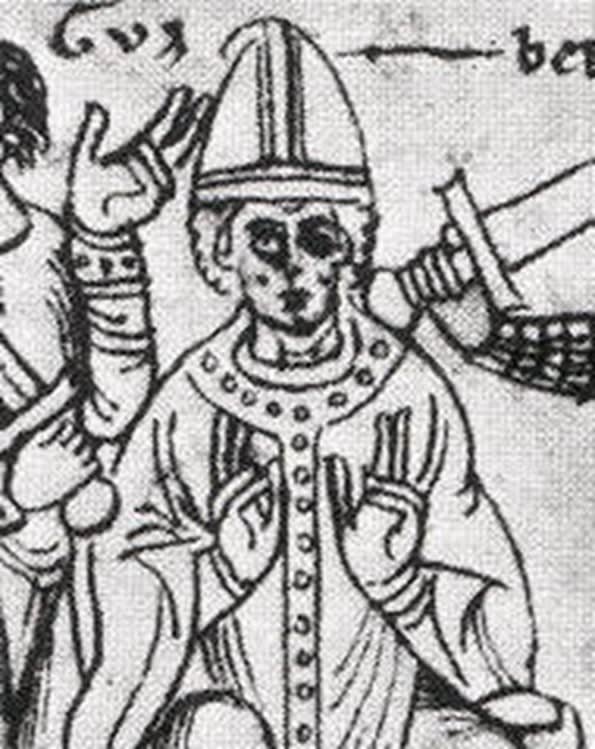
After a series of defeats for Henry, including battles at Mellrichstadt in 1078 and Flarchheim in 1080, the fate of the conflict was decided on 15 October 1080 at the Battle on the White Elster.
Although Henry technically lost the battle, his rival Rudolf was mortally wounded and lost his right hand — the same hand with which he had once sworn allegiance to Henry.
Many contemporaries interpreted this as divine punishment.
Yet another claimant soon replaced Rudolf.
Hermann of Salm was crowned anti-king in 1081.
He lacked the charisma of his predecessor and, after years of maneuvering, died ingloriously in an internal conflict in 1088.
The last serious opponent of this phase was Egbert of Meissen, who even defeated Henry at Gleichen in 1088.
His power also collapsed.
Deprived of his possessions at the imperial assembly in Regensburg, Egbert was treacherously murdered at a mill on 3 July 1090.
Henry IV appeared to have emerged victorious from years of internal warfare.
Yet even harsher trials awaited him, including betrayal by those closest to him.
In March 1080, Pope Gregory VII, unwilling to accept the decline of his allies, excommunicated Henry for a second time.
Henry’s response was decisive.
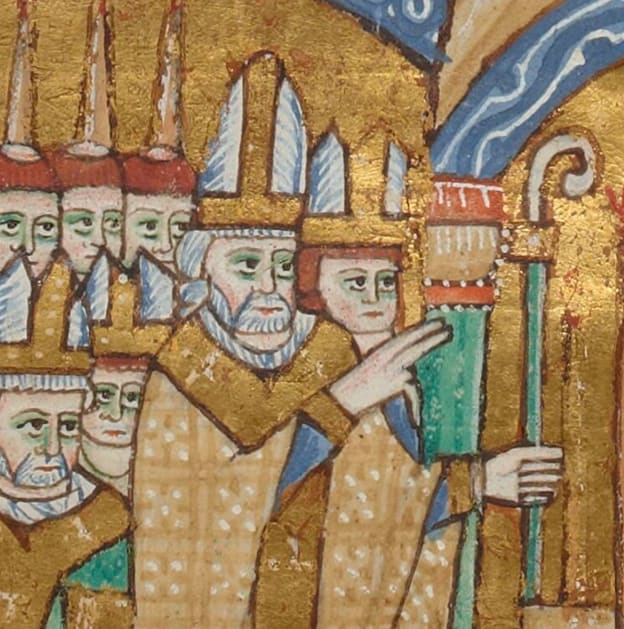
On 25 June 1080, German and Lombard bishops elected an antipope: Archbishop Wibert of Ravenna, who took the name Clement III.
Europe was now completely divided.
There were two rival kings and two rival popes, while virtually every duchy became an arena in the struggle for power.
After overcoming Rudolf of Rheinfelden, Henry turned toward Rome.
The Italian campaign dragged on for years, and the city had to be besieged three times.
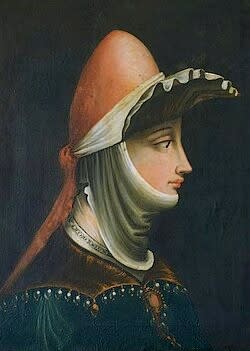
Between assaults, the emperor maneuvered across northern Italy, attempting to contain his principal opponent there — Matilda of Tuscany, the powerful margravine who served as Gregory VII’s most important political ally.
Only in March 1084 did the Eternal City finally fall.
On 24 March, Clement III formally occupied the papal throne, beginning a prolonged schism.
One week later, on Easter Sunday, 31 March 1084, Clement placed the imperial crowns upon the heads of Henry and his wife Bertha.

The triumph, however, was overshadowed.
While Henry celebrated his victory, Gregory VII, trapped inside Castel Sant’Angelo, waited for assistance from the Normans under Robert Guiscard.
Henry’s weakened army could not withstand the combined Norman and Muslim forces serving under Guiscard, and the emperor withdrew from Rome.
The forces that came to rescue the pope then looted and burned the city with such brutality that the enraged Roman population ultimately forced Gregory VII himself to flee.
Gregory died in exile at Salerno on 25 May 1085, leaving the papal throne vacant for almost two years.
After Queen Bertha’s death in 1087, Henry attempted to strengthen his position through new alliances with the Saxon nobility and his eastern neighbors.
On 14 August 1089, he married Eupraxia Vsevolodovna, daughter of the Kievan prince Vsevolod I.
After converting to the Latin rite, she took the name Adelaide.
The situation became dangerous again when Matilda of Tuscany married Welf, son of the Duke of Bavaria.
This alliance united Henry’s opponents in Germany and Italy.
In 1090, Henry returned to Italy once more, but fortune now turned against him.
After defeat near Canossa in 1092 and the betrayal of his eldest son Conrad, who joined the papal camp, the emperor became effectively trapped around Verona for three long years, from 1093 to 1096.
This became a period of profound personal and political crisis.
His second wife, Adelaide, fled to Matilda of Tuscany and, before church councils, made shocking accusations against her husband, claiming that she had been forced into sexual relations with other men.
Pope Urban II once again placed Henry under anathema.
The chronicles report that the emperor came close to suicide.
Only the collapse of the marriage between Matilda and Welf in 1097 allowed him to escape the Italian trap and return to Regensburg.
Henry IV entered history not only as a warrior, but also as a pragmatic reformer.
Understanding that the great princes could not be trusted, he developed a new pillar of royal authority — the ministeriales, a service nobility drawn from legally unfree men.
By granting them influence and advancement, Henry secured their personal loyalty.
The emperor also actively supported the expanding cities, particularly Speyer, Worms, and Goslar, turning them into important centers of centralized royal authority.
A particularly significant aspect of his reign was his protection of Jewish communities.
In 1090, Henry issued remarkable protective charters to the Jews of Worms and Speyer.
These guaranteed:
• protection of life and property;
• freedom of religion and trade;
• the right to maintain their own internal judicial institutions.
When the First Crusade unleashed a wave of anti-Jewish massacres, Henry IV was among the few rulers who attempted to restrain the violence.
In 1097, he allowed Jews who had been forcibly baptized to return to Judaism.
In 1103, he included the protection of Jews in the solemn oath connected with the Landfrieden, or “Peace of the Land.”
Henry also expressed his passion for imperial grandeur through architecture.
During his reign, Speyer Cathedral was consecrated in 1061.
Henry later decided to transform it into a monumental Kaiserdom, an imperial cathedral symbolizing the divine character of his authority.
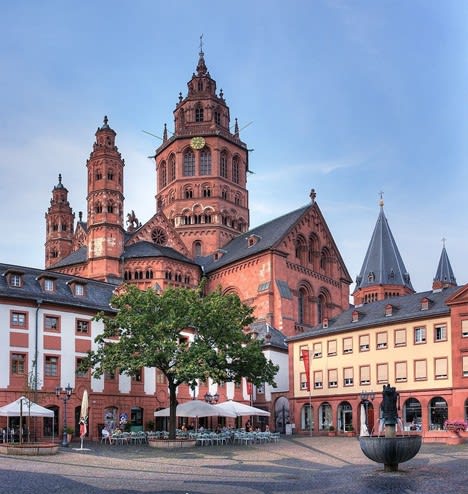
Shortly before his death, he also began the reconstruction of Mainz Cathedral.
Across Saxony and Thuringia, meanwhile, a network of powerful castles was constructed, intended to keep rebellious territories under control.
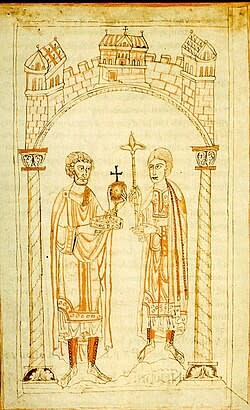
The tragedy of Henry IV was that he was ultimately overthrown not by popes or dukes, but by his own children.
After the death of his rebellious son Conrad, the emperor placed his hopes in his younger son, the future Henry V, forcing him to swear never to rebel against his father.
Yet in 1104, the younger Henry, fearing that his own succession might be endangered by his father’s excommunication, secretly abandoned the imperial army and placed himself at the head of a rebellion.
In 1105, through deception and treachery, Henry V lured his father to the fortress of Böckelheim.
There he forced him to surrender the imperial regalia and sign an abdication.
But the aging Henry IV did not surrender.
Escaping to Liège, he declared his abdication invalid and defeated his son’s forces near a bridge over the Meuse in March 1106.
Victory seemed close, but the emperor’s strength was undermined by sudden illness.
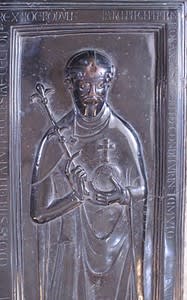
On 7 August 1106, Henry IV died at the age of fifty-five.
Before his death, he displayed a final gesture of magnanimity by sending his son his imperial regalia — his sword and ring — together with his paternal blessing.
Even in death, Henry did not immediately find peace.
His body was moved several times.
At first, he was buried in Liège, but under pressure from the Church the cathedral was declared desecrated because the dead emperor had remained under excommunication.
In 1106, his coffin was transported to Speyer, where it remained for five years in the unconsecrated Chapel of St. Afra.
Only in 1111, after Henry V obtained the posthumous lifting of the excommunication, was the body of the great emperor solemnly transferred, on the fifth anniversary of his death, into the family crypt of Speyer Cathedral, beside his father and grandfather.



