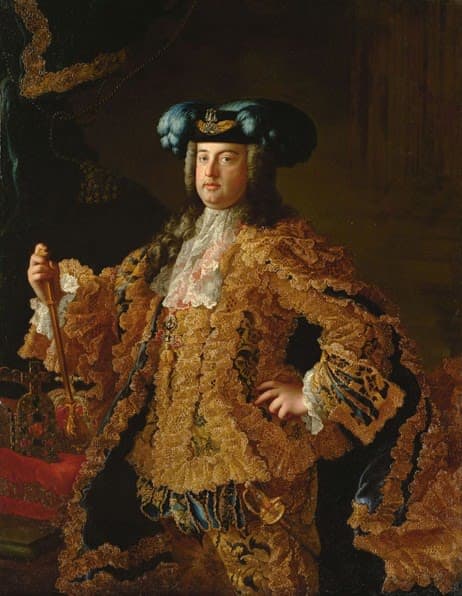

The life of Francis I Stephen, who was destined to become Holy Roman Emperor and founder of the House of Habsburg-Lorraine, began in Lunéville, in the Duchy of Lorraine, on the territory of present-day France. He was born into a noble family as the fourth son of Leopold, Duke of Lorraine, and Princess Élisabeth Charlotte of Orléans. Fate decreed that he would become the eldest of their sons to survive into adulthood. He was closely connected by blood to the powerful Habsburg dynasty: Francis’s grandmother Eleanor was a daughter of Emperor Ferdinand III himself. Within his own family, the young prince was particularly close to his brother, Prince Charles Alexander of Lorraine, and his sister, Princess Anne Charlotte.

Holy Roman Emperor Charles VI consistently looked favorably upon the Lorraine family. Beyond their obvious dynastic connections, the family had distinguished itself for many years through loyal and impeccable service to the House of Habsburg.
Initially, Charles VI’s major dynastic plans centered on Francis’s elder brother, Leopold Clement, Hereditary Prince of Lorraine. The emperor intended him to marry his daughter, Archduchess Maria Theresa. However, after Leopold Clement’s premature death, the Viennese court turned its attention to Francis. The younger brother was now regarded as the emperor’s future son-in-law and as a key figure in European politics.

From that moment onward, Francis’s life changed dramatically. He moved to Vienna, where he was raised alongside Maria Theresa. From an early age, they grew up with the clear understanding that they were expected to marry in the future.
In a rare development for a dynastic union, this political arrangement gradually grew into a sincere and profound mutual affection.
At the age of fifteen, upon arriving at the Viennese court, Francis received possession of the Silesian Duchy of Teschen, which the emperor had transferred to his father in 1722. In 1729, following his father’s death, the young man inherited the title of Duke of Lorraine by right.

By the beginning of the 1730s, Francis had begun to participate actively in social and political life. In 1731, an important event took place in The Hague: at a specially convened Masonic lodge meeting held in the residence of the British ambassador Philip Stanhope, 4th Earl of Chesterfield, Francis was initiated into Freemasonry by John Theophilus Desaguliers.
Soon afterward, during a journey to England, Francis received the honorary degree of Master Mason. The gathering took place at Houghton Hall in Norfolk, the estate of British Prime Minister Robert Walpole.
Meanwhile, Maria Theresa, eager to keep her beloved as close to her as possible, actively intervened in his career. In 1732, she secured Francis’s appointment as locum tenens, or governor, of Hungary.
Francis himself had little enthusiasm for the position, but he yielded to his fiancée’s wishes and agreed in June 1732 to travel to the Hungarian capital of Pressburg, modern-day Bratislava.
However, the peaceful course of his life was interrupted by major European politics. In 1733, the War of the Polish Succession broke out, and France immediately took advantage of the turmoil to attempt to seize Lorraine.
France’s chief minister, Cardinal Fleury, had serious concerns: if Lorraine became inseparably linked to the Habsburgs through Francis’s marriage, Austrian influence would extend directly toward the French frontier.
Long and exhausting negotiations followed, leading to a preliminary peace settlement in October 1735, which would only be formally confirmed by the Treaty of Vienna in November 1738.
Under the terms of the agreement, Lorraine was transferred to Stanisław I Leszczyński, father-in-law of King Louis XV of France and the defeated claimant to the Polish throne. France firmly demanded that Maria Theresa’s fiancé renounce his hereditary duchy.


As compensation for this enormous loss, Francis was promised the Grand Duchy of Tuscany, which he was expected to receive in 1737.
In March 1736, Emperor Charles VI personally urged his future son-in-law to agree secretly to the exchange. The situation was extremely tense. Before formally announcing the engagement, the emperor seriously considered alternative arrangements, including a marriage between Maria Theresa and the future King Charles III of Spain.
A contingency plan was also prepared for Francis: if the marriage failed to take place, he would become Governor of the Austrian Netherlands.

The struggle over the Tuscan succession represented an extraordinarily complex diplomatic problem. The reigning Grand Duke of Tuscany, Gian Gastone de’ Medici, had no children.
The powerful Elisabeth Farnese passionately sought to secure Tuscany for her son, the future Charles III, relying on her family ties to the House of Medici through her great-grandmother Margaret.
Francis, however, was not an outsider to this intricate genealogical web. He and Gian Gastone were distant cousins, both being great-grandsons of Francis II, Duke of Lorraine.
Moreover, Francis had a direct connection to the House of Medici through his maternal great-great-grandmother, Marie de’ Medici, Queen of France and Navarre.
Although military operations in Europe had ended, the final territorial settlement depended upon the death of the elderly Grand Duke Gian Gastone.

For Francis, surrendering his homeland was an extraordinarily painful ordeal.
On January 31, 1736, he formally agreed to marry Maria Theresa, but when the time came to sign the document transferring Lorraine, his hand faltered. Three times he put down the pen before finally adding his signature.
His brother Charles Alexander and his mother Élisabeth Charlotte fiercely opposed the concession.
To support her fiancé, on February 1 Maria Theresa sent him a touching letter, promising that she would completely renounce her future right to rule if her father were unexpectedly to produce a male heir.
Despite all the intrigue, love prevailed. On February 12, 1736, Francis and Maria Theresa were married in the Augustinian Church in Vienna, and on February 14 the capital was engulfed in lavish wedding celebrations.
The diplomatic machinery continued to operate. On May 4, 1736, a secret treaty was signed between the emperor and Francis, while on January 5, 1737, representatives of Spain and the Holy Roman Empire formally approved the territorial exchange at Pontremoli.
Spain surrendered Parma, Piacenza, and Tuscany to the Empire, while Vienna in turn recognized Don Carlos of Spain as King of Naples and Sicily.
Already on January 10, Spanish troops began hurriedly withdrawing from Tuscany, making way for 6,000 Austrian soldiers. On January 24, 1737, Francis formally received Tuscany from his father-in-law. Until that point, Maria Theresa had formally borne the title Duchess of Lorraine.
In the summer of that same year, Francis once again departed for the theater of war, traveling to Hungary in June 1737 to participate in the campaign against the Ottoman Empire.
At the height of the war, on July 9, 1737, Gian Gastone de’ Medici died in distant Italy, finally allowing all of the territorial agreements to come fully into effect.
In October 1738, Francis returned from the front to Vienna. Soon afterward, on December 17, 1738, he traveled south together with the pregnant Maria Theresa and his brother Charles to inspect his new possessions.
On January 20, 1739, they made a ceremonial entry into Florence, where they spent three eventful months.
The ties between the two dynasties continued to strengthen. In 1744, Francis’s brother Charles Alexander married Maria Theresa’s younger sister, Archduchess Maria Anna of Austria.
That same year, Charles was appointed Governor of the Austrian Netherlands, where he loyally served the Habsburgs until his death in 1780.
Francis’s own great political moment arrived in the mid-1740s.
Through his wife’s diplomatic efforts and the conditions established by the Peace of Füssen, Maria Theresa secured her husband’s election as Holy Roman Emperor.
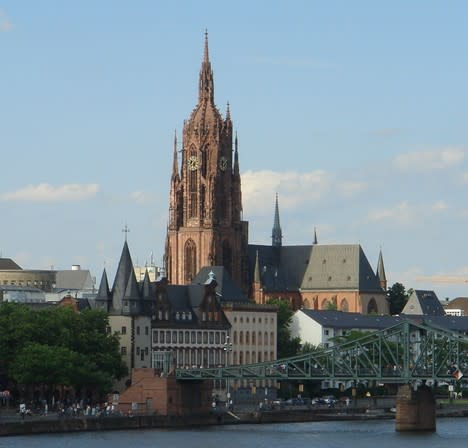
The triumphant election took place on September 13, 1745, and on October 4, in the magnificent Imperial Cathedral of Saint Bartholomew in Frankfurt am Main, Francis was formally crowned, succeeding Charles VII.
Maria Theresa also proclaimed him full co-ruler of all her extensive hereditary territories.

Behind the façade of a brilliant reign, however, lay a complicated family life.
Their marriage produced sixteen children, including their youngest daughter Marie Antoinette, who entered history as the last Queen of France before the Revolution, but the relationship was not free from bitterness.
Francis repeatedly proved unfaithful to his wife. His romantic affairs were no secret at the Viennese court and were barely concealed.
The most notorious was his long-term relationship with Princess Maria Wilhelmina von Auersperg, who was almost thirty years younger than the emperor.
Their relationship was openly discussed by ambassadors, recorded in the diaries of visitors to the court, and was well known even to Francis’s own children.

The era of the first emperor of the House of Habsburg-Lorraine ended suddenly.
On August 18, 1765, while returning in his carriage after an opera performance in Innsbruck, Francis I died unexpectedly.
His body was transported to Vienna and ceremonially laid to rest in Tomb No. 55 of the Imperial Crypt.
After his death, the imperial crown passed to his eldest son, Joseph II.
The Grand Duchy of Tuscany was inherited by his younger son Peter Leopold, the future Emperor Leopold II.
The widowed Maria Theresa, deeply affected by the loss of her husband, continued to rule her vast empire with a firm hand until her own death in 1780.


