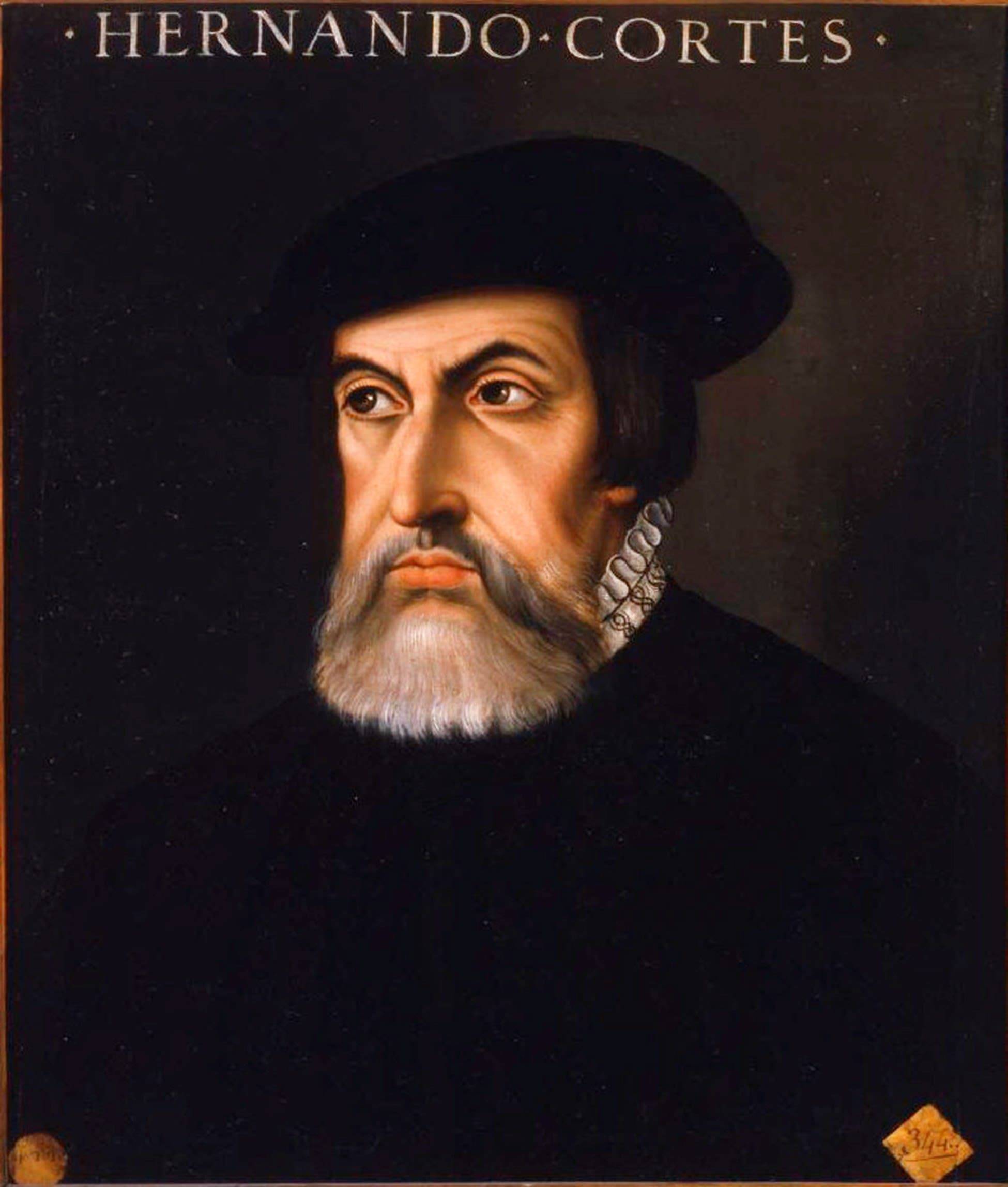
Hernán Cortés de Monroy was born in 1485 and was the only son of Martín Cortés de Monroy and Catalina Pizarro Altamirano, two old hidalgos. At his baptism in the Church of St. Martin in Medellín he was given the name of his paternal grandfather. At the time, the names Fernando, Hernando, and Hernán were regarded as the same, so all three spellings were used by contemporaries. His relationship with his mother was difficult she was “stern and tight-fisted”, but with his father he enjoyed a warmer bond. Hernán grew up as a typical child of his estate, first under a wet nurse and then a tutor who taught him fencing.
Until the age of fourteen, Cortés was brought up in his native Medellín. He was then sent to the prestigious University of Salamanca to study law. His studies, however, lasted only two years. In the winter of 1501 he returned home, disappointing his parents, who had placed great hopes in their only son. Despite the short term, Cortés received an excellent education for the sixteenth century, knew Latin, and even composed poetry something acknowledged even by his opponents.


The chief reason Cortés quit his studies was his desire to sail to the New World. He dreamed of joining the colonization of the island of Santo Domingo (Hispaniola), where his distant kinsman Nicolás de Ovando had been appointed governor. According to Gómara, Cortés missed the ship after falling from a rooftop during a tryst with a married woman and injuring his leg. He then spent two more years in Spain, either working in a notary’s office or dreaming of taking part in the Italian campaigns.

At the end of 1503 Cortés finally persuaded his parents to pay for his passage. He arrived in Santo Domingo on April 6, 1504. Governor Ovando welcomed his relative warmly and granted him the status of vecino a full colonist entitling him to land with Indians and to build a house. In return, Cortés was obliged to serve on Hispaniola for five years. He quickly became a noticeable figure in the colony, taking part in punitive expeditions. After the reform of 1506 he was appointed notary in the Indian settlement of Azua, where he considerably improved his finances by receiving land of his own. Yet the settled life of a landowner did not appeal to him.
In 1509 the new governor of Hispaniola was Diego Colón, son of the discoverer of America, Christopher Columbus. Cortés failed to gain entry into his circle, but his fate changed with the planned conquest of Cuba, conceived by Colón. Diego Velázquez de Cuéllar was placed in command. Cortés managed to secure the post of royal treasurer in this expedition, which numbered about 300 men.

In November 1511 the expedition reached Cuba. There Cortés soon found himself at the center of intrigues: he was arrested while trying secretly to sail to Hispaniola with a denunciation of Velázquez, who sought to pursue policies independent from Diego Colón. Despite the arrest, Cortés reached an arrangement with the governor. He gave up the treasurer’s post, but in return became alcalde of Santiago de Cuba, then the capital, and promised to marry Velázquez’s sister-in-law, Catalina Juárez. Cortés did not want this marriage, for he already had a mestiza daughter, Catalina, by an Indian concubine, but he was forced to consent.

After the “pacification” of Cuba, Velázquez lacking the right to lead independent expeditions began outfitting clandestine raids to neighboring lands. In February 1517 Francisco Hernández de Córdoba’s expedition discovered Yucatán, and in 1518 Juan Grijalva continued the explorations, bringing news of the mainland’s wealth. These privately financed expeditions opened to the governor the prospect of great conquests.
In the autumn of 1518 Cortés, learning of Velázquez’s plans, began to fight for the right to lead the expedition to conquer Mexico. He received authorization from the government of Santo Domingo, and on October 23, 1518, Velázquez signed a contract with him. Under its terms, Velázquez would outfit only three ships; all other expenses for ten vessels, army pay, and provisions fell on Cortés. He spent his entire fortune, mortgaged estates, sold slaves, and plunged into heavy debt.
By November 1518 relations between Hernán Cortés and the governor of Cuba, Diego Velázquez, had completely deteriorated. Fearing Cortés’s growing independence, Velázquez tried to rescind the contract, but, thanks to the arrival of Grijalva’s expedition and Pedro de Alvarado’s agitation among the crews, he temporarily postponed his plans. On the night of November 18, 1518, Cortés stole a march on his rival and secretly left the Cuban capital.
His army at first numbered only 350 men, but after moving his squadron to Villa de la Santísima Trinidad, Cortés persuaded the crew of Juan Grijalva to join him, raising his strength to more than 500 infantry. Cortés immediately showed that his aim was not mere plunder but true colonization. His banner bore the Latin motto “Under this sign you shall conquer,” alluding to Emperor Constantine and lending the expedition the aura of a religious mission.
Cortés’s force was motley yet well equipped for its time: 508 infantry, 16 horsemen, arquebusiers, crossbowmen, as well as 100 sailors and 200 enslaved porters. Among his men were future conquerors of Central America Pedro de Alvarado, Cristóbal de Olid, Gonzalo de Sandoval, and others. All embarked on eleven ships and on February 10, 1519, set sail for the coast of Yucatán.
The first contact with the highly developed Maya civilization took place on the island of Cozumel. Horrified by a sacrificial rite, the Spaniards tried to destroy the shrine. There they were fortunate to find Jerónimo de Aguilar, a Spanish friar who had been captured by the Maya and had learned their language. He became Cortés’s first interpreter. The expedition then moved along the coast. In Tabasco the Spaniards fought the local peoples, but instead of gold they were given twenty women, among whom was Malinche (Doña Marina). She knew Nahuatl, the language of the Aztecs, and became Cortés’s official interpreter and concubine.


On Maundy Thursday, 1519, the expedition landed in the harbor of San Juan de Ulúa. On Easter the Spaniards celebrated a solemn mass, after which Cortés demonstrated his military power to the local governor Tendile. In response, Moctezuma II, ruler of the Aztecs, sent gifts but categorically refused to meet. Among the gifts were images of the sun and moon fashioned from gold and silver, which only whetted the appetites of the Spaniards, suffering from heat, hunger, and disease.

Soon an embassy of Totonacs from Cempoala arrived to Cortés, offering an alliance against their hated Aztecs. This gave Cortés a legitimate pretext to stay. He immediately founded the port of Villa Rica de la Veracruz and created a municipal council there, which elected him captain general and chief justice. This step directly challenged Governor Velázquez, for it made Cortés accountable only to the king of Spain. Cortés arrested Velázquez’s supporters and sent his first report of the conquest to the king, naming as his chief goal “bringing the natives into the holy Catholic Church.” The message was accompanied by a huge quantity of precious objects meant to win the king to his side.
On the night of July 26, 1519, after dispatching his letter, Cortés ordered the ships scuttled in the harbor. This decisive act became the symbol that there was no way back. Leaving a garrison in Veracruz, he prepared for a march into the interior.
Cortés’s first objective was the mountain principality of Tlaxcala, a long-standing enemy of the Aztecs. After fierce fighting in which the Spaniards suffered losses, Tlaxcalan leaders offered an alliance. On October 3, Cortés was received with ceremony in the city, and the Tlaxcalans provided him with a force of ten thousand warriors. In return they asked to be received into Christianity.

The next stop on the road to the Aztec capital was the sacred city of Cholula. According to legend, a plot had been laid against the Spaniards. In retaliation, Cortés carried out a bloody massacre in the city lasting about five hours and claiming up to six thousand lives. He then concluded a peace with Cholula’s rulers, intimidating them with his ruthlessness.
On November 8, 1519, the Spaniards entered Tenochtitlan, the Aztec capital. They were graciously received by Moctezuma II himself, who presented Cortés with gold. The Spaniards were dazzled by the city’s beauty but remained wary. When an attack occurred on the Spanish garrison at Veracruz, Cortés took a desperate step and seized Moctezuma as a hostage. Outwardly the ruler’s status did not change, but he was under constant guard.


Six months later Cortés learned of the landing of Pánfilo de Narváez, whom Governor Velázquez had sent to Mexico to arrest him and take command of the conquest. Narváez’s armada was massive: eighteen ships, nine hundred soldiers, and eighty horsemen. Cortés acted shrewdly, sending spies and letters to Veracruz offering Narváez’s men to join him.

Leaving a small garrison in Tenochtitlan under Pedro de Alvarado, Cortés set out with seventy Spaniards to face Narváez. On May 28, 1520, he seized him, and Narváez’s entire army went over to Cortés. Buoyed by this victory, Cortés even sent part of his newly won force to reconnoiter northern and southern lands, but in the midst of preparations a revolt broke out in Tenochtitlan, and messengers brought alarming news of heavy losses.
While Cortés dealt with Narváez, an uprising erupted in Tenochtitlan. The cause was commander Pedro de Alvarado, who, during a festival honoring the gods Huitzilopochtli and Tezcatlipoca, ordered the slaughter of hundreds of unarmed priests and noble Indians likely driven by the desire to seize their gold. Outraged, the Mexica besieged the Spanish garrison, which now relied solely on the hostage Moctezuma.
When Cortés arrived with reinforcements, Moctezuma had lost all value as a hostage; the Indians had elected a new ruler, Cuitláhuac. Cortés tried to use Moctezuma one last time: on June 25, he brought him onto the palace roof to calm the crowd. Moctezuma was pelted with stones and died a few days later. Indigenous chronicles claim he was killed by the Spaniards themselves.
The Spaniards’ position was desperate. Tenochtitlan, set on an island, was cut off from the mainland; the Aztecs had removed the causeways’ bridges. On the night of July 1 began the bloody retreat known as the “Night of Sorrows.” The Spaniards lost all their artillery, all the gold, and suffered enormous casualties. The survivors were badly wounded; the withdrawal turned into a nightmare.


Yet on the way to their Tlaxcalan allies Cortés’s column was overtaken by a huge Aztec host. In the Battle of Otumba on July 7, 1520, a small force of Spaniards and allies managed to rout the vastly larger army. They succeeded in killing the commander, whereupon the Indians scattered a result many deemed miraculous. Few returned to Tlaxcala, but more importantly the Tlaxcalans and Totonacs remained faithful to the Spaniards, supplying new resources.
After the “Night of Sorrows” Cortés showed himself not only as a commander but also as a farsighted politician. In Tlaxcala he drew up a protocol for the loss of the royal fifth, as well as a bill of indictment against his rivals Velázquez and Narváez. Cortés and his army sent a collective letter to King Charles V, asking him to confirm Cortés as captain general. In his second relación to the king, Cortés proposed calling the conquered lands “New Spain.”
This was a stroke of genius, for in the early sixteenth century Spain was not yet fully unified, and by using this term Cortés demonstrated loyalty and helped the king strengthen his authority. He effectively made the conquered territory part of a great and indivisible Spanish Empire, protecting it from the claims of other adelantados. Cortés’s relaciones, written with literary and political flair, were published in Europe and made his name famous.
Before Cortés could launch a new offensive against Tenochtitlan, the city was struck by a smallpox epidemic brought by Narváez’s African slave. The Aztec emperor Cuitláhuac died of the disease, and Cuauhtémoc was elected the new ruler.
Realizing that a land assault alone would not suffice, Cortés began building a fleet in Tlaxcala. Thirteen landing brigantines were constructed, then disassembled and carried to the Valley of Mexico by thousands of Indian porters. The Spaniards also gained a new ally in the city-state of Texcoco, which provided a rear base.
On May 30, 1521, the siege began. The Spaniards and their allies cut the aqueduct, depriving the city of water. Despite many setbacks, they managed to break through to the central square three times. The most grievous moment came on June 30, when, during the assault on Tlatelolco, the Spaniards suffered heavy losses. Cortés then resolved to take the city by starvation.


On August 13 Cuauhtémoc tried to flee by canoe but was captured. It soon emerged that the gold lost during the “Night of Sorrows” had vanished without trace. Legend has it that Cortés tortured Cuauhtémoc and his close companions with fire to force them to reveal the treasure’s hiding place. This brutality contrasts sharply with the official relaciones, in which Cortés does not mention the episode.

Despite the cruelty, Cortés’s political backing in Spain grew. His father and supporters at court persuaded King Charles V of his loyalty. Receiving Cortés’s third relación with its detailed account of the capture of Tenochtitlan and rich gifts, on October 15, 1522, Charles V signed a decree officially appointing Hernán Cortés “governor, captain general, and chief justice” of all New Spain. This was official recognition of his conquests and the beginning of a new stage in the history of the Americas.
After conquering Mexico, Cortés moved from conquistador to ruler. His ambitions and political views were no less sweeping than his military talents.
One of the rewards granted to Cortés by King Charles V for the conquest of New Spain was a personal coat of arms. By tradition, Cortés himself had to propose its design. The arms, confirmed by royal decree on March 7, 1525, became not merely a status symbol, but a complex heraldic document.
From the outset Cortés acted like an independent ruler, relying on his military merits and the lack of precise limits in the royal charter. Fearing a repetition of the demographic catastrophe on Cuba and Hispaniola, he sought to preserve existing indigenous social structures. He replaced Aztec governors with his own lieutenants, and the main instrument of governance became the encomienda system, which had analogues in both Spanish and indigenous traditions.
From 1522 Cortés assumed for himself the right to distribute lands. His encomiendas operated under rules progressive for the age: a ban on the labor of women and children under twelve; limits on the workday; regulation of rations and provision of rest days. After twenty days of labor for the Spaniards, Indians received thirty days to work for themselves.
Cortés also introduced a policy of segregation (traza). Spaniards were permitted to live only in strictly designated urban quarters, while indigenous peoples retained self-government in their own settlements. This was intended to prevent the emergence of “wild” colonies and to maintain control over territory.
The conversion of the Indians to Christianity was one of Cortés’s paramount tasks. He entrusted the mission to the mendicant orders, above all the Franciscans, whom he considered more suitable for work with the local population than higher church prelates mired, in his view, in luxury and vice. Pope Adrian VI granted the Franciscans very broad powers, and in May 1524 the first mission of twelve “apostle” friars arrived in Mexico. Cortés gave them a ceremonial welcome. The friars resolved to preach in the local languages and to oversee Spanish officials, defending the Indians from arbitrariness.


Despite his merits, Cortés’s policies aroused suspicion in Spain. He behaved like an independent ruler, and his views on the church and colonial administration sharply diverged from the official line. In his fourth relación to the king he wrote of his disdain for the luxury and vices characteristic of the ecclesiastical hierarchy in Spain and asked that no bishops be sent to New Spain.
Seeing that Cortés sought full economic and political autonomy, King Charles V took steps to limit his power. In 1523–1524 he sent to Veracruz a Royal Audiencia to keep Cortés in check and increase the crown’s revenues. In these circumstances, Cortés’s decision to leave Mexico City and set out on the Honduras expedition remains a puzzle for historians.
After the Aztec Empire’s conquest, Cortés did not rest. He controlled vast territories rich in silver and yearned for new ventures. In 1523 he sent two detachments south to find a strait linking the Atlantic and Pacific and to bring all Central America under his sway. His ambitions, however, collided with the interests of other conquistadors.
He pursued his independent policy despite the opposition of Francisco de Garay, governor of Jamaica. Backed by Cortés’s rivals, Garay landed at Pánuco with a thousand men, but Cortés, relying on his royal charter, defeated him in armed confrontation. He then invited Garay to Mexico City to discuss a marriage between their children, but Garay died suddenly on Christmas Day, 1523 giving occasion to accuse Cortés of poisoning.

Another problem was Cristóbal de Olid, whom Cortés had sent to Honduras. Olid conspired with Velázquez and declared his independence. Without awaiting formal inquiry, Cortés dispatched his cousin, Francisco de las Casas, who executed Olid once again demonstrating Cortés’s resolve and capacity to act on his own.

Despite his successes, Cortés felt his power in Mexico City weakening. The king sent him a Royal Audiencia an evident sign of mistrust. In these conditions he took an irrational decision to lead the Honduras expedition in person. He set out in October 1524 with a huge retinue, taking with him even all the Aztec rulers, including the former emperor Cuauhtémoc.
During the expedition Cortés freed his concubine and interpreter Malinche and married her off much to everyone’s surprise. His behavior grew increasingly strange. He sent royal officials back to Mexico City, effectively depriving himself of authority in the capital. While crossing the mangrove swamps of Tabasco, Cortés accused Cuauhtémoc of conspiracy and on February 28, 1525, hanged him one of the most controversial episodes of his biography.
After the expedition, on receiving news of chaos and the deaths of his supporters in Mexico City, Cortés hesitated for a long time but eventually returned. In May 1526 he arrived at Veracruz, and by June had restored his power, now even more precarious. The king, then at war with France, appointed a commission to investigate Cortés’s conduct, headed by judge Luis Ponce de León.
The royal judge reached Veracruz in June 1526. Cortés met him with honors, but two days later Ponce de León suspended him from the governorship. Soon the judge fell gravely ill and died, as did his companions. By will, his powers passed to Marcos de Aguilar. Cortés was again accused of poisoning, but the Mexico City council, which did not recognize Aguilar, appealed to Cortés to take power.
At that moment Cortés had a real chance to proclaim New Spain an independent state, since Charles V was embroiled in war in Europe. Cortés did not do so. He restored his authority, tightened control over Spanish settlers, and continued efforts to reach an understanding with the king. He sent his fifth relación, in which he defended himself and demanded recognition of his services. When Marcos de Aguilar also died in March 1527, Cortés was again accused of poisoning.
Despite all difficulties, Cortés did not abandon his ambitions as an explorer. He aimed to find a direct route from Mexico to the Spice Islands, contested by Spain and Portugal. This would provide him with new resources in his struggle for power. In May 1527 he outfitted three ships under his cousin Álvaro de Saavedra Cerón. Cortés even wrote letters in Latin to the rulers of the islands and to the Emperor of China, revealing his global designs.
The expedition failed. After a harrowing voyage Saavedra reached the Philippines but could not return to Mexico. His crew was arrested by the Portuguese, and only years later did a few sailors make it back to Spain. The failure further damaged Cortés’s reputation and finances—but did not break him.

After Cortés left for Honduras, his power in Mexico City collapsed. In August 1527 the royal treasurer Alonso de Estrada carried out a coup, expelling Cortés from the capital and launching a hunt for gold, even opening graves. In Spain Cortés’s position also worsened: at the request of his rival Pánfilo de Narváez, the king banned the printing of Cortés’s relaciones.
At the same time, in April 1528, Charles V appointed as head of the Royal Audiencia Nuño de Guzmán, notorious for his cruelty. In secret instructions he was ordered to seize all of Cortés’s possessions and, if possible, to eliminate him.
Realizing the fragility of his position, Cortés decided to return to Spain and explain himself to the king in person. He prepared carefully, assembling lavish gifts, including gold, silver, a collection of exotic birds, jaguars, and even Indian jugglers. On April 15, 1528, he sailed from Veracruz.
After forty-two days Cortés arrived at Palos in Spain, after twenty-four years away. His popularity was extraordinary, and he was received with honors. He soon married Juana de Zúñiga, niece of the powerful Duke of Béjar, securing powerful patrons at court.
King Charles V received him graciously. Yet Cortés failed to regain the title of governor of New Spain. On April 1, 1529, he received instead the title of marquis and ownership of the lands he had seized. He also became a member of the prestigious Order of Santiago. His wedding to Juana de Zúñiga was called “the most magnificent in Spain.”
By royal decree of July 6, 1529, the Marquisate of the Valley of Oaxaca was created, and Cortés became its marquis. He was granted vast estates (about seven million hectares) and the right to administer justice over his twenty-three thousand vassals.
While Cortés was in Spain, Nuño de Guzmán, heading the Audiencia, launched a full-scale campaign against him. He initiated legal proceedings and mass deportations of Indians into slavery. Juan de Zumárraga, bishop of Mexico and “protector of the Indians,” wrote a detailed report to the king about the chaos in New Spain, giving Cortés grounds to seek authority once more. In January 1530 the king appointed a second Audiencia to restore order.
On July 15, 1530, Cortés returned to Mexico. He was forbidden to enter Mexico City until the second Audiencia arrived. He settled at his estate in Cuernavaca, where a luxurious palace was built for him. His new wife, Juana, bore him a son, Martín, though their first child, a daughter Catalina, died. During this period Cortés turned to agriculture, cultivating sugarcane and raising livestock.


The second Audiencia, arriving in January 1531, audited Cortés’s holdings. It turned out that under his jurisdiction were not twenty-three thousand but more than two million people. As a result, Cortés lost part of his lands, but in exchange bargained for several wealthy indigenous towns.
Despite all obstacles, Cortés did not give up his pioneering ambitions. In 1532–1535 he outfitted three expeditions into the Pacific to check Nuño de Guzmán’s expansion and to find a route to the Spice Islands. One of the expeditions discovered the Baja California peninsula.
These expeditions proved unsuccessful, bringing heavy losses and disappointment. In April 1536 Cortés returned to Mexico. At that time the first viceroy, Antonio de Mendoza, arrived in Mexico City. At first their relations were cordial, since they were linked by kinship, but over time they soured, as Mendoza began stripping Cortés of his powers and confiscated his shipyards.

Insulted and unsupported by the king, Cortés resolved in November 1539 to return to Spain to explain himself to Charles V one last time. Leaving his wife in Mexico, he sailed for Europe accompanied by his sons.
Back in Spain, Cortés was seated on the Council of the Indies and given a house in Seville. He entered court circles, but his complaints against Viceroy Mendoza languished. In response to neglect, he displayed his famous audacity when he leapt onto the running board of the royal coach and declared to Charles V: “I am the man who gave you more lands than your forefathers left you cities!”
Seeking to regain the king’s favor, Cortés took part in the assault on Algiers in 1541, which proved catastrophic. In storms and a failed siege, he lost all his property and failed to obtain a command from the monarch. Though received with honors, he could not achieve his central aim of regaining power in New Spain.
Until his death he petitioned the king for compensation and restoration of his rights, but never obtained full satisfaction. In 1543 Charles V left Spain, and his successor Philip II was in no hurry to resolve the long-standing matters. Worried about his legacy, Cortés fell into debt, and his lawsuits remained unresolved.

In 1544 he wrote the king a letter that amounted to a spiritual testament. In it he expressed disappointment and pride, declaring that he had given his life and fortune to the service of God and king, subduing vast lands without anyone’s help but rather in the face of envy and obstacles.
In the summer of 1547 Cortés decided to return to Mexico, which he called his home. Before he could sail, however, he fell ill and quietly died on December 2, 1547, at age sixty-two in Castilleja de la Cuesta, near Seville.
In his will he asked to be buried in Mexico. Thus began a long series of reburials that became a symbol of the complex and contradictory history of his legacy. His body was reinterred at least eight times before, in 1794, it was moved to the Hospital of Jesús Nazareno in Mexico City a foundation of his own.
After Mexico’s independence in 1823, when Cortés came to be regarded as a cruel conqueror, his remains were secretly removed and hidden to prevent their destruction. The place of his burial remained a secret for 110 years. Only in 1946, after the publication of a secret memorandum, were scholars able to locate and study his remains. Examination showed that Cortés was below average height, sturdily built, and suffered from illness. Today his resting place in the hospital is marked only by a simple brass plaque.
After Cortés’s death his descendants continued the struggle for power. His elder son, Martín Cortés, returned to Mexico in 1562 and led the opposition against the policies of Viceroy Luis de Velasco, precipitating a political crisis. In the end Martín and his brothers were arrested, and one of them was tortured. Cortés’s Mexican fief was abolished.


