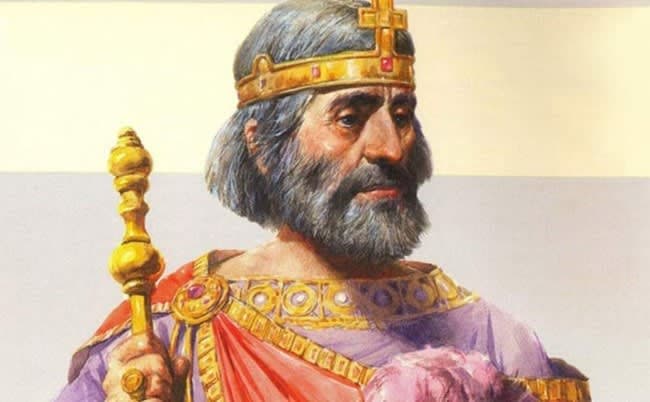

The biography of Heraclius I, one of the most significant emperors of Byzantium, begins in 575. He was the son of Heraclius the Elder, a powerful general and Exarch of Africa. The question of his origins still causes debate among historians. Some sources suggest his African or Syrian roots; however, the Armenian origin of his father is generally recognized. The historian Walter Kaegi notes that Heraclius was bilingual, knowing both Greek and Armenian. The seventh-century Armenian author Sebeos even counted him among the Armenian Arsacid dynasty. In favor of this version also speaks the emperor’s evident interest in Armenia and his favor toward the Armenians.
Heraclius’s ascent to power was conditioned by the deep crisis that engulfed the empire under the reign of Emperor Phocas. In 608 Heraclius the Elder, ruler of Africa, and his brother George decided on a revolt. They proclaimed themselves consuls, and their armies, led by their sons, advanced on the capital. By that time the empire was on the brink of collapse: the war with the Persians under the pretext of avenging the murdered Emperor Maurice had turned into complete defeat; Persian troops invaded Mesopotamia, Syria, and Asia Minor. Inside the country rebellions raged, and the capital suffered from famine and internal conflicts.
In October 610 the fleet of the rebels under the command of Heraclius the Younger reached Constantinople. He was supported by allies from Sicily, Crete, and Thessalonica, as well as by the comes of the Excubitors Priscus and the influential party of the “Greens.” Phocas, deprived of support, could offer no resistance. He was executed, and Heraclius, although he pretended to be ready to return to his father, was proclaimed emperor. On the same day, October 5, 610, Patriarch Sergius placed the crown upon him. From this moment began the era of the Heraclian dynasty, which ruled the empire for almost a century.


Soon after the coronation Heraclius married his fiancée Eudokia, who had been released from imprisonment by Phocas. He immediately began to strengthen his dynasty, making his eight-month-old son Constantine co-ruler. Despite his promises, his second marriage caused serious condemnation. In 612 Eudokia died, and a year later Heraclius married his niece Martina, the daughter of his sister. This marriage, forbidden by church canons, aroused the indignation of the people and the clergy. Even his own brother Theodore condemned this union. The unpopularity of the marriage forced Heraclius to strive for control over the Church in order to legitimize his choice.
The beginning of Heraclius’s reign was marked by catastrophic defeats in the war with the Sasanian Persian Empire. The Persians, taking advantage of the chaos in Byzantium, seized Syria, Antioch in 611, Caesarea of Cappadocia in 612, and Egypt in 616—the main source of grain for Constantinople. In 614 Persian troops took Jerusalem, captured the Life-giving Cross, and, according to reports, brutally massacred Christians.
The empire was on the verge of disintegration. The Avars and Slavs threatened Constantinople from the north. In 619 the Avars besieged Thessalonica, and in 620 Heraclius had to pay them a ransom in order to conclude peace. He also relinquished most of the possessions in Spain to free up troops for the war with the Persians. Realizing that it was necessary to concentrate on the main enemy, Heraclius began a series of brilliant military campaigns.
From 622 he led several campaigns against the Persians. Despite a new siege of Constantinople by the Avars in 626, which ended in complete failure for them, Heraclius continued the offensive. In 628 he won a decisive victory in Mesopotamia and, together with the Khazar allies in Transcaucasia, brought the war to an end.

In 629 Heraclius returned to Constantinople in triumph. The main symbol of his victory was the return of the Life-giving Cross to Jerusalem. It was at this time that he officially adopted the Greek title basileus, which until then had been used for Persian kings, and called himself “basileus in Christ.”
The exhausting war with the Persians weakened both Byzantium and Persia, leaving both empires defenseless before a new threat in the form of the Arab invasion.
At the same time Heraclius tried to resolve the theological disagreements in the empire, which had been aggravated during the Persian occupation. Together with Patriarch Sergius he developed the doctrine of Monothelitism, which asserted that Christ had two natures (divine and human) but one will. This doctrine was intended to reconcile the supporters of the Council of Chalcedon (the Chalcedonians) and their opponents (the Miaphysites), especially in Syria and Egypt. However, the reform was not successful. Many Miaphysites did not accept it, and the Jacobites in Syria were subjected to persecutions. Heraclius’s efforts proved futile, for by the end of his life most of the territories where the Miaphysites lived had been conquered by the Arabs.
The war with the Arabs, which began in 634, led to rapid and crushing defeats for the Byzantines. In 636, at the Battle of Yarmouk, Byzantium suffered defeat. In 637 Jerusalem was lost, and in 642 the Arab armies captured Egypt, which deprived the empire of its richest province.


On February 11, 641, Emperor Heraclius I died of dropsy. His death, in the opinion of many, was a punishment for the sinful marriage with his niece. After his demise a prolonged political crisis began in the empire, known as the “Twenty Years’ Anarchy.”

The dowager Martina tried to proclaim herself empress but was forced to yield under the pressure of the people. Power passed to Heraclius’s sons Constantine III from the first marriage and Heraclius II from Martina. However, after only three months Constantine III died, and the people accused Martina of poisoning him. As a result of a coup arranged by General Valentin, Martina and her son Heraclius II had their tongues and noses cut off and were then sent into exile.
The throne was given to the underage son of Constantine III, Constans II. His reign was marked by constant internal intrigues and further territorial losses. The dynasty of Heraclius finally fell with the reign of his grandson Justinian II, who was overthrown, had his nose cut off, and was exiled. He managed to regain the throne but was overthrown again, which put an end to his line and plunged Byzantium into a period of political instability.
Heraclius I’s efforts to reform and save the empire were enormous, but they could not prevent its subsequent decline. He went down in history as the emperor who was able to restore Byzantium’s former might by defeating the Persians, but who could not protect it from a new, even more formidable threat.


