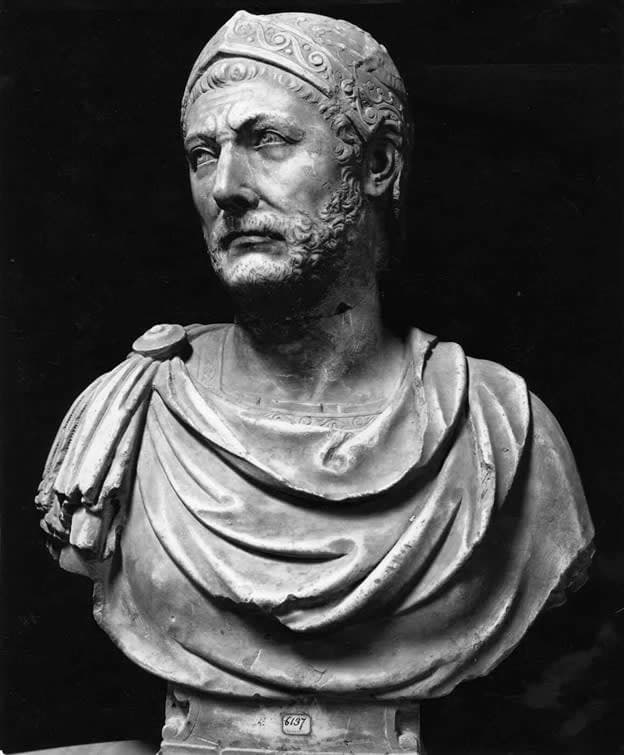
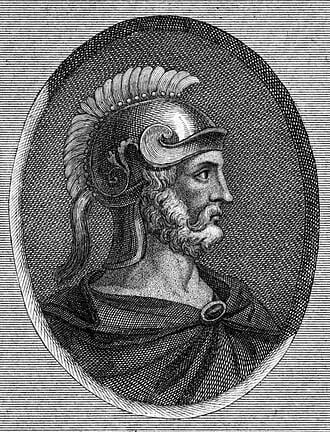
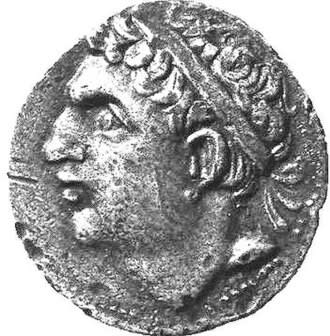
The story of one of antiquity’s greatest commanders begins in 247 BC, when the firstborn son of the distinguished Carthaginian military leader Hamilcar Barca was born and given the name Hannibal. His family belonged to the highest aristocracy of Carthage and traced its lineage back to the companions of the legendary Elissa, the founder of the city. The family nickname “Barca,” which meant “lightning” in Phoenician (“Keraunos” in Greek), was associated with their swift and devastating style of warfare.
Hannibal grew up in a large family. He had two younger brothers, Hasdrubal and Mago, and three older sisters, whose lives became closely intertwined with the political affairs of the period. One of them married Bomilcar in 238 BC, another became the wife of Hasdrubal the Fair, while the youngest was married to the Numidian prince Naravas in order to strengthen political alliances. Historian J. Seibert has also suggested the grim possibility that Hamilcar may have had a fourth son who was sacrificed to the gods around 240 BC, during a period of severe hardship for the city.
Hannibal’s childhood was inseparably connected with his father’s military ambitions. Hamilcar, who rarely saw his son because of the wars in Sicily, regarded his children as successors who would continue the work of his entire life. Watching them play, he is said to have prophetically exclaimed that he was raising “lion cubs for the destruction of Rome.”
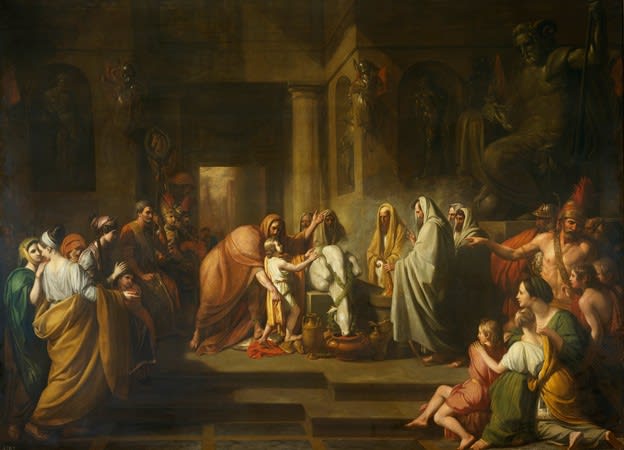
A decisive turning point in the life of nine-year-old Hannibal came when Hamilcar was preparing to sail to Spain in order to restore Carthaginian power after the First Punic War. Before an altar during a sacrifice, his father asked the boy whether he wished to accompany him. After Hannibal enthusiastically agreed, Hamilcar made him swear an oath of eternal hatred toward Rome. This “Hannibalic Oath” became a driving force throughout the rest of his life.
After arriving in Gades, Hannibal grew up under the harsh conditions of a military camp while receiving an excellent and diverse education from Greek tutors such as the Spartan Sosylus. He studied languages, including the dialects of Iberian tribes, and learned the art of strategy while fighting alongside his father.
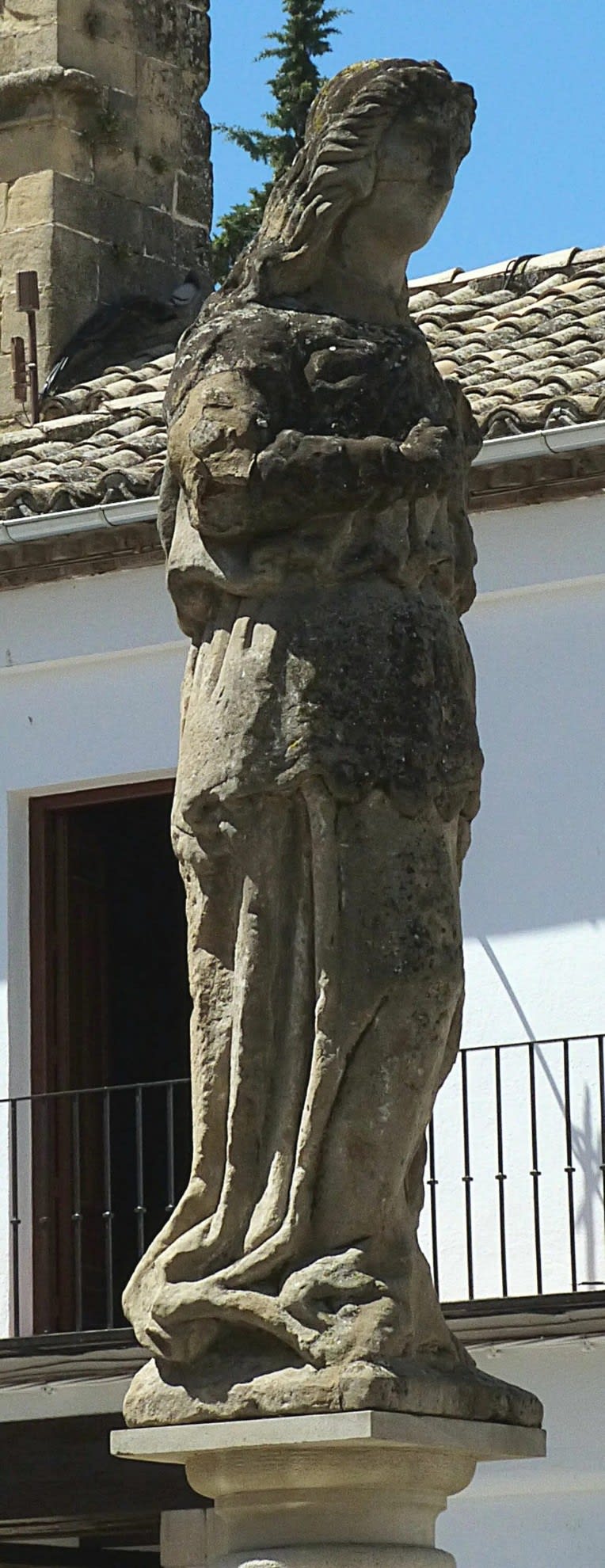
Tragedy struck the family in the winter of 229–228 BC during the siege of Helike. In order to save Hannibal and Hasdrubal from a sudden attack by the Oretani, Hamilcar drew the enemy toward himself and died in the waters of a river.
Command passed to his son-in-law Hasdrubal the Fair. Under his leadership, Hannibal, after returning from Carthage in 224 BC, became commander of the cavalry. During his years of service, he earned a reputation as a fearless leader, and when Hasdrubal was murdered by one of his servants in 221 BC, the army and the popular assembly unanimously elected Hannibal commander-in-chief.
Having become the supreme ruler of Punic Spain, he spent the next two years subduing the Olcades and Vaccaei, capturing Salamanca, and defeating the Carpetani near the Tagus River. During the same period, he strengthened his position by marrying the Iberian princess Imilce of Castulo.
The point of no return came with the conflict over Saguntum, a city under Roman protection. Ignoring the arrogant demands of Roman envoys, Hannibal began the siege in 219 BC. Even after suffering a serious wound to the thigh, he did not relax his pressure, and after eight months of stubborn resistance Saguntum fell.
Rome responded by declaring war. Hannibal, who had already developed a daring plan to invade Italy itself, redistributed his forces, sending part of the Iberian troops to Africa, and in the spring of 218 BC marched from New Carthage at the head of a huge army.
His route took him across the Pyrenees. After overcoming resistance from local tribes and leaving part of his forces in Catalonia, he reached the Rhône. Skillfully crossing the river and avoiding a confrontation with the army of Consul Scipio, Hannibal turned toward the Alps.
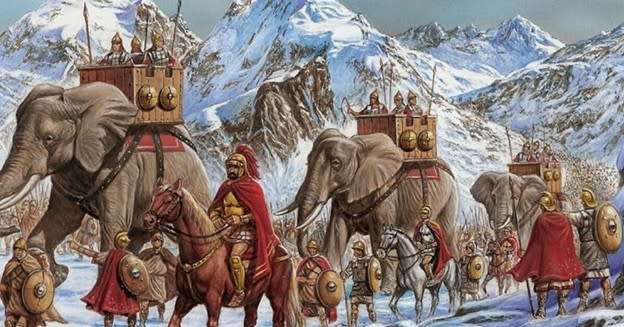
The crossing of the Alps in October 218 BC became one of the greatest achievements in military history. Fighting both mountain tribes and the brutal natural environment, Hannibal lost almost half of his army, descending into the Po Valley with only 20,000 infantrymen and 6,000 cavalrymen.
Nevertheless, the element of surprise was enormous. The first clash near the Ticinus River ended in victory for the Carthaginian cavalry, while the Battle of the Trebia in mid-December became a catastrophe for the Romans. Thanks to Mago’s ambush, the army of Consul Sempronius Longus was almost completely destroyed.
In the spring of 217 BC, after crossing the Apennines and the treacherous marshes of the Arno River, where Hannibal lost an eye because of a severe illness, he prepared a massive ambush near Lake Trasimene. The Roman army of Flaminius was trapped between the mountains and the lake and completely defeated.
With Rome facing disaster, Fabius Maximus was appointed dictator and adopted a strategy of wearing down the enemy while avoiding major battles. Hannibal, devastating Apulia and Campania, repeatedly tried to provoke “the Delayer,” but Fabius remained resolute.
On one occasion, he nearly trapped the Carthaginians near Casilinum, but Hannibal escaped through an ingenious maneuver involving oxen.
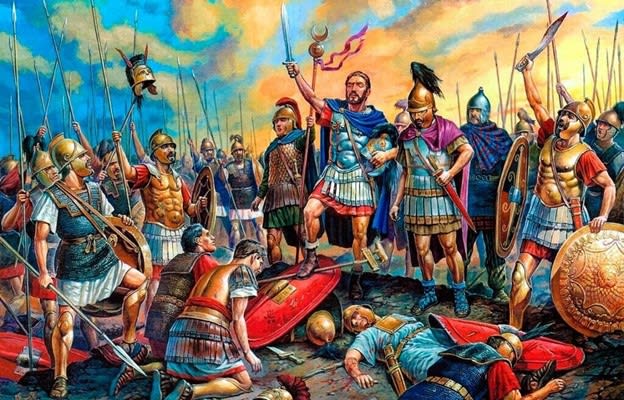
In 216 BC, Rome’s patience ran out, and the new consuls led an enormous army against the enemy. At the Battle of Cannae, Hannibal demonstrated the pinnacle of tactical skill. His center deliberately withdrew, creating a “pocket” into which the Roman legions advanced. The African infantry and cavalry then attacked them from the flanks and rear.
Approximately 50,000 Romans fell on the battlefield. It was then that Maharbal famously remarked that Hannibal knew how to win a victory but did not know how to use one, after the commander refused to march immediately on Rome.
Victory at Cannae brought Capua, Syracuse, and the Macedonian king Philip V to Hannibal’s side. However, the war entered a prolonged phase. Avoiding direct confrontations with Hannibal himself, the Romans began systematically recapturing lost territories.
Hannibal maneuvered throughout southern Italy and captured Tarentum, but gradually lost the initiative. In 211 BC, attempting to draw the enemy away from besieged Capua, he approached the very walls of Rome, causing panic and cries of “Hannibal at the gates!” However, he did not attempt to storm the fortified metropolis.
The fall of Capua marked the beginning of his decline. Despite local successes, such as the Second Battle of Herdonia and the death of Consul Marcellus in an ambush in 208 BC, the situation became increasingly critical.
His final hope of joining forces with his brother Hasdrubal, who had arrived from Spain, collapsed in 207 BC when Hasdrubal was killed at the Battle of the Metaurus and his severed head was thrown into Hannibal’s camp.
Confined to Bruttium, Hannibal fought a stubborn defensive war for several years. In 205 BC, at the Temple of Juno Lacinia, he left a monumental inscription summarizing his achievements.
However, Scipio’s successes in Africa forced the Carthaginian government to recall its greatest general. Hannibal left Italy with profound bitterness, believing that he had been defeated not by the Roman people but by the “malicious jealousy” of the senate of his own city, which had denied him support at decisive moments.
In 204 BC, the era of his Italian campaign came to an end, and the great Barcid returned home to fight his final battle.
In the autumn of 203 BC, obeying a severe order from Carthage, Hannibal left the shores of Italy. At Croton, he loaded his reduced but battle-hardened army of 24,000 men onto ships and reached Leptis without resistance.
He spent the winter in Hadrumetum and Byzacium, urgently preparing for another confrontation: purchasing horses, stockpiling provisions, and forging alliances with Numidian tribes. He understood that this time the war was no longer about supremacy but about the very survival of his homeland.
The campaign of 202 BC began with the Carthaginians’ fatal violation of the truce, which gave Publius Cornelius Scipio freedom of action. The Roman commander launched a rapid and destructive raid through the valley of the Bagradas River, effectively cutting Carthage off from its inland bases.
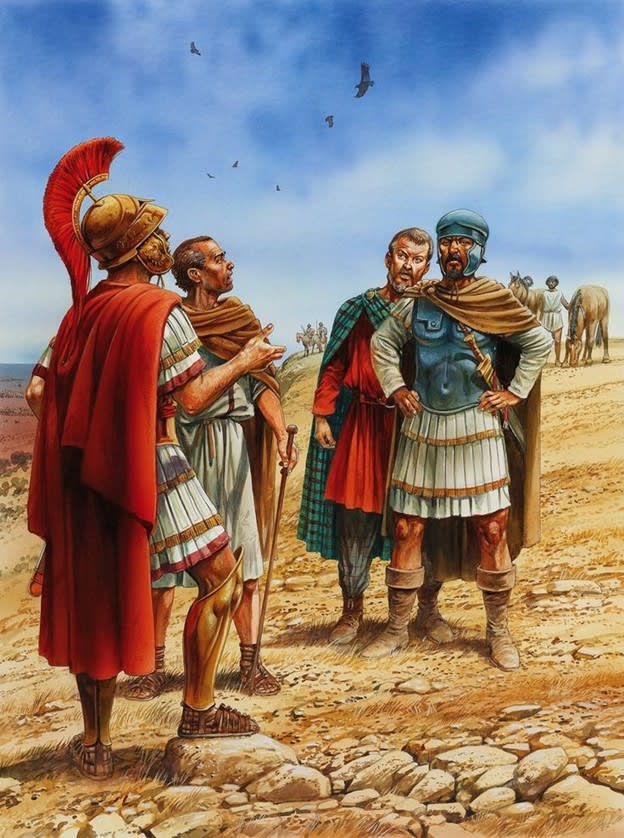
Hannibal, forced to act contrary to his plans, marched toward the city of Zama. It was here that the famous incident involving Hannibal’s scouts took place. Scipio discovered the spies but did not execute them. Instead, he ordered that they be shown the entire Roman camp, demonstrating complete confidence in his forces.
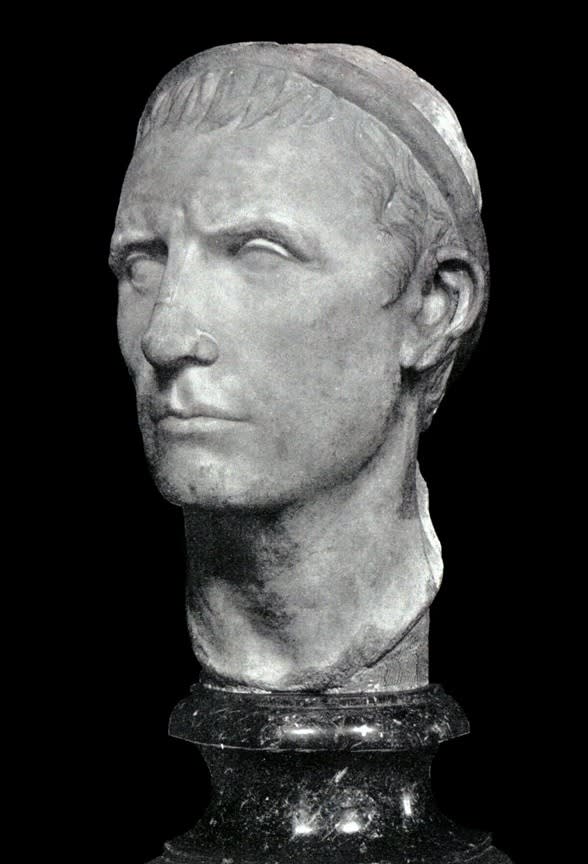
This audacity encouraged the two greatest commanders of the era to meet personally. Hannibal proposed peace on his own terms, attempting to preserve the remnants of Carthaginian influence, but Scipio, aware of his advantage, remained uncompromising.
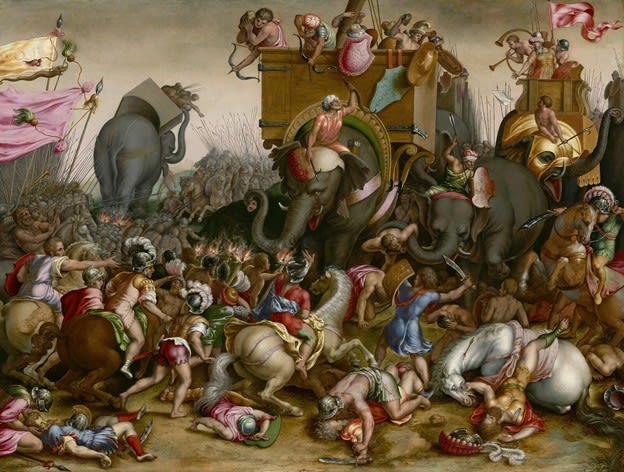
The following day, the Battle of Zama began. Fortune turned against Hannibal. The Carthaginian elephants, enraged by Roman javelins, disrupted the ranks of their own cavalry. The Numidian cavalry of Masinissa, which had once been one of Hannibal’s greatest sources of strength, struck him from the rear.
The defeat was devastating. Hannibal escaped with a small detachment to Hadrumetum and then to Carthage. For the first time in decades, he returned to his native city to acknowledge defeat and persuade the Council of Elders to accept the harsh peace terms.
The treaty was severe. Carthage lost all of its territories outside Africa and almost its entire fleet and was forbidden to wage war without Roman permission.
Hannibal personally dragged opponents from the speaker’s platform when they called for continued resistance, understanding that any delay would result in the complete destruction of the city.
In 201 BC, the Second Punic War officially came to an end.
Remarkably, even after the defeat Hannibal remained free. The Barcid faction retained considerable influence, and the city needed a leader capable of controlling its mercenaries.
According to some accounts, he formally remained in command of the army until 199 BC, forcing soldiers to work on olive plantations in order to prevent their moral decline.
In 196 BC, Hannibal was elected suffete, the highest official of the republic. Demonstrating himself to be a brilliant administrator, he struck at the power of the corrupt oligarchy.
He secured annual elections for judges and conducted a financial audit that uncovered enormous embezzlement. His declaration that taxation would not be necessary if the oligarchs simply returned what they had stolen made him a popular hero, but it also created deadly enemies within the country.
The oligarchs reported to Rome that Hannibal was preparing an alliance with the Syrian king Antiochus III. Fearing extradition, Hannibal escaped under cover of darkness from his estate to the island of Cercina and from there fled to Tyre.
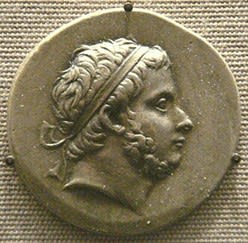
In the autumn of 195 BC, Hannibal finally met Antiochus III the Great in Ephesus. However, the king, wary of the Punic commander’s authority and reputation, was reluctant to give him command.
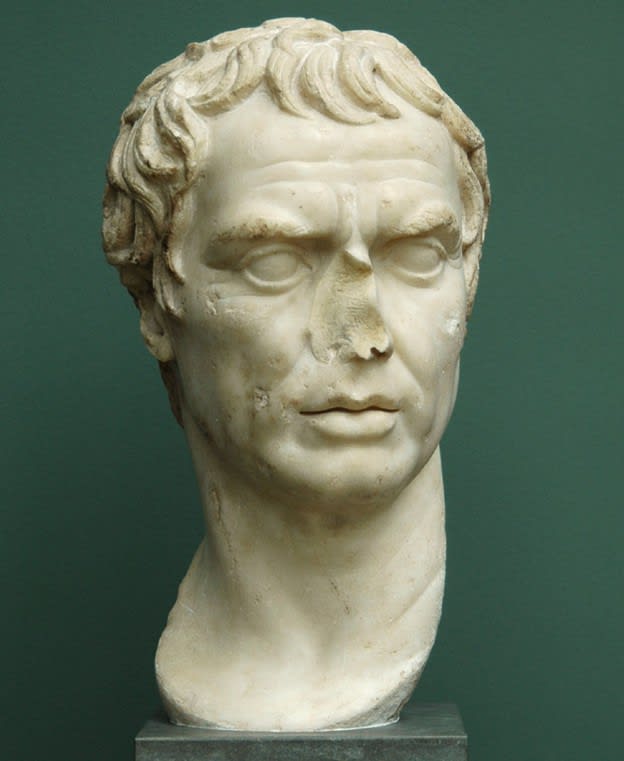
During this period in Ephesus, the legendary second meeting between Hannibal and Scipio took place. When the Roman asked whom Hannibal considered the greatest military commander, Hannibal named Alexander the Great, Pyrrhus, and himself.
When Scipio smiled and asked, “And what would you have said if you had defeated me?”, Hannibal replied, “Then I would have placed myself above Alexander.”
During the Roman–Seleucid War, Hannibal attempted to persuade Antiochus to invade Italy but was given command only of a fleet. In 189 BC, his squadron was defeated by the Rhodians off the coast of Pamphylia.
After Antiochus was defeated at Magnesia, one of the Roman peace conditions once again demanded the surrender of Hannibal. The great exile fled to Crete, where, according to legend, he cleverly protected his wealth from the local inhabitants by hiding his gold inside bronze statues.
Later, fate brought him to Greater Armenia and the court of King Artaxias I, whom he helped found the city of Artaxata.
He later found refuge in Bithynia under King Prusias. There Hannibal once again demonstrated his ingenuity, winning a naval battle against the Pergamene fleet through an unusual tactic: his soldiers threw pots filled with poisonous snakes onto the enemy ships.
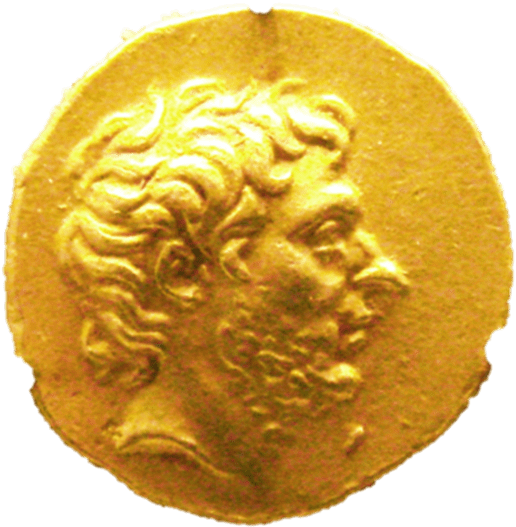
Rome could not rest peacefully while Hannibal remained alive. In 183 BC, Titus Quinctius Flamininus arrived at the court of Prusias and demanded that Barca be handed over.
The Bithynian king, eager to gain Roman favor, ordered Hannibal’s refuge in Libyssa surrounded. When Hannibal saw that all seven exits from his house had been blocked by soldiers, he understood that there was no way to escape.
“Let us finally relieve the Romans of their long-standing anxiety, since they are too impatient to wait for the death of one old man,” he is said to have declared before taking the poison that he always carried inside a ring.
Thus ended the life of a man who single-handedly challenged the greatest empire of the ancient world.
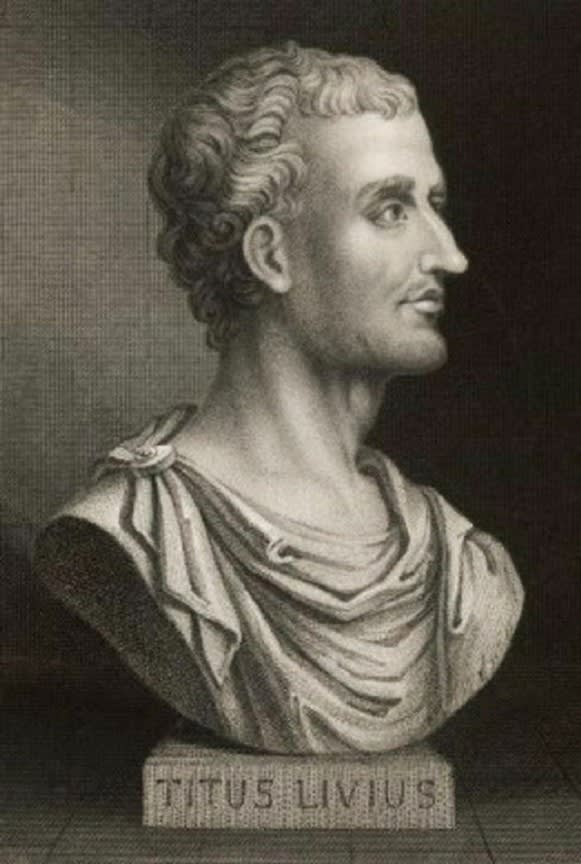
Roman historiography created a dual image of Hannibal. Livy acknowledged his almost superhuman endurance, bravery, and talent, but at the same time attributed to him “Punic treachery” and “inhuman cruelty.”
For Rome, he remained the embodiment of a nightmare for generations. The phrase “Hannibal ante portas” — “Hannibal is at the gates” — inspired fear for centuries.
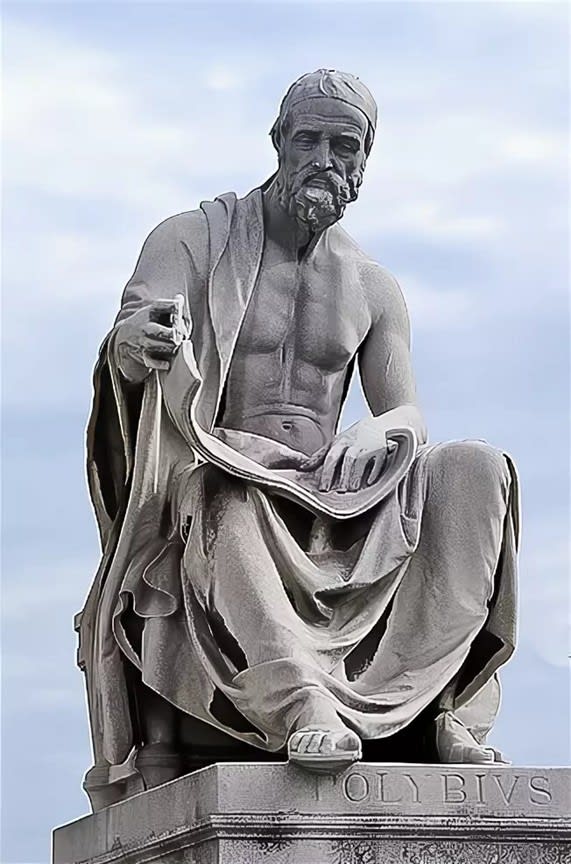
Modern historians, however, as well as his contemporary Polybius, saw a different picture. Hannibal was a highly educated man who knew Greek and several Iberian languages.
He was religious and particularly revered Melqart. Even in exile, he engaged in literary activity and left behind works written in Greek.
His military genius, whose greatest expression was the Battle of Cannae, is still studied in military academies throughout the world.
During the Enlightenment and the Napoleonic Wars, Hannibal’s image was reinterpreted. Napoleon saw him as a predecessor and as the symbol of a tragic hero who fell not because of weakness but because of betrayal by his own people.


