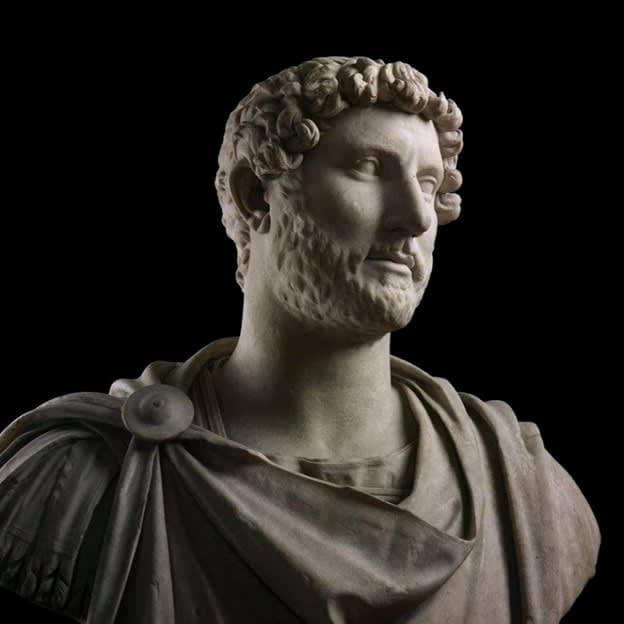

The future emperor Hadrian was born on January 24, 76 CE, in Italica, in southern Spain. His family, the Aelii, was among the wealthiest and most influential in Baetica and was related by blood to Emperor Trajan’s house. At the age of ten Hadrian lost his father and was placed under the guardianship of Trajan and his kinsman Publius Acilius Attianus.

From an early age Hadrian showed a strong interest in Greek literature, earning the nickname “little Greek” (Graeculus). His career advanced under Trajan’s patronage: he served in various legions and held the offices of quaestor and praetor. In 97 he was chosen to inform Trajan of his adoption by Nerva. Despite a period of temporary disfavour, Hadrian regained the goodwill of the emperor and of his wife, Pompeia Plotina. Soon he married Vibia Sabina, Trajan’s great-niece.
Hadrian accompanied Trajan in the First Dacian War, where he showed bravery. In 108 he became suffect consul, and in 112 archons at Athens. In 117, when Trajan fell ill, Hadrian was appointed governor of Syria, giving him independent command of the troops.
Trajan died on August 11, 117. The document adopting Hadrian was signed only after his death, which aroused suspicions; nevertheless, the Syrian legions proclaimed Hadrian emperor, and he accepted the throne.
Unlike Trajan’s expansionist policy, Hadrian chose to strengthen the frontiers and focus on the empire’s internal development. He relinquished the recently conquered Assyria and Mesopotamia to the Parthians and made Armenia a protectorate. In the autumn of 117, after settling affairs in the East, he went to Dacia to manage conflicts there, and only in 118 did he arrive in Rome.
Hadrian was probably the most widely travelled emperor in Roman history. In 121 he set out on his first tour, visiting Gaul and then Britain, where in 122 he began building the famous Hadrian’s Wall, 117 km long. He then visited Spain and Africa, inspecting the troops.


Hadrian had a special love for Greece. He spent the winter of 124–125 in Athens, was initiated into the Eleusinian Mysteries, and adorned the city with many splendid buildings. In 130 he visited Jerusalem, which lay in ruins, and decided to found a new city on the site: Colonia Aelia Capitolina.
Hadrian’s journeys were not mere pleasure trips. He personally inspected the provinces, strengthened borders, and built roads and cities. His policy aimed at a stable and economically prosperous empire.
Hadrian devoted great attention to the provinces’ economic development. Theaters, libraries, and temples were built across the empire. In Rome he built the Pantheon, the Mausoleum of Hadrian (now Castel Sant’Angelo), and the Temple of Venus and Roma. He also cared for Athens, which he regarded as his favorite city, and completed the Temple of Olympian Zeus there.


Hadrian carried out an important legal reform, codifying Roman law together with the jurist Salvius Julianus. He created an imperial council, divided Italy into four regions, and appointed only Romans to state offices.
Under Hadrian a powerful system of defensive works was constructed. The best known is Hadrian’s Wall in Britain. Provincials were increasingly admitted into the legions, and new militia-type units were formed, reducing the share of Italians in the army.
Hadrian’s principal military campaign was the suppression of the Jewish revolt of 131–135. The rebels seized Jerusalem, but the Roman general Sextus Julius Severus defeated them. Jerusalem was finally destroyed, and the leader of the revolt, Bar Kokhba, was killed. Some 580,000 Jews died in the fighting; many fortresses and villages were taken. After this, there were no major uprisings in Palestine.

Hadrian had no children of his own. The great love of his life was a Greek youth named Antinous, whom he met in 124. In 130 Antinous drowned in the Nile under mysterious circumstances. Hadrian was inconsolable. He deified his favorite, founded the city of Antinopolis at the place of his death, and ordered countless statues raised in his honor throughout the empire.
Hadrian died on July 10, 138, after a severe illness. Before his death he adopted Antoninus Pius, making him his heir. Shortly before the end he composed his own epitaph, which reflects his subtle and melancholy spirit.


