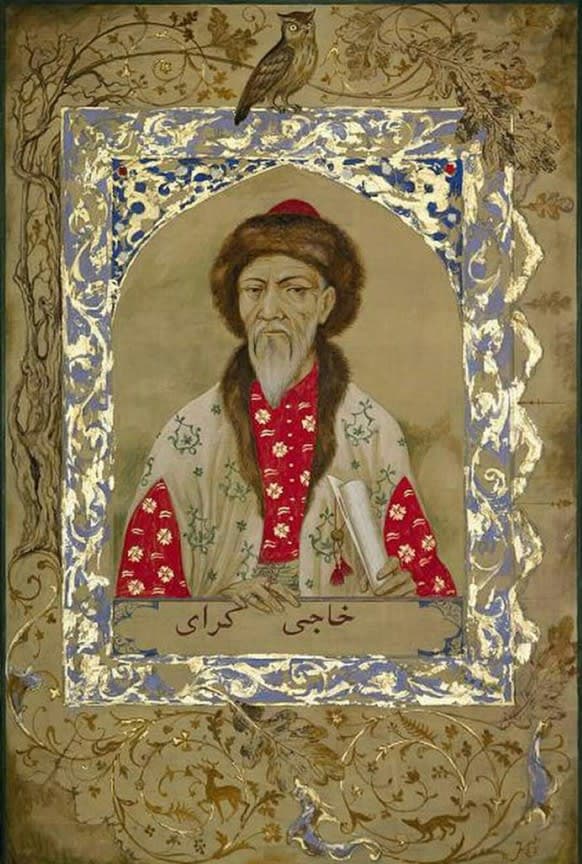
Hacı I Giray, the founder of the Crimean Khanate and the Giray dynasty, traced his lineage to Genghis Khan through his grandson Tuqa-Timur, the thirteenth son of Jochi, son of Genghis Khan. His forebears served as governors of the Crimean ulus of the Golden Horde. Hacı Giray was born in Lida, a town of the Grand Duchy of Lithuania, to which his family had fled due to political instability in Crimea. His father, Ghiyas al-Din, and his uncle, Devlet-Berdi, were sons of Taş-Timur, who in 1395 had proclaimed himself an independent Crimean khan but was driven out by Tamerlane.


In 1428, with the support of Grand Duke Vytautas of Lithuania, Hacı Giray seized Crimea for the first time. He managed to secure the backing of powerful Crimean murzas from the Shirin clan, but was soon expelled by the Golden Horde khan Ulugh Muhammad. In 1431, having mustered forces again in Lithuania, Hacı Giray returned and laid siege to Solkhat (Stary Krym). He defeated the Golden Horde’s troops and consolidated his position in Crimea, also concluding an alliance treaty with the Principality of Theodoro.

In 1434, a Genoese expedition to Crimea aimed against Hacı Giray’s ally, the prince of Theodoro, was crushed by a five-thousand-strong detachment of the Crimean khan. This enabled him to conclude a favorable peace with Genoa, under which it recognized Hacı Giray as the Crimean khan and paid ransom for its captured soldiers. However, that same year Ulugh Muhammad invaded Crimea once again, forcing Hacı Giray to retreat. He again found refuge in Lithuania, where he became an honored hostage at the court of Grand Duke Sigismund Kęstutaitis.
By 1440, the Crimean aristocracy, dissatisfied with the oppression of the Golden Horde’s khans, appealed to the new grand duke of Lithuania, Casimir Jagiellon, to release Hacı Giray. Accompanied by the Lithuanian commander Radziwiłł, Hacı Giray returned to Crimea and in March 1441 was proclaimed khan. He expelled the governor of Sayyid Ahmad, and in 1445 decisively routed his forces.

Once secure on the throne, Hacı Giray moved the capital to Qırq Yer (Çufut-Qale), and later to Salaçıq, becoming the first independent ruler of the Crimean yurt. He continued the struggle against the Golden Horde, and in 1452 defeated Khan Sayyid Ahmad, who was forced to flee to Kyiv, where he was arrested and sent into exile in Lithuania. In 1465, Hacı Giray won another major victory by routing Mahmud Khan of the Great Horde, who had attempted to attack Rus’. These victories significantly weakened the Golden Horde and ultimately contributed to its final dissolution.
Hacı Giray was highly popular among the people and earned the epithet “Angel” (Melek). He died in August 1466 and was buried in a mausoleum in Salaçıq, near present-day Bakhchysarai. His struggle for independence made the Crimean Khanate a new influential player in the region, and his descendants, the Girays, would rule Crimea until the eighteenth century.


