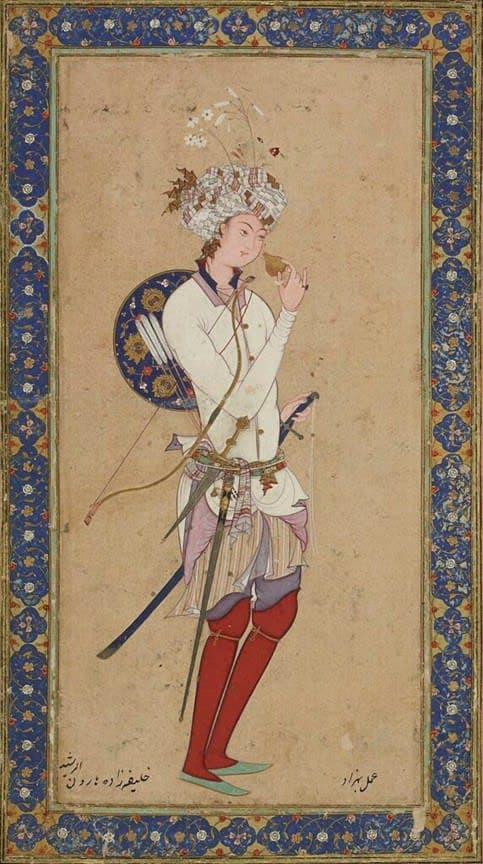

The story of Hārūn begins in the Iranian city of Rayy, in a mighty citadel surrounded by deep moats. Historians have debated the exact date of his birth for centuries: both 17 March 763 and 16 February 766 are cited. Modern Orientalists such as Hugh Kennedy and C. E. Bosworth tend to favor the year 766, although the Soviet scholarly tradition usually adhered to the earlier date. His father was the caliph al-Mahdī, and his mother was the legendary Khayzurān a Yemeni slave woman who became the lawful wife of the ruler and the de facto co-ruler of the empire. Hārūn always recalled Rayy with warmth, yet his true cradle was Baghdad.

When the boy was only three years old, the family moved to a luxurious palace on the banks of the Tigris. The prince’s upbringing was thorough and systematic. From the ages of five to fifteen he studied Islamic law, philosophy, Islamic history, and the subtleties of Qurʾanic interpretation under the guidance of the greatest minds of the era, such as the linguist al-Kisāʾī. Yet the key figure in his life became Yaḥyā ibn Khālid of the Barmakid family. Hārūn trusted his mentor so deeply that he called him “father,” and at the age of thirteen appointed him his personal secretary with virtually unlimited authority.
Even before reaching adulthood, Hārūn was thrown into the crucible of war. In 780 and 782 he nominally led punitive expeditions against the Abbasids’ principal enemy, Byzantium. Although real command was exercised by experienced generals, the presence of the prince among the troops inspired the soldiers. During the second campaign the Muslims achieved a decisive victory, reaching the Bosporus for the first time in Abbasid history and dictating peace terms to Constantinople.
It was for this triumph that al-Mahdī bestowed upon his son the honorary laqab “al-Rashīd” (“the Rightly Guided” or “He Who Walks the Straight Path”). During the same period, Hārūn was appointed second in line to the throne after his brother al-Hādī and was entrusted with the governance of vast territories: Egypt, Syria, Armenia, Azerbaijan, and Tunisia. In reality, Yaḥyā the Barmakid always stood behind him, his political weight growing by the day. There are versions suggesting that Khayzurān and Yaḥyā sought to persuade al-Mahdī to make Hārūn the sole heir, but the caliph’s death in 785 interrupted these plans, leaving the empire on the threshold of the brief and turbulent reign of al-Hādī.
The accession of Hārūn al-Rashīd in mid-September 786 (sources cite 14, 15, or 17 September) marked the beginning of an era that the great historian al-Masʿūdī called the “Blessed Age.” Ruling a realm stretching from the Atlantic to India, Hārūn began his reign by appointing his “father” Yaḥyā to the post of vizier.
In the early years of his rule, Hārūn shared power with a formidable tandem: his mother Khayzurān (who ruled de facto until her death in 789) and the Barmakid family. This was a time of extraordinary splendor. Baghdad became a global center of learning and trade, reaching the zenith of Islamic culture. Yet behind the façade of prosperity lurked political instability. The empire was shaken by uprisings: Egypt rebelled against crushing taxation; social and religious revolts flared up in Syria, India, and Yemen; the Maghrib and al-Andalus had been lost even before Hārūn’s time; and during his reign Ifrīqiya (modern Tunisia) effectively seceded from the caliphate, where the Aghlabid dynasty came to power, agreeing only to pay an annual tribute.

Despite internal problems, Hārūn remained a “warrior of the faith.” He personally led major invasions into Anatolia in 803, 804, and 806, striking fear into Byzantium.
The image of Hārūn al-Rashīd in culture constitutes a separate chapter in world literature. Legends of the caliph who, disguised as a merchant, wandered the streets of Baghdad at night to learn the concerns of ordinary people immortalized him in the collection One Thousand and One Nights. It is historically attested that he corresponded with the Frankish emperor Charlemagne, to whom he sent as a gift an exotic white elephant named Abū al-ʿAbbās—an event that caused a sensation in Europe.

The end of his life, however, was far from fairy-tale. In 803, for reasons that remain unclear, Hārūn suddenly turned his wrath against the Barmakids, overthrowing his loyal advisers and friends. The end of the greatest caliph came on 24 March 809 in Ṭūs, during a military campaign against the rebel Rāfiʿ ibn al-Layth. With his death, the Abbasid Caliphate permanently lost its unity: the empire plunged into a civil war between his sons al-Amīn and al-Maʾmūn, marking the beginning of the long decline of what had once been a great power.


