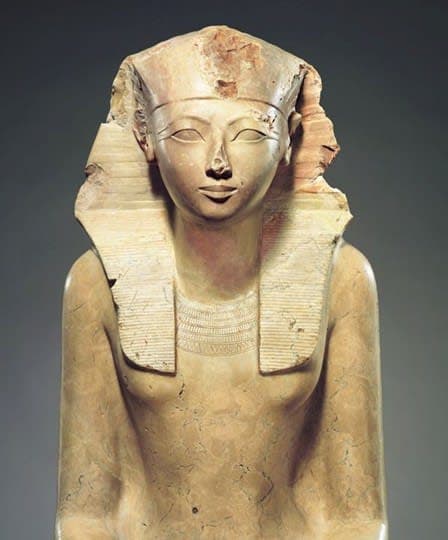

The history of Ancient Egypt knows many great names, but the figure of Hatshepsut, a representative of the Eighteenth Dynasty, stands apart. Her reign, which became an era of unprecedented prosperity and architectural triumph, remains the subject of lively scholarly debate. According to the ancient tradition recorded by the Egyptian priest-historian Manetho of the 3rd century BCE (in the translation of Josephus), the queen, mentioned under the name Amesses, ruled for 21 years and 9 months. However, Sextus Julius Africanus, citing the same author, gives a full 22 years of reign. Modern scholarship, relying on the short chronology, places the years of her life either in 1490/1489–1468 BCE or 1479–1458 BCE. Discrepancies in dating are often explained by uncertainty regarding the reign of her husband, Thutmose II, whose time on the throne varies from 4 to 13 years in different king lists.
Hatshepsut was flesh of the great dynasty, the daughter of the third pharaoh of the Eighteenth Dynasty, Thutmose I, and Queen Ahmose, which made her the granddaughter of Ahmose I, founder of the New Kingdom. During her father’s lifetime she was granted the high title “God’s Wife,” the chief priestess of the Theban god Amun. Surrounded by luxury and attention, she retained throughout her life a deep attachment to her nurse Sitre In(et), for whom she later erected a statue and granted the exceptional privilege of burial in the Valley of the Kings.
Hatshepsut’s fate was closely intertwined with family ties: she had a sister Neferubity and several half-brothers — Wadjmose, Amenmose, Thutmose II, and possibly Ramose. After the early death of her elder brothers, Thutmose II became heir, whom Hatshepsut married to preserve the purity of royal blood and continuity of power. Their union produced a daughter, Neferure, whom Hatshepsut from an early age prepared for a great future, entrusting her to the care of her favorite and architect Senenmut. There are also suggestions of a second daughter, Merit-Ra Hatshepsut, although modern Egyptologists more often consider her the daughter of the priest Huy.

After the death of Thutmose II in 1490 BCE, the throne formally passed to his minor son by a concubine, Iset — Thutmose III. Hatshepsut became his regent. However, within a year and a half, with the support of the Theban priesthood and the oracle of Amun, a political transformation occurred. During a ceremonial procession, the statue of the god “indicated” Hatshepsut as the true ruler.
The queen adopted the full titulary of the pharaohs. Her names became:
Horus name: Userkau (“Powerful in Spirits”);
Throne name: Maatkare (“Truth Is the Spirit of the Sun God”);
Personal name: Hatshepsut-Amenmenes (“Foremost of Noble Women, Divine Elixir”).
To legitimize her authority, a legend of theogamy — a divine marriage between Amun-Ra and Queen Ahmose — was created. Propaganda claimed that the god himself, in the form of Thutmose I, conceived Hatshepsut so that she might rule the world. To conform to royal convention, Hatshepsut wore male attire and the false beard during official ceremonies, although in private monuments and some statues she retained a feminine appearance, calling herself “the most beautiful of women.”

Hatshepsut’s reign became a time of a construction boom. She restored monuments destroyed by the Hyksos and transformed the face of Egypt. At Karnak she erected the magnificent “Red Chapel” of granite and installed four gigantic obelisks. Two of them, 29.56 meters high, were the tallest in Egypt at the time. In the quarries of Aswan there still lies an unfinished obelisk 41.8 meters high and weighing about 1,200 tons, also intended for her projects.
The jewel of her architectural legacy was the mortuary temple at Deir el-Bahri, named Djeser Djeseru (“The Most Sacred of Sacred Places”). Built under the direction of Senenmut over nine years (from the 7th to the 16th regnal year), the temple astonishes with its three terraces connected by ramps and adorned with gleaming white colonnades. Here, among sphinxes and gardens of myrrh trees, the main events of her reign were immortalized.


Around 1482–1481 BCE, Hatshepsut organized a grand expedition to the mysterious land of Punt (“God’s Land”). Under the command of the general Nehsi, five large ships reached the shores of the Horn of Africa (modern Somalia). The Egyptians returned with treasures: ebony, gold, ivory, exotic animals, and — most importantly — living myrrh trees for the garden of Amun.

For a long time, Hatshepsut’s reign was considered exclusively peaceful. However, recent research confirms her participation in military campaigns. In the 12th year of her reign, a victory was achieved in Kush (Nubia), and inscriptions in the tomb of Djehuty explicitly state that the queen personally accompanied the troops and collected tribute. She also maintained control over Sinai, Phoenicia, and Palestine.
Hatshepsut died in the 22nd year of her reign, around 1458 BCE, at a little over 50 years of age. Analysis of her mummy in the 21st century showed that she suffered from diabetes, arthritis, and cancer (of the liver and bones). Remarkably, she may have accidentally poisoned herself: her cosmetic lotion contained carcinogenic benzopyrene. The immediate cause of death may have been blood infection following the extraction of a molar.

The search for her body lasted decades. The mummy was found in the modest tomb KV60, originally attributed to her nurse. Only in 2007, thanks to DNA analysis and CT scanning that matched a tooth found in a box bearing her name, did Zahi Hawass officially confirm that it was Hatshepsut. In 2021 she took her place of honor in the National Museum of Egyptian Civilization.
After Hatshepsut’s death, her stepson Thutmose III launched a large-scale campaign to erase her names and images. Her cartouches were chiseled out, obelisks were walled in, and her name was removed from king lists. For a long time this was interpreted as revenge for usurpation. However, modern historians such as Charles Nims and Peter Dorman note that the persecution began only about 20 years after her death (around the 42nd year of Thutmose III’s reign). Most likely, it was an act of political expediency: to preserve cosmic order (Ma’at), the precedent of female rule had to be erased to secure the legitimacy of future male heirs.
Today Hatshepsut is recognized as one of the most successful rulers in world history. She not only maintained power in a patriarchal society but also transformed Egypt into a flourishing superpower of the ancient world, leaving monuments that continue to inspire awe more than three and a half millennia later.


