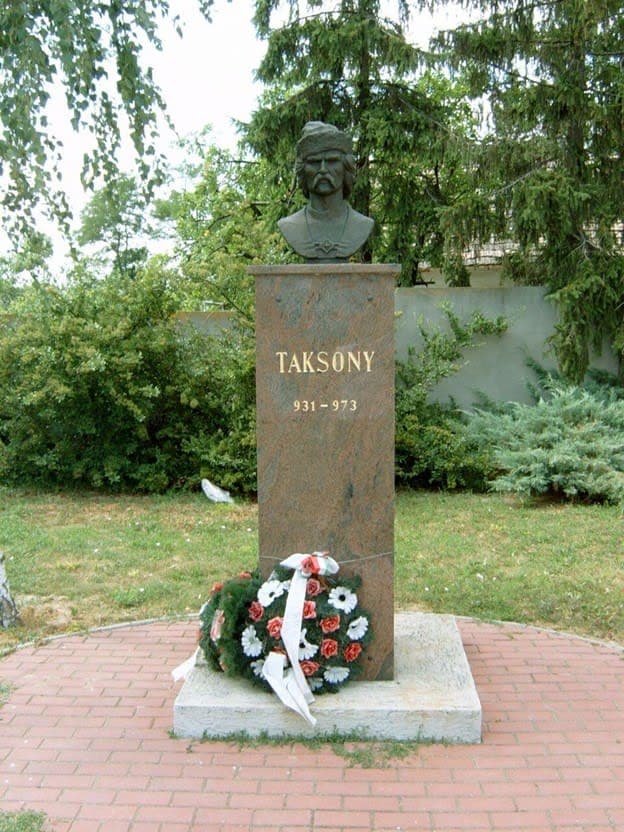

The life of Taksony, whose exact year of birth, 931, was carefully recorded in the famous medieval chronicle Gesta Hungarorum (The Deeds of the Hungarians), was closely intertwined with military campaigns from the very beginning. As early as 947, at the age of sixteen, he led a daring invasion of Italy by the Magyar cavalry, driven by youthful enthusiasm and the ambitions of a grand prince's son. During this extensive raid, Hungarian forces swept across the entire Italian peninsula, reaching as far as distant Apulia. The threat was so great that Berengar II, who at the time was a claimant to the Italian throne, was forced to pay the young commander a substantial tribute simply to persuade him to withdraw his troops and leave his territories in peace.
Around the same period, Taksony's father, Grand Prince Zoltán, arranged a marriage for his son in an effort to strengthen political alliances. According to Gesta Hungarorum, the bride came "from the land of the Huns" (a kunok földjéről). Since the Magyars of that era often referred to their eastern nomadic neighbors as Huns, historians generally agree that Taksony's wife was a noblewoman of Pecheneg origin, a marriage intended to reinforce Hungary's ties with the nomadic peoples of the steppes.
A turning point not only in Taksony's life but also in the history of Europe came in 955. It was then, following the catastrophic defeat of the Hungarians at the Battle of Lechfeld (the Battle of Augsburg) at the hands of the German king Otto I the Great, that Taksony assumed the title of Grand Prince. It is known that he personally participated in that terrible battle and miraculously managed to survive the bloodbath that destroyed the elite of the Magyar army. The disaster at Augsburg became a brutal but sobering lesson: it permanently brought an end to Hungarian campaigns of conquest in the West and greatly accelerated their historic transition toward a settled way of life.


Nevertheless, centuries of raiding traditions could not disappear overnight. Having lost the opportunity to plunder German territories, the Hungarian military machine under Taksony did not come to a halt. Instead, it simply redirected its attention from the West to the South. The Byzantine Empire became its new target, seemingly a more vulnerable victim.
In 957, the Byzantine emperor Constantine VII Porphyrogenitus, undoubtedly influenced by the destruction of the Hungarian army at Augsburg, made the bold decision to discontinue the traditional tribute payments to the Magyars. However, he fatally underestimated the Hungarians' ability to recover their military strength. By April 959, their cavalry had already reached the walls of Constantinople and laid siege to the great city.

Realizing their mistake, the Byzantines resorted to sophisticated diplomacy. They attempted to turn the Bulgarians against the Hungarians, paying them substantial sums to establish a buffer zone that would absorb and repel Magyar raids. Yet Taksony proved to be no less skilled a diplomat. In 965, he concluded a direct agreement with the Bulgarian Tsar Peter I. Under the terms of the treaty, the Hungarians promised not to plunder Bulgarian lands, while Tsar Peter granted their armies unrestricted passage through his territories directly to the borders of the Byzantine Empire.

In an attempt to punish the Bulgarians for this betrayal, the new emperor, Nikephoros II Phokas, took a fateful step in 967 by calling upon the Kievan prince Sviatoslav Igorevich for assistance. Instead of gaining a reliable ally, Byzantium found itself facing an enemy of unprecedented power.
Sviatoslav did not merely conquer Bulgaria. In the spring of 970, he invaded the territory of the Byzantine Empire itself. The Grand Prince of Kiev brought with him an enormous army that united Bulgarians, Hungarians, and even his long-standing steppe enemies, the Pechenegs, under his banners. According to the authoritative estimates of the Hungarian historian Ferenc Makk, Magyar horsemen accounted for as much as one-third of Sviatoslav's entire massive army.
The fact that the Hungarians managed to assemble such a formidable army after the catastrophe at Augsburg clearly demonstrates the profound processes taking place within their society during Taksony's reign. Previously fragmented tribes and clans were rapidly consolidating into a unified people, while the authority of the Grand Prince was steadily growing stronger.
At the same time, the system of governance was undergoing a transformation. The second most important title in the Magyar hierarchy, that of the supreme military commander (gyula), had by then lost its original meaning and had come to be regarded as the personal name of the ruler of Transylvania.
In practice, a system of dual authority had emerged in the country. Grand Prince Taksony firmly controlled the territories of Pannonia, while Gyula ruled Transylvania with virtually absolute authority.
As a wise strategist, Taksony understood that he did not yet possess sufficient military strength to bring the entire country under his control by force. He therefore chose diplomacy. Around 967, he established a strong political alliance with Gyula, cementing it through the marriage of his son, the future Grand Prince Géza, to Gyula's beautiful daughter, Sarolt.
The Battle of Arcadiopolis in 970 marked the end of the era of Magyar terror in Europe. The campaign of the united army of barbarian allies against Byzantium ended in a crushing defeat. This battle brought the history of Hungarian plundering raids to a definitive conclusion.
By the end of the tenth century, the Magyars had firmly settled in their territories, and their rulers were beginning to understand an essential reality: to survive in the new political environment and become a fully recognized part of the European world, they needed to embrace Christianity.


However, the path toward the new faith proved difficult. The intense geopolitical conflict with Byzantium made the conversion of the Hungarians to Christianity according to the Greek rite impossible. Recognizing this, Taksony attempted to seek spiritual protection in the West by turning to the Pope in Rome.
In 963, it seemed that this mission would succeed. Pope John XII even consecrated a certain Zacheus as Bishop of the Hungarians. Yet once again, Taksony encountered the overwhelming force of high politics.
Zacheus's mission was never carried out because of the determined opposition of Otto I. Having become Holy Roman Emperor in 962, Otto closely guarded his influence in the region and categorically insisted that the Hungarians accept baptism exclusively through his authority, thereby becoming his vassals rather than placing themselves directly under the jurisdiction of the Roman pontiff.
Thus, Grand Prince Taksony entered history as a transitional ruler, a bridge between two fundamentally different eras. He inherited authority over fragmented nomadic tribes that had survived a devastating military defeat, yet he left his successors a more consolidated society standing on the threshold of conversion to Christianity and the emergence of a powerful European kingdom.


