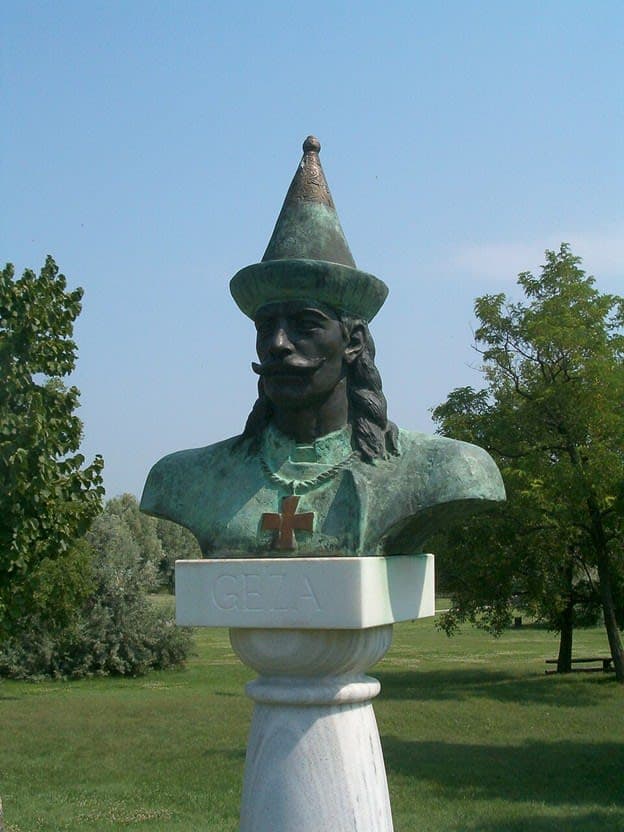
The legacy inherited by Grand Prince Géza from his father Taksony proved to be an incredibly heavy burden, demanding an iron will and extraordinary political cunning from the new ruler. Upon ascending the throne, Géza assumed control of a country torn apart by deep internal contradictions. Political life among the Hungarians was dominated by tribal and clan fragmentation. Powerful tribal chieftains considered themselves the rightful masters of their own territories, reducing the title of Grand Prince of the Magyars to little more than an impressive symbolic distinction rather than an effective instrument of government.
The international political situation posed even greater threats. An era of radical transformation had begun, leaving little chance of survival for a state that continued to operate according to its old traditions. Following the devastating defeats inflicted upon the Hungarians by both their western German neighbors and their powerful southern neighbor, Byzantium, at the Battle of Arcadiopolis in 970, the Magyars were forced to abandon their centuries-old tradition of plundering raids once and for all. The collection of tribute in exchange for refraining from attacks, which had served as one of the most important and substantial sources of wealth for the tribal aristocracy, became a thing of the past. The treasury was left empty, and the warriors grew increasingly dissatisfied.


The situation was further aggravated by an unprecedented geopolitical shift: the German emperor Otto II married the Byzantine princess Theophano. This dynastic marriage effectively formed an iron ring around Hungary, bringing together two powerful Christian empires that had previously suffered the most from Magyar raids. The Hungarians now found themselves trapped between two united superpowers.
Adding fuel to the fire was an acute dynastic crisis within Hungary itself. Grand Prince Taksony, seeking to strengthen centralized authority, had designated his eldest son Géza as his successor, blatantly violating the centuries-old system of succession by seniority.
According to ancient steppe customs, power was supposed to pass not from father to son but to the eldest living member of the ruling dynasty. This tradition provided any influential relative of the new prince with a legitimate justification for rebellion.

However, Géza proved to be precisely the kind of man this ruthless era demanded. In historical memory, he remained an extremely controversial figure: an unscrupulous politician, a selfish and power-hungry schemer, and later a remarkably hypocritical Christian.
Harsh and uncompromising, he lived for himself, denying none of his desires. Yet, paradoxically, he became one of the most outstanding rulers in Hungary's early history. The secret of his greatness lay in the fact that his overwhelming personal ambitions and thirst for absolute power coincided perfectly with the vital interests of the emerging Hungarian state. Every selfish action he took was directed toward centralizing the fragmented territories and ruthlessly eliminating separatism.
Géza's path toward consolidating his power began during his father's lifetime. Around 967, obeying Taksony's wishes, he entered into a dynastic marriage with Sarolt, the daughter of the influential ruler of Transylvania, Gyula II.
This political alliance not only secured the eastern borders of the principality but also gave Géza a wife whom chroniclers admiringly described as "the most beautiful woman among her people" (nemzetének legszebb asszony).
Nevertheless, Géza, being a true pagan, had no intention of limiting himself. He maintained an entire harem and, even after formally converting to Christianity, categorically refused to dismiss his wives, keeping all of them at his court.

Before ascending to the throne as Grand Prince, Géza ruled the Principality of Bihar, an appanage that traditionally belonged to the heir to supreme authority.
Upon becoming Grand Prince, he made a cunning tactical move. In accordance with ancient customs, he ceded Bihar to his powerful relative, Koppány, Prince of Somogy, who was evidently the principal claimant to the throne under the principle of seniority.
However, while surrendering these lands, Géza simultaneously unleashed a merciless campaign of terror against everyone who dared to question the legitimacy of transferring power directly from father to son.
For his brutal suppression of opposition among the noble families, the prince earned the sinister nickname Véres Kezű, meaning "Bloody Hands."
His entire life became an unending struggle against the regional princes, and this campaign ultimately proved successful. By the time of Géza's death, only three independent rulers remained unconquered within Hungarian territory.
They were the aforementioned Koppány, Prince of Somogy and Bihar; Gyula the Younger, ruler of Transylvania and cousin of Princess Sarolt; and Prince Ajtony, who maintained firm control over the vast territories between the Maros and Danube rivers.

Understanding that the state could not survive without peace along its borders, Prince Géza prohibited the Magyars under his authority from carrying out plundering raids (kalandozások), threatening violators with death.
In 973, he took a historic step by sending an embassy to Quedlinburg and concluding a peace treaty with the powerful German emperor Otto I.
However, Géza's commitment to peace was purely pragmatic. When internal turmoil erupted in the Holy Roman Empire in 983, the Magyar ruler did not hesitate to exploit his neighbor's weakness. In a lightning-fast offensive, he seized Lower Austria.
It was not until 991 that the Germans, having finally gathered sufficient strength, managed to drive the Hungarian garrisons out of these territories.
The crowning achievement of Géza's political cunning was his conversion to Christianity in 974. Recognizing that baptism was inevitable, he brilliantly maneuvered through a complex diplomatic game, successfully avoiding the political traps laid by both the Byzantine and German empires, each of which sought to turn Hungary into its vassal through ecclesiastical subordination.
The Benedictine monk Bruno, who baptized the Grand Prince, had been personally consecrated as Bishop of Hungary by the Pope.
Thanks to this sophisticated diplomatic maneuver, the Hungarian Church gained autonomy, remaining subordinate to neither the Greek ecclesiastical hierarchy nor the German clergy.
Although Géza had become a Christian on paper, he remained a pagan at heart and continued openly worshipping the old idols.
This was not merely a matter of habit but also a calculated political decision. The prince had no desire to enter into open confrontation with his people and army, the overwhelming majority of whom remained faithful to their ancestral religion.
When outraged Christian priests reproached him for sacrilege, Géza arrogantly responded with his famous declaration that he was "wealthy enough to offer sacrifices both to the old gods and to the new God."
The new religion provided the Grand Prince with another invaluable advantage in resolving the question of succession.
Invoking the established laws and traditions of Europe's Christian monarchs, Géza decisively dismantled the ancient system of succession by seniority and officially designated his eldest son, Vajk, who had received the Christian name Stephen (István) at baptism, as his successor.
According to pagan customs, however, the throne unquestionably should have passed to the rebellious Prince Koppány.
Through his iron-fisted rule, the shedding of rivers of blood, and the construction of a complex network of political alliances, Prince Géza led Hungary out of a profound domestic and international political crisis.
He had plowed and richly fertilized the soil upon which his son Stephen — the future first king and patron saint of Hungary — would establish a powerful, centralized, and seemingly unshakable Hungarian kingdom.


