Glycerius’s path to power began far from imperial ambition.
It is possible that in his earlier years he successfully commanded Roman legions in Dalmatia, but by the fateful year 472 he was firmly established at the imperial court in Ravenna, holding the prestigious military office of Count of the Domestics — commander of the elite imperial guard.
This position was an excellent stepping stone to supreme power: two decades earlier, in 456, the future emperor Majorian had held the same office.

By that time, the Western Roman Empire was suffocating in the flames of civil war.
The all-powerful barbarian commander Ricimer, the de facto ruler of Italy, had entered into open conflict with the legitimate emperor Procopius Anthemius.
In April 472, Ricimer delivered a devastating political blow. He summoned Olybrius to Italy — the distinguished senator whom the Vandal king Genseric had already promoted as a candidate for the throne in 461 — and proclaimed him emperor in opposition to Anthemius.
In July, after an exhausting five-month siege, Rome fell and Anthemius was ruthlessly killed.
The triumph of the rebels, however, was short-lived.
By November 472, Olybrius died during an outbreak of plague after occupying the throne for only a few months.
Around the same time, death also claimed the seemingly invincible Ricimer.
The Western throne was left vacant.
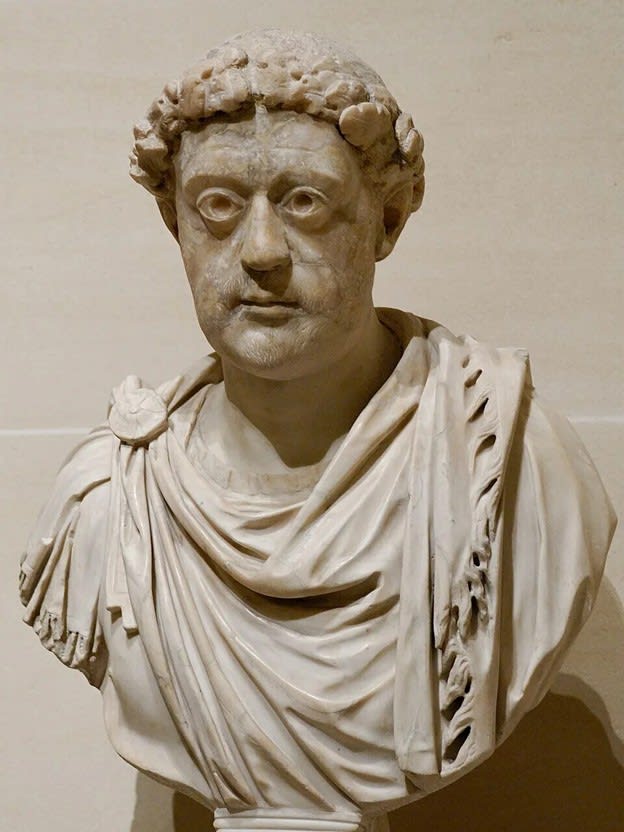
The Eastern emperor Leo I Macella, now the only fully legitimate ruler of the Roman world, hesitated painfully over what to do.
His court suffered from an acute shortage of trustworthy men in an empire devastated by betrayal and intrigue.
Four long months passed, yet Constantinople still failed to name a new Western Augustus.

The power vacuum could not continue indefinitely.
By March 473, the initiative in Ravenna was seized by Gundobad, nephew of the late Ricimer, who had inherited his uncle’s titles of patrician and magister militum.
Relying on Germanic units of the Roman army and securing the support of the Burgundian king and magister militum of Gaul Chilperic, Gundobad took the fate of the empire into his own hands.

His choice fell upon Glycerius, commander of the imperial guard.
The sources disagree over the exact date of his elevation.
The Paschale Campanum gives 3 March, while the Fasti Vindobonenses Priores records 5 March 473.
Assessments of his accession also differ.
The Byzantine chronicler Theophanes the Confessor respectfully calls Glycerius “a distinguished man,” while the Gothic historian Jordanes harshly states that he obtained power “more by seizure than by election.”
Whatever the precise circumstances, once again a Western emperor had ascended the throne through the will of a barbarian commander.
Very little is known about Glycerius’s domestic policy, but the surviving evidence presents him as a deeply religious and active ruler.
Glycerius established himself in northern Italy.
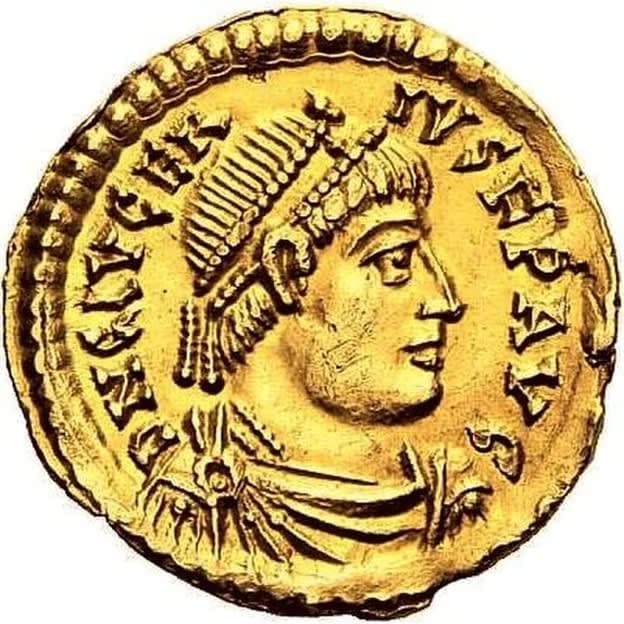
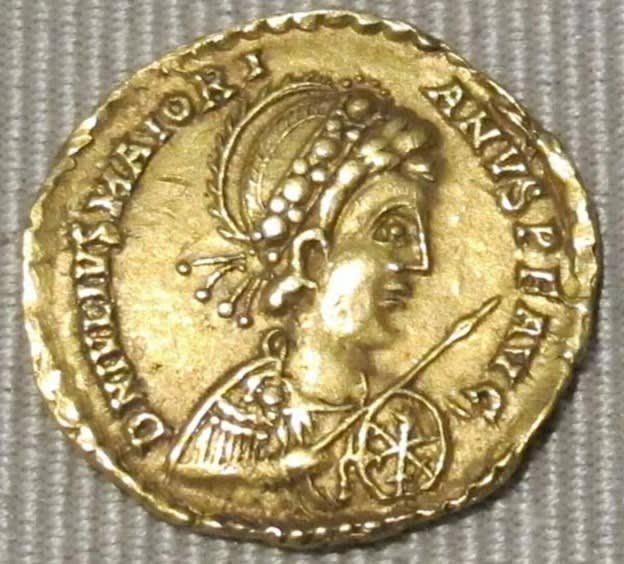
Almost all surviving coins from his reign were minted at Mediolanum, modern Milan, and Ravenna.
These coins are particularly interesting.
The emperor’s portrait was rendered in an archaic style reminiscent of coinage from a century earlier, while the reverse traditionally depicted the monarch standing frontally, holding a cross-topped sceptre and a statuette of Victory on a globe — symbols of imperial permanence in which few people still truly believed.
Magnus Felix Ennodius, in his biography of Bishop Epiphanius of Pavia, reports that Glycerius undertook “many measures for the public good,” although he provides only one specific example.
At the bishop’s request, the emperor generously compensated the bishop’s mother for damage caused by certain imperial subjects.
The only surviving law issued by Glycerius is dated 11 March 473.
Addressed to Himilco, Praetorian Prefect of Italy, it was directed firmly against simony, the sale of ecclesiastical offices.
Interestingly, the law was willingly adopted by the Praetorian Prefects of Illyricum and the East, even though Glycerius had no legal authority over the Eastern emperor’s territories.
The historian Ralph Mathisen interprets this as a shrewd political maneuver.
By issuing such a conspicuously pious law, Glycerius not only sought the approval of the powerful Church but also desperately attempted to build bridges with Constantinople by demonstrating ideological unity with Eastern imperial policy.
The foreign-policy situation gave Glycerius no time to consolidate his rule.
In 473, Italy faced two deadly threats almost simultaneously.
The first came from the Visigoths.
Their ambitious king Euric ordered a massive invasion of the Italian Peninsula.
The campaign was led by the commander Vincentius, who, according to the Gallic Chronicle of 511, held the high military rank of magister.
It appeared that Italy was about to face another devastating invasion, but Glycerius reacted with remarkable speed.
The imperial commanders Alla and Sindila inflicted a crushing defeat on Vincentius, who was killed in battle.
Italy was saved, although the empire paid for the victory by losing the Gallic cities of Arelate, modern Arles, and Massilia, modern Marseille, which were captured by the Visigoths that same year.
They would later be briefly recovered by Glycerius’s successor.

Barely had the dust settled from the fighting with the Visigoths when an even more dangerous threat approached from the east — the Ostrogoths.
Their history had become closely intertwined with Rome’s fate as early as 454, when, following the collapse of the Hunnic Empire, the Eastern emperor Marcian allowed three Gothic brothers — Valamir, Theodemir, and Vidimir — to settle in northern Pannonia.
After plundering the lands of Illyricum, the Ostrogoths had occupied territories along the middle Danube by 469.
Following the death of Theodemir, his ambitious son Theodoric, the future great king of Italy, led part of the people southward to conquer Lower Moesia.
Another section of the Gothic population, led by Vidimir, abandoned its previous settlements and marched directly toward Italy.

Glycerius’s political intelligence revealed itself most clearly in this crisis.
He calculated the catastrophic scenario with remarkable precision.
If Vidimir’s Ostrogoths joined forces with the surviving elements of Vincentius’s Visigothic army, the empire might collapse entirely.
Ravenna had no military resources for a war on two fronts.
Glycerius therefore turned to subtle diplomacy supported by gold.
He sent an embassy to Vidimir and presented the king with an enormous payment of 2,000 solidi.
According to Jordanes, the emperor persuaded the Ostrogoths to leave Italy for Gaul, telling them that their relatives, the Visigoths, ruled nearby.
Vidimir accepted the gifts and marched into Gaul, where his people eventually merged with the Visigoths.
Through this sophisticated diplomatic maneuver, Glycerius saved Italy from devastation without shedding a single drop of Roman blood.
Despite his military and diplomatic successes, the Eastern Empire continued to regard Glycerius as an illegitimate usurper.
Leo I Macella viewed him merely as an obedient puppet of the barbarian Gundobad and categorically refused to recognize him.
Constantinople selected its own candidate — Julius Nepos, magister militum of Dalmatia and nephew by marriage of Aelia Verina, the wife of Leo I.

Only the severe winter and the closure of Mediterranean ports to navigation prevented Nepos from attacking Italy immediately.
Soon afterward, on 18 January 474, Leo I died.
Power passed to his young grandson Leo II, who appointed his father Zeno as co-emperor.
The change of government in the East brought no relief to Glycerius.
Zeno likewise firmly denied any legitimacy to his claim to the Western throne.
Until the very end, Glycerius attempted to avoid confrontation.
As a gesture of reconciliation, he even declined to appoint a second Western consul for 474, leaving the young Leo II as the sole consul of the entire Roman Empire.
The gesture was not appreciated.

In the spring of 474, Julius Nepos’s fleet crossed the Adriatic.
Aware of the danger, Glycerius moved from Ravenna to Rome.
His determination to resist is suggested by a small silver coin minted in Rome.
The obverse bore the inscription:
“D N GLYCERIUS P F AUG”
while the reverse carried:
“VICTORIA AUGGG” — “Victory of the Augusti.”
The three letters “G” symbolized three supposedly equal emperors: Glycerius, Zeno, and Leo II.
It was a desperate political manifesto asserting the legitimacy of his rule.
Glycerius’s cause, however, was doomed.
Between 19 and 24 June 474, the forces of Julius Nepos landed at Ostia.
Glycerius surrendered without offering any resistance.
Why did an emperor supposedly backed by Gundobad’s army not even attempt to fight?
Historians generally see the answer in Glycerius’s profound political isolation.
Constantinople had declared him an enemy, while neither the Roman Senate nor the Gallo-Roman aristocracy offered him meaningful support.
Gundobad himself was absent from Italy at the decisive moment.
Some historians suggest that he had travelled to Gaul to gather reinforcements.
Another possibility is more convincing: after the death of his father, the Burgundian king Gundioc, Gundobad hurried home to participate in a bitter succession struggle against his three brothers — Godomar, Chilperic, and Godegisel.
Deprived of both an army and allies, Glycerius was left alone against his opponent.
The overthrow was bloodless.
Julius Nepos spared Glycerius’s life but permanently removed him from the political stage.
According to the Anonymous Valesianus, John of Antioch, Evagrius Scholasticus, and the Fasti Vindobonenses Priores, the deposed monarch was sent to Dalmatia and ordained bishop of Salona.
Jordanes incorrectly claimed that he became bishop of Ostia.
The fate of Glycerius therefore closely resembled that of Emperor Eparchius Avitus, who some twenty years earlier had likewise been deposed and forced into the episcopate at Placentia.

Glycerius quietly settled in Salona and devoted himself to the service of God.
In 475, Julius Nepos himself fell victim to a coup organized by the magister militum Flavius Orestes.
In an ironic twist of fate, the deposed Nepos fled to the very same Salona where the Glycerius he had overthrown was already living in exile.
Nepos remained there until 480, surviving even the collapse of the Western Roman Empire in 476, when Orestes’s son Romulus Augustus was deposed by Odoacer, leader of the Heruli.

In 480, Julius Nepos was treacherously murdered by two of his own officials, Viator and Ovida.
The Byzantine historian Malchus of Philadelphia, whose works survive through the writings of Patriarch Photius, makes a disturbing accusation.
He claims that the true organizer of the conspiracy and murder of Nepos was none other than Bishop Glycerius, perhaps acting in the interests of Odoacer, ruler of Italy.
In the cynical and brutal political world of the age, where betrayal had become commonplace, the revenge of a former emperor against the man who had overthrown him would hardly have been inconceivable.
Later rumors claimed that Odoacer rewarded Glycerius by appointing him to the prestigious position of Archbishop of Mediolanum.
The only weak evidence for this claim comes from the writings of Bishop Ennodius, where the name “Glycerius” appears in a list of Milanese bishops between Martinianus and Lazarus.
Most historians, however, regard this as merely a coincidence and believe that Flavius Glycerius quietly ended his life within his diocese at Salona.


