
Temüjin was born in the Delüün-Boldog area, on the banks of the Onon River, into the family of Yesügei-Bagatur of the Borjigin clan and his wife Höelun of the Olkhonud clan, whom Yesügei had once taken from the Merkit Yeke-Čiledü. The boy was named after the Tatar chieftain Temüjin-Üge, whom Yesügei had defeated on the eve of his son's birth. According to legend, the newborn clutched a clot of blood in his fist — a sinister yet fateful sign foretelling the boy’s great future.
When Temüjin was nine years old, his father betrothed him to ten-year-old Börte from the Onggirat clan, leaving his son to live with the bride’s family until he came of age. On the way back, however, Yesügei stopped at a Tatar encampment, where he was poisoned, and three days after returning home, he died.
The death of the family head marked the beginning of harsh years for young Temüjin. Yesügei’s supporters, and later Targutai-Kiriltukh, chieftain of the Tayichi’ut, abandoned the widows and children, taking away their livestock and driving them from their homeland. For several years, the family wandered the steppe in poverty, surviving on roots and game. It was during this time that enmity arose between Temüjin, his brother Khasar, and his half-brother Begter. The conflict stemmed from Begter taking all the food the brothers found. No longer willing to give everything to Begter, Temüjin conspired with Khasar to lure him into a trap and killed him.
Begter’s murder gave their enemies a convenient pretext to pursue Temüjin. He was soon captured by the Tayichi’ut, who shackled him in a wooden collar. However, by showing cunning, Temüjin escaped, hiding in a lake, aided by a servant, Sorgan-Shira. Sorgan’s sons concealed the fugitive in a cart of wool and later sent him home. This family would later enjoy special status in the empire, and Chilaun, Sorgan’s son, became one of Genghis Khan’s four nökörs.
At the age of eleven, Temüjin befriended Jamukha, future leader of the Jadaran, and twice became his sworn blood-brother (anda). Several years later, he married Börte, receiving as dowry a luxurious sable coat. With this gift, he went to Tooril, khan of the Kereit and anda of his father, securing the support of this influential ruler.

With Tooril’s support, Temüjin’s forces began to grow. He gathered nökörs around him, conducted successful raids, and preferred to recruit captured enemies into his service rather than destroy them. His first serious challenge came in a war with the Merkits, who, in Temüjin’s absence, abducted Börte and Yesügei’s second wife, Sochikhel. In 1184, with the help of Tooril and Jamukha, Temüjin defeated the Merkits and recovered Börte, though Sochikhel refused to return.
After the victory, Tooril returned to his own horde, while Temüjin and Jamukha lived together again, renewing their anda alliance. They exchanged golden belts and horses, but their unity was short-lived. Within six months to a year, their paths diverged. Some of Jamukha’s noyons and nökörs joined Temüjin, becoming one of the causes of future enmity.
Separated from Jamukha, Temüjin began building his own ulus. In the khan’s camp, important posts were given to Boorchu and Jelme, while command of the army went to Subutai-Bagatur — the future famous general. Around this time, Temüjin’s second son Chagatai (exact date unknown) and third son Ögedei (October 1186) were born. He formed his first ulus around 1186 (some say 1189/1190), commanding three tumens — about 30,000 warriors.
Jamukha sought a pretext for open war, which came with the death of his younger brother Taichar, killed while attempting to steal horses from Temüjin’s lands. Gathering three tumens, Jamukha went to war. The battle near the Gulegu mountains, between the headwaters of the Sengur River and the upper Onon, ended in Temüjin’s defeat.
Temüjin’s first major undertaking after this defeat was a campaign against the Tatars in alliance with Tooril-khan. In 1196, the combined forces of the Kereit, Temüjin’s army, and the Jurchens of the Jin dynasty dealt several crushing blows to the Tatars, bringing rich spoils. The Jin granted Tooril the title “Wang” (prince) and Temüjin the title “Jautkhuri” (military commissioner). From then on, Tooril became known as Wang Khan, and Temüjin was considered his vassal.
In 1197–1198, Wang Khan raided the Merkits without Temüjin’s participation and kept all the spoils, straining relations. After 1198, when the Jin weakened in Eastern Mongolia, Temüjin seized their eastern territories.
In 1199, taking advantage of the death of Inanch-khan and the split of the Naiman into two uluses — Buyuruk-khan (Altai) and Tayang-khan (Black Irtysh) — Temüjin, Wang Khan, and Jamukha campaigned against Buyuruk and defeated him. On the return, a Naiman detachment blocked their way. At night, Wang Khan and Jamukha abandoned the camp, hoping Temüjin would perish. Learning of the betrayal, Temüjin withdrew without fighting. The Naiman, instead of pursuing him, attacked the Kereit, putting Wang Khan in a desperate situation. He asked Temüjin for help, and Temüjin sent nökörs. In the ensuing battle, Boorchu, Mukhali, Borokhül, and Chilaun distinguished themselves. In gratitude, Wang Khan bequeathed his ulus to Temüjin.
In 1200, Wang Khan and Temüjin launched a joint campaign against the Tayichi’ut, supported by the Merkits. Temüjin was seriously wounded by an arrow, but Jelme tended to him all night. Among the captives was Sorgan-Shira — the man who had once saved Temüjin — and a skilled archer named Jirgoadai, who admitted to shooting the arrow. Instead of executing him, Temüjin accepted him into his army, giving him the name Jebe (“arrowhead”). The Tayichi’ut were pursued, many killed, and the rest taken into service. This was Temüjin’s first major independent victory.
In 1201, the Tatars, Tayichi’ut, Merkits, Oirats, and others united against Temüjin, proclaiming Jamukha as gur-khan. Temüjin again sought Wang Khan’s help, and he came with an army.
In 1202, Temüjin campaigned alone against the Tatars. Before battle, he ordered, under pain of death, that no one take spoils until the fight was over. Relatives — Altan, Daritai-otchiqin, and Khuchar — broke the order, looting early. Angered, Temüjin sent Jebe and Khubilai to take back the goods.
The victory over the Tatars ended with a decision to execute all adult males, sparing only children below the height of a cart wheel — revenge for ancient killings of Mongol ancestors, including Yesügei. But Temüjin’s brother Belgütei revealed the plan to a Tatar named Tseren-Eke. Warned, the Tatars armed themselves, inflicting heavy losses. From then on, Belgütei was barred from family councils.
In spring 1203, at Kharkhaljit-Elet, Temüjin’s forces clashed with the united armies of Jamukha and Wang Khan. Wang Khan did not want war, but was persuaded by his son Nilkha-Sangum and Jamukha. After a battle in which Wang Khan’s son was wounded, the Kereit left the field. Soon after, Temüjin struck swiftly and, in autumn 1203, completely destroyed the Kereit. Wang Khan’s ulus ceased to exist; the khan himself died, and Nilkha-Sangum was later killed by the Uighurs.
In 1204, Jamukha joined the Naiman. Temüjin, after a military reform, marched with 45,000 horsemen. In battle, the Naiman were defeated, Tayang-khan was killed, and his son Küchlüg fled to Buyuruk in the Altai.
Pushing forward, Temüjin campaigned against the Merkits. In spring 1205, on the Bukhtarma River, he defeated the combined forces of Küchlüg and Toqto’a-beki. Toqto’a-beki was killed, and much of his army drowned in the Irtysh. Küchlüg fled to the Qara-Khitai, soon becoming a prominent figure there.
After the Naiman defeat, most of Jamukha’s followers joined Temüjin. In autumn 1205, Jamukha himself was betrayed by his own nökörs. Temüjin offered him mercy, but Jamukha refused, saying: “As there is room in the sky for only one sun, so in Mongolia there should be only one ruler.” He asked for an honorable death without bloodshed, and Temüjin’s warriors broke his back.
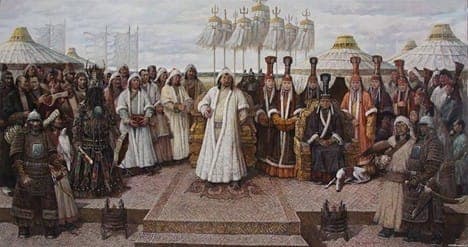
In spring 1206, at the sources of the Onon River, a great kurultai was held, proclaiming Temüjin the Great Khan of all Mongols and giving him the name Genghis Khan.
He established the Yassa — a code of laws in which loyalty, mutual aid, and courage were the highest virtues, while cowardice and treachery were the worst crimes. Offenders were executed, but even enemies who had remained loyal to their lord were spared.
Genghis Khan reorganized the people into tens, hundreds, thousands, and tumens, mixing clans, and appointed commanders from among his loyal companions. All men were considered warriors.
A personal guard unit, the keshik, was created, as well as a vanguard corps of heroes (baghatur). A courier system and intelligence service were organized. The state was divided into two wings: the right led by Boorchu, the left by Mukhali.
Thus, by 1206, a unified Mongol state had been fully formed, and Genghis Khan became its sole ruler.



