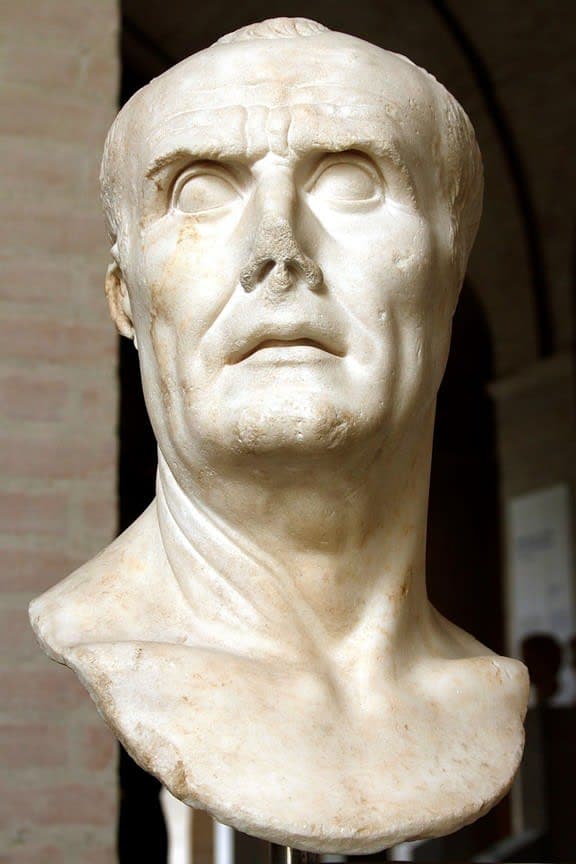

The story of Gaius Marius begins in the shadow of the Apennine Mountains, in the small village of Cereatae near the town of Arpinum. He was born around 158–157 BC into a family whose origin is still a matter of debate. The hostile tradition, preserved by Plutarch, portrayed Marius as a simple peasant, an honest laborer, almost a ploughman, who “became acquainted with city life late.” However, modern historians see this rather as a rhetorical image of a “new man.” In reality, Marius most likely belonged to the equestrian order — the local aristocracy, which had ties with the influential Roman houses of the Herennii and the Caecilii Metelli.

The young Gaius Marius did not receive the refined Greek education that was considered obligatory for a Roman noble. He did not know the language of Hellas and preserved a stern indifference toward it until the end of his days, believing that it was “absurd to learn the language of a people living in slavery.” His school was military service. His mind, untouched by Greek sophistry, was forged in campaigns and camp life, which later allowed him to become the ideal opposite of the pampered capital nobility.
Marius’ military path began when his age barely allowed him to bear arms — around 141 BC. However, his talent was fully revealed under the walls of Numantia in 134–133 BC. There he found himself in the close circle of the great Scipio Aemilianus. Marius quickly won the respect of the stern commander through his discipline and courage. Legend says that once, at a feast, Scipio was asked whether Rome would ever have another defender equal to him. Slapping Marius, who was lying nearby, on the shoulder, Scipio answered: “There will be one, and perhaps even this man.”

These words became a prophecy. In that same camp, Marius made acquaintances with the future leaders of the age: Gaius Gracchus and even the young Numidian prince Jugurtha, with whom fate would later bring him face to face on the battlefield. After the war, Marius was elected military tribune — no one knew him by sight, but all the tribes voted for him, having heard of his exploits.
The civil career of the “new man” was difficult. Marius failed in local elections in Arpinum, but he did not give up and achieved the quaestorship in Rome around 122–121 BC. In 119 BC, with the support of the Metelli, he became tribune of the people. Here his independent character showed itself: he proposed a law that reduced the influence of the nobility on elections, and when the consul Lucius Caecilius tried to resist, Marius threatened to send his own patron to prison. But at the same time, he opposed grain distributions to the plebs, earning a reputation as a politician who sought no one’s favor.
In 116 BC, he became praetor with difficulty, barely defending himself against accusations of bribery, and was then sent as propraetor to Further Spain. There he successfully suppressed bandit movements, hardening his character and accumulating resources. The most important step toward power was his marriage to Julia, a representative of an ancient, though impoverished, patrician family. This union introduced Marius into high society and later connected him with the family of the future Caesars.
In 109 BC, Marius went to Numidia as a legate under Quintus Caecilius Metellus. While Metellus conducted the war slowly and methodically, Marius won the hearts of the soldiers, sharing all their hardships, digging trenches, and eating the same food. He understood that victory in this war was his key to the consulship.
The conflict with Metellus broke out when Marius asked to be released for the elections in Rome. Metellus contemptuously replied that Gaius should wait for the elections together with his own young son — that is, for another twenty years. Enraged, Marius began agitation against the commander, accusing him of dragging out the war. Arriving in Rome just two weeks before the elections, he won a triumphant victory. In 107 BC, Gaius Marius became consul for the first time.
It was then that he carried out his main reform: faced with a shortage of recruits, he opened the doors of the army to the “proletarii” — propertyless citizens. The army was transformed from a militia of landowners into a professional force personally loyal to the commander, who promised them booty and land.


Marius completed the war in Numidia in 105 BC, capturing the cities of Capsa and Cirta. However, the final point was put by his quaestor — Lucius Cornelius Sulla, who achieved the surrender of Jugurtha from the Mauretanian king Bocchus through diplomacy. This success of Sulla planted the seeds of future hatred between the two leaders.
While Marius celebrated his triumph over Jugurtha on January 1, 104 BC, Rome trembled with terror. The tribes of the Cimbri and the Teutones had destroyed two Roman armies at the Battle of Arausio. Italy was defenseless. In violation of all laws, Marius was elected consul five times in a row, from 104 to 100 BC.
He turned his legions into a well-oiled machine. The soldiers, who carried all their baggage on themselves, received the nickname “Marius’ mules.” In 102 BC, at Aquae Sextiae, Marius almost completely destroyed the tribe of the Teutones. According to legend, when the barbarians passed by his camp for six days, they mockingly asked the Romans what they should tell their wives in Rome. Marius answered them on the battlefield.
In 101 BC, at the Battle of Vercellae, together with his colleague Catulus, he crushed the Cimbri. The massacre was monstrous; the barbarians were destroyed. Marius returned to Rome as a hero, the “third founder of Rome” after Romulus and Camillus. Libations were made to him as to a god.


Marius did not merely recruit the poor — he changed the very structure of the legion.
Cohorts: Instead of small maniples, the legion began to be divided into 10 powerful cohorts.
Symbolism: Each legion received a silver eagle as its sacred symbol.
Pilum: Marius replaced one of the iron pins in the head of the spear with a wooden peg. When it struck a shield, the peg broke, the spear bent and became stuck, making it useless for the enemy and preventing it from being thrown back.

Peaceful life proved more difficult for Marius than war. In 100 BC, he formed an alliance with the radical tribune Saturninus in order to secure land for his veterans. But when Saturninus turned to open violence, the Senate ordered Marius to suppress the revolt of his own ally. Marius obeyed and locked Saturninus in the Curia, but the crowd pelted the rebels with roof tiles. This episode deprived Marius of the support of both the people and the nobility.
Throughout the 90s BC, he remained in the shadows, unsuccessfully trying to provoke a war in the East with Mithridates in order to return to power. Even during the Social War in 90 BC, he was not given supreme command, because people feared his renewed rise.

In 88 BC, the struggle for command against Mithridates led to an open clash with Sulla. The tribune Sulpicius Rufus passed a law transferring authority to Marius, but Sulla took an unprecedented step — he led his legions against Rome. Marius, declared an enemy of the state, fled.
His wanderings became legendary: he hid in the marshes of Minturnae and was found naked and filthy. When a barbarian executioner entered his prison cell, Marius shouted: “Do you dare to kill Gaius Marius?” The executioner fled in terror. Marius crossed over to Africa, where, sitting among the ruins of Carthage, he compared his fate with that of the fallen city.
In 87 BC, when Sulla went to the East, Marius returned to Italy, joining forces with the consul Cinna. They took Rome by storm. Marius unleashed terror in the city: the heads of his enemies, including Octavius and Catulus, were displayed in the Forum. He became consul for the seventh time in 86 BC, but ruled for only a few days. Old age, illness, and nightmares broke him. On January 13, 86 BC, Gaius Marius died, imagining in his deathbed delirium that he was leading an army against Mithridates.
Years later, Sulla, having returned to Rome, would order his remains to be dug up and thrown into the River Anio, but he would not be able to cast out from history the memory of the man who created Rome’s professional army.


