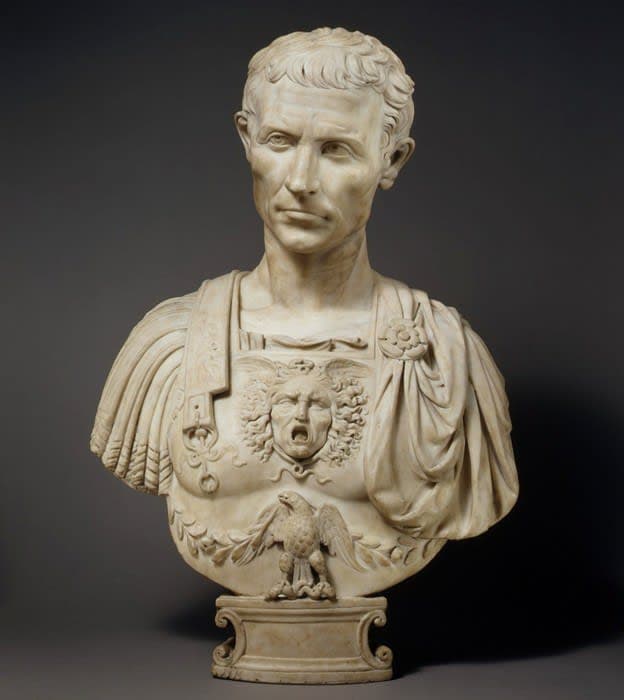

There is no single agreed date for Caesar’s birthday: some sources give 12 July, others 13 July, 100 BCE.
Caesar’s childhood was spent in the Subura, a Roman district with a less-than-stellar reputation. He received a home education, studying Greek, literature, and rhetoric. He also trained physically swimming and horseback riding. One of his teachers was the renowned rhetorician Gnipho, who also taught Cicero. At about age 15, in 85 BCE, Caesar lost his father and, since all his older male relatives had already died, he effectively became head of his clan. Soon after, he was betrothed to Cossutia, a girl from a wealthy equestrian family.

In the mid-80s BCE the influential politician Cinna nominated Caesar to the honorable but highly restrictive priesthood of flamen Dialis (priest of Jupiter). To accept, Caesar had to break his engagement to Cossutia and marry Cinna’s daughter, Cornelia. He agreed, but the investiture never happened because the pontifex maximus Quintus Mucius Scaevola, an opponent of Cinna, refused to conduct the ceremony.
Soon after the wedding Cinna was killed and the dictator Lucius Cornelius Sulla seized power in Rome. Sulla began mass proscriptions, and Caesar’s life was in danger. Sulla demanded he divorce Cornelia, but Gaius flatly refused. His name was entered on the proscription lists, and he was forced to flee Rome. He survived only thanks to the intercession of influential relatives and to Sulla’s reluctance to execute patricians.

Leaving Italy, Caesar went to the province of Asia, where he joined the staff of the governor Marcus Minucius Thermus. His first important assignment was negotiations with Nicomedes IV, king of Bithynia. Caesar successfully persuaded the king to provide a fleet to fight the city of Mytilene. After the capture of the city, in which he took part, Caesar was awarded the civic crown, one of Rome’s highest military honors. His stay at Nicomedes’ court later gave rise to many rumors.
In 78 BCE, upon learning of Sulla’s death, Caesar immediately returned to Rome.
Back in Rome, Caesar became active in politics, bringing accusations against Sullan supporters. In 77 BCE he prosecuted Gnaeus Cornelius Dolabella for extortion. Although Dolabella was acquitted, Caesar’s speech was so powerful that it circulated in manuscript copies for a long time.
To improve his oratorical skills Caesar went to Rhodes to study with the famous rhetorician Apollonius Molon. On the way he was captured by Cilician pirates, who demanded a huge ransom of 50 talents. After he was ransomed, Caesar raised a squadron, seized the pirates, and despite the governor’s refusal to try them had them crucified. Ancient authors note that he ordered them to be killed first and only then crucified, which historians consider an act of mercy.
In 74 BCE Caesar returned to Rome and was admitted to the priestly college of pontifices. A few years later, in 69 BCE, he became quaestor in the province of Further Spain, which gave him a seat in the Senate. That same year his wife Cornelia and his aunt Julia died. At their funerals Caesar delivered two speeches, attracting widespread attention. During the eulogy for Julia, he showed the public a wax bust of her husband, Gaius Marius, whom Sulla had consigned to oblivion.
Soon Caesar married Pompeia, Sulla’s granddaughter, and began openly supporting Gnaeus Pompeius Magnus (Pompey the Great), being the only senator to back the law granting Pompey extraordinary powers to fight the pirates.

In 65 BCE, as curule aedile, Caesar became famous for staging incredibly lavish games that impressed even jaded Romans. He shared the costs with his colleague Marcus Calpurnius Bibulus, but all the glory went to him. He also restored all of Gaius Marius’s trophies, which Sulla had banned.
In 64 BCE Caesar presided over a standing criminal court and convicted many participants in Sulla’s proscriptions, despite the dictator’s law that protected them. During this period his chief creditor became Marcus Licinius Crassus, as the young politician was generous in his spending.
After the death of the pontifex maximus Quintus Caecilius Metellus Pius, Caesar put himself forward for this highest priestly office. He invested enormous sums in bribing voters and, according to legend, told his mother before the election: “Today, mother, you will see your son either as pontifex maximus or as an exile.” He won by a large margin, and this lifetime appointment guaranteed him a successful political career.
In 63 BCE Lucius Sergius Catilina (Catiline) attempted his famous seizure of power. Although some sources linked Caesar to the conspiracy, no reliable evidence was ever found. Historians believe that by this time Caesar already had legal avenues to achieve his aims and had no interest in participating in a coup.
At the Senate meeting to decide the conspirators’ fate, Caesar spoke against the death penalty, proposing life imprisonment an unusual punishment for Romans. However, after a persuasive speech by Marcus Porcius Cato the Younger, who hinted at Caesar’s complicity, the Senate voted for execution.


In December 62 BCE a scandal threatened Caesar’s reputation. During the festival of the Bona Dea, which only women could attend, a man named Publius Clodius Pulcher infiltrated Caesar’s house. Rumor had it he had come to Caesar’s wife, Pompeia. Without waiting for a verdict, Caesar divorced her. In court, when asked for his reasons, he uttered the famous line: “Caesar’s wife must be above suspicion.” Clodius was ultimately acquitted because Caesar refused to testify against him. Historians suppose he did not wish to make an enemy of the rapidly rising politician.
At the beginning of 61 BCE Caesar was to go to Further Spain as propraetor. But his many creditors, to whom he owed vast sums, tried to prevent him from leaving Rome until he repaid them. The situation was saved by his influential friend and patron Marcus Licinius Crassus, who stood surety for him for the colossal amount of 830 talents. Thanks to this, Caesar was able to depart.
Passing through a poor village, he reportedly said he “would rather be first here than second in Rome,” showing ambitions far beyond a conventional political career.
On arriving in Spain, Caesar immediately took action. He raised a levy among the locals and led it against disaffected tribes in the north and northeast of the province. Dio Cassius wrote that Caesar sought military victories to rival Pompey’s fame. He besieged mountain tribes in the Herminian range and forced them back to the Atlantic. After a failed landing from rafts, he summoned a fleet from Gades, defeated the enemy, and was hailed as imperator by his soldiers an honorary title for a victorious commander.

After the fighting Caesar undertook administrative reforms. He revised taxation, easing the burden on residents, and decreed those creditors could not collect from debtors more than two-thirds of their annual income. This helped resolve the province’s debt crisis without violating creditors’ rights. Some sources claim he extorted money from locals, but these rumors are likely untrue, as no one accused him of extortion upon his return to Rome.
Leaving the province early, at the start of 60 BCE, Caesar significantly improved his finances and could settle his debts. Seeing his success, his creditors were ready to extend new loans, believing in his political future.
For his victories in Spain Caesar was granted a triumph. But to stand in the next year’s consular elections he had to be physically present in Rome, while a triumphator could not enter the city before the ceremony. Caesar asked the Senate to allow him to register his candidacy in absentia, but his opponent, Cato the Younger, filibustered with a lengthy speech to block the vote. In the end Caesar renounced the triumph and entered the city, choosing the consulship over the triumph.
Around the same time, he formed a secret political alliance with Rome’s two most influential men, Gnaeus Pompey the Great and Marcus Licinius Crassus. This alliance is known as the First Triumvirate. Pompey needed support to ratify his eastern settlements and to obtain land for his veterans; Crassus wanted tax relief for his publican allies; Caesar gained the backing necessary for reforms and advancement. Historians disagree on the alliance’s date, but it clearly aimed against the Senate.
Despite longstanding enmity between Pompey and Crassus, Caesar reconciled them. The alliance was unofficial and carefully concealed, which explains the lack of a precise creation date in the sources.
From the outset of his consulship in 59 BCE Caesar showed resolve. He ordered the daily publication of the minutes of Senate and popular assembly meetings so citizens could monitor political actions.
He soon proposed an agrarian law to grant land to Pompey’s veterans and the urban poor. The bill was moderate, since land was to be purchased from willing sellers, not confiscated. But the other consul, Bibulus, and his supporters led by Cato opposed it, fearing Caesar’s rising popularity. During the vote in the Forum a brawl erupted, Bibulus and his lictors were beaten, and Bibulus then shut himself in his house and tried to declare Caesar’s laws invalid, citing unfavorable omens, to no avail.
Caesar also passed other laws favoring the triumvirs: Pompey’s eastern settlements were ratified and taxes reduced for Crassus’s contractors. In addition, an extortion law was adopted that became the basis for later provincial governance laws. Finally, Caesar secured for himself the governorship of Cisalpine Gaul and Illyricum for an unprecedented five years, and later also Transalpine (Narbonese) Gaul.

In the autumn of 59 BCE a scandal broke when one Lucius Vettius claimed that a plot was being prepared against Pompey and Caesar. Though his testimony was contradictory and Vettius was soon found dead in prison, Caesar used the incident to strengthen his position. Despite these successes, by year’s end the triumvirs’ popularity had fallen, as they had come to dominate all political life in Rome, which was unpopular.
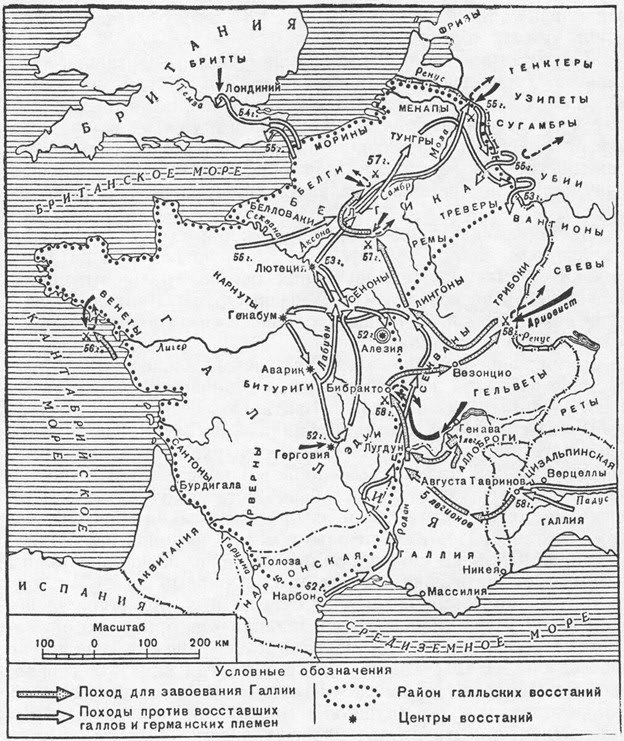
At the beginning of his proconsulship, in late March 58 BCE, Caesar arrived in Gaul to take up his provinces, only to be drawn immediately into large-scale war. His first task was to prevent the Celtic tribe of the Helvetii from migrating into Roman territory. He blocked them and, when they invaded the lands of Rome’s allies, pursued and defeated them. In the same year he defeated the Germanic leader Ariovistus, who was trying to entrench himself on the left bank of the Rhine.

In 57 BCE Caesar, without formal pretext, launched war against the Belgae in northeastern Gaul, defeating them at the Axona and the Sabis. The following year the subdued tribes revolted, and Caesar had to divide his forces among his legates. He himself, after meeting with the triumvirs at Luca, returned to lead the offensive against the rebels. The Romans won a series of victories, and a fleet under Decimus Brutus destroyed the enemy navy.
In 55 BCE Caesar routed Germanic tribes that had crossed the Rhine and even made a brief expedition into Germania, building a 400-meter bridge over the river in only ten days. Later that year he undertook the first Roman reconnaissance expedition to Britain. Although it did not yield decisive results due to inadequate preparation, he organized a second expedition the next year. On returning to Gaul the Roman army faced a Belgic uprising that destroyed one legion. In response, Caesar carried out punitive campaigns and launched another foray into Germania.
In early 52 BCE most, Gallic tribes united under the talented leader Vercingetorix. Cut off from his main forces, Caesar outmaneuvered Vercingetorix to reunite with his troops, then began a methodical siege of Gallic strongholds. At the decisive Battle of Alesia, he blockaded Vercingetorix in a well-fortified town and then defeated the Gallic relief army. It was one of Caesar’s most impressive victories; Vercingetorix surrendered and the revolt was crushed.

By the end of his proconsulship all Gaul had been subdued, and through trusted men in Rome—Gaius Oppius and Lucius Cornelius Balbus—Caesar stayed constantly informed of events in the capital.
During his proconsulship Caesar faced growing resistance in Rome. The consuls of 56 BCE sought to strip him of his command, and Lucius Domitius Ahenobarbus, an implacable opponent, became the main claimant to his provinces.
In mid-April 56 BCE the triumvirs met at Luca to plan their next steps. They agreed that Pompey and Crassus would again be consuls to keep their enemies from power. In return they promised Caesar a five-year extension of his proconsular authority.
The meeting resulted in Pompey and Crassus becoming consuls in 55 BCE. They kept their promises: Caesar’s command was extended for five years, Pompey received Spain, and Crassus Syria. However, in 54 BCE Julia, Caesar’s daughter and Pompey’s wife, died; and in 53 BCE Crassus was killed at the Battle of Carrhae. His death delivered a decisive blow to the triumvirate, since his wealth and influence had balanced tensions between Pompey and Caesar.

The situation in Rome grew tense. In 52 BCE Pompey was elected sole consul, granting him extraordinary powers. He initiated laws aimed against Caesar, though he allowed Caesar to run for the consulship in absentia. Soon, however, Pompey introduced an amendment that effectively nullified this permission.
By the end of his proconsulship Caesar was in peril. He faced prosecution in Rome, and his enemies, led by Cato and Lucius Domitius Ahenobarbus, sought to strip him of command and force him to return as a private citizen without immunity.
By 50 BCE open conflict between Caesar and Pompey was evident. From Gaul, Caesar made several attempts to negotiate with the Senate, offering mutual concessions. He was willing to give up Narbonese Gaul and retain only two legions, provided his immunity and the right to run in absentia were guaranteed. The Senate refused.
On 1 January 49 BCE a letter from Caesar was read in Rome in which he declared his resolve to defend his rights. The Senate responded that Caesar would be considered an enemy of the state if he did not relinquish his command. His allies, the tribunes of the plebs Mark Antony and Quintus Cassius Longinus, vetoed the decree. Soon, however, they were warned that their safety could not be guaranteed and fled Rome to Caesar’s camp symbolizing a complete break with the Senate.
On 7 January the ultimate decree (senatus consultum ultimum) was issued, calling citizens to arms. Although Caesar had only a single legion, he decided to act without waiting for reinforcements. He was ready for civil war.
After being declared an enemy, Caesar assembled his only legion, the XIIIth, and, addressing his soldiers, convinced them of the justice of his cause. Around 10 January 49 BCE he crossed the border river Rubicon and marched on Rome. Tradition holds that he then uttered the famous phrase: “The die is cast!” (Alea iacta est!).
Caesar’s actions were swift and unexpected. He immediately seized Ariminum and pushed south, meeting little resistance. Many towns on his route surrendered without a fight. Pompey’s supporters were unprepared for such speed and lacked unified command. Seeing the situation slipping away, Pompey began preparing to evacuate to Greece. His commander Lucius Domitius Ahenobarbus, trapped in Corfinium, was handed over to Caesar by his own soldiers. Gaius, showing his famous clementia, released Ahenobarbus and his companions a calculated political move to win wavering aristocrats.


On 17 March 49 BCE Pompey successfully evacuated his forces from the port of Brundisium to Greece. Lacking a fleet to pursue, Caesar secured his rear and went to Spain, where seven legions loyal to Pompey were stationed. Before leaving he took control of the state treasury and appointed his supporters Mark Antony and Marcus Aemilius Lepidus to govern Italy and Rome.
On the way to Spain Caesar met resistance at Massilia (Marseille), but unwilling to waste time, he left part of his forces to besiege it. In Spain he faced a Pompeian army stronger than his own. Thanks to skillful maneuvers, Caesar forced the enemy to surrender without a pitched battle. After victory he again showed clemency, discharging all soldiers to their homes and allowing those who wished to join his ranks.
While returning from Spain Caesar learned he had been appointed dictator to hold elections. He used his powers to place his allies in key posts and to pass several important laws, including granting Roman citizenship to residents of certain towns.
At the start of 48 BCE Caesar crossed to Greece to give Pompey a decisive battle. His army suffered great hardships shortages of food, disease, and an enemy superior in numbers. At Dyrrhachium Caesar’s forces were defeated, but Pompey failed to deliver the final blow. According to tradition, after the battle Caesar said: “Today victory would have been theirs, had they a commander to win it.”

After the setback Caesar withdrew to Thessaly to rebuild his forces. There, near Pharsalus, on 9 August 48 BCE, the decisive engagement took place. Despite numerical inferiority, Pompey’s army was utterly defeated. Pompey fled to Egypt, where he was killed on the orders of the local king Ptolemy XIII.
Arriving in Egypt, Caesar was drawn into the dynastic struggle between Ptolemy XIII and his sister Cleopatra. He took Cleopatra’s side; she famously gained access to his headquarters wrapped in a rug. This decision sparked the Alexandrian War, during which Caesar narrowly escaped death. After winning, he placed Cleopatra and her younger brother on the throne and spent several months in Egypt, fueling rumors of their affair and that Caesarion was his son.
Leaving Egypt, Caesar moved to Asia Minor to quell the revolt of Pharnaces II, son of Mithridates VI. He crushed him at the Battle of Zela, after which he coined the famous words: “I came, I saw, I conquered” (Veni, vidi, vici!).
He then went to Africa, where Pompey’s supporters had gathered. On 6 April 46 BCE at the Battle of Thapsus Caesar won a decisive victory. Many Pompeians fled or committed suicide; the most famous, Cato the Younger, took his own life at Utica. After returning to Rome Caesar celebrated four triumphs, though many realized these were victories over Romans.
The civil war ended after the Battle of Munda in Spain on 17 March 45 BCE. In this hard-fought battle Caesar crushed the last Pompeian forces. Afterwards he departed from his policy of clemency and ordered all prisoners executed. He celebrated his fifth triumph the first in history to commemorate Romans’ victory over Romans.


After his victories Caesar began establishing one-man rule, relying on his powers as dictator. He was appointed dictator three times, each time with greater authority.
First he became dictator in 49 BCE to hold elections, serving only 11 days. The second time, in 48 BCE, he was appointed for a year with unlimited powers. The third time, after Thapsus, he was made dictator for ten years—effectively a lifetime appointment. Finally, in early 44 BCE Caesar received the title dictator perpetuus—dictator in perpetuity. Thus he became the first Roman ruler to officially fix indefinite power for himself. He also added the title “Imperator” to his name (Imperator Gaius Iulius Caesar), previously used for victorious generals.
Caesar used the dictatorship to address Rome’s chronic problems, but his drive for lifelong power aroused resentment among the nobility, including former allies. They saw his rule as a threat to republican traditions and feared he sought kingship.
To bolster his sole authority, Caesar actively cultivated the sacralization of his person, giving it divine or sacred status. He skillfully exploited the ancient legend of the Julian clan’s descent from the goddess Venus. In the Forum he built the lavish Temple of Venus Genetrix, proclaiming her the legendary ancestress not only of his family but of all Romans. He also planned a temple to Mars to underscore his link with that god, but did not live to do so.
After Munda in 45 BCE the Senate showered Caesar with unprecedented honors, many with a divine undertone. His statue was set up in the Temple of Jupiter Capitolinus, and on the day after his victory, the festival of Parilia (Rome’s founding day), games were held in his honor as if he were the city’s founder. A statue of him was placed on the rostra, and in the Temple of Quirinus (a deity identified with Romulus) a statue appeared inscribed “To the Unconquered God.”
By early 44 BCE the Senate and the popular assembly granted Caesar new privileges: the title “Father of the Fatherland” (parens patriae), the right to place his image on coins, and to have oaths sworn by his genius. The month Quintilis was renamed July in his honor, and a new priestly cult was created. All these measures—especially the creation of a priesthood devoted to Caesar placed him alongside the chief gods of the Roman pantheon.
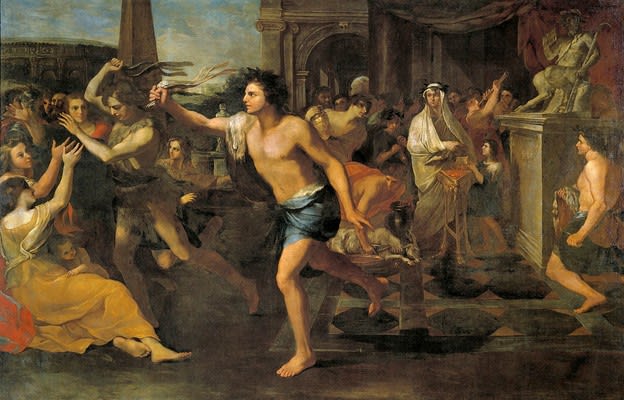
Despite these honors, Caesar stubbornly rejected the title rex (“king”), hated by Romans since antiquity. On 15 February 44 BCE, at the Lupercalia festival, he publicly refused the royal diadem offered by Mark Antony.

In sacralizing his image, Caesar may have looked to Alexander the Great, who was also deified after his Egyptian campaign.
Using his dictatorial powers, Caesar enacted broad reforms to strengthen the state. He increased the number of senior magistrates (praetors, quaestors, aediles) to involve more men from the provincial aristocracy and the equestrian order in governance. He also claimed the right personally to nominate candidates for high office and expanded the Senate to 900 members.
He sought provincial support by granting Roman citizenship and lowering taxes. He reformed finance, instituting regular gold coinage and, for the first time in Roman history, placing his own portrait on the coins. Caesar limited free grain doles, reducing the number of recipients, and actively promoted colonization, resettling veterans and the poor in new cities such as Carthage and Corinth.
His extensive building program including the new Forum of Caesar and restoration of other structures aimed not only to beautify Rome but also to create jobs.
One of his most important and enduring reforms was the Julian calendar. Devised by the Alexandrian scholar Sosigenes on the basis of the solar year, it consisted of 365 days with an extra day every four years. To correct the lag in the old calendar, the year 46 BCE was lengthened to 445 days. The new calendar, known as the Julian, was used in Europe for sixteen centuries.
Despite his reforms, Caesar’s drive for lifelong power provoked discontent among the Roman aristocracy. In early 44 BCE a conspiracy formed, led by Marcus Junius Brutus and Gaius Cassius Longinus. Alongside them were former Pompeians as well as Caesar’s own associates.
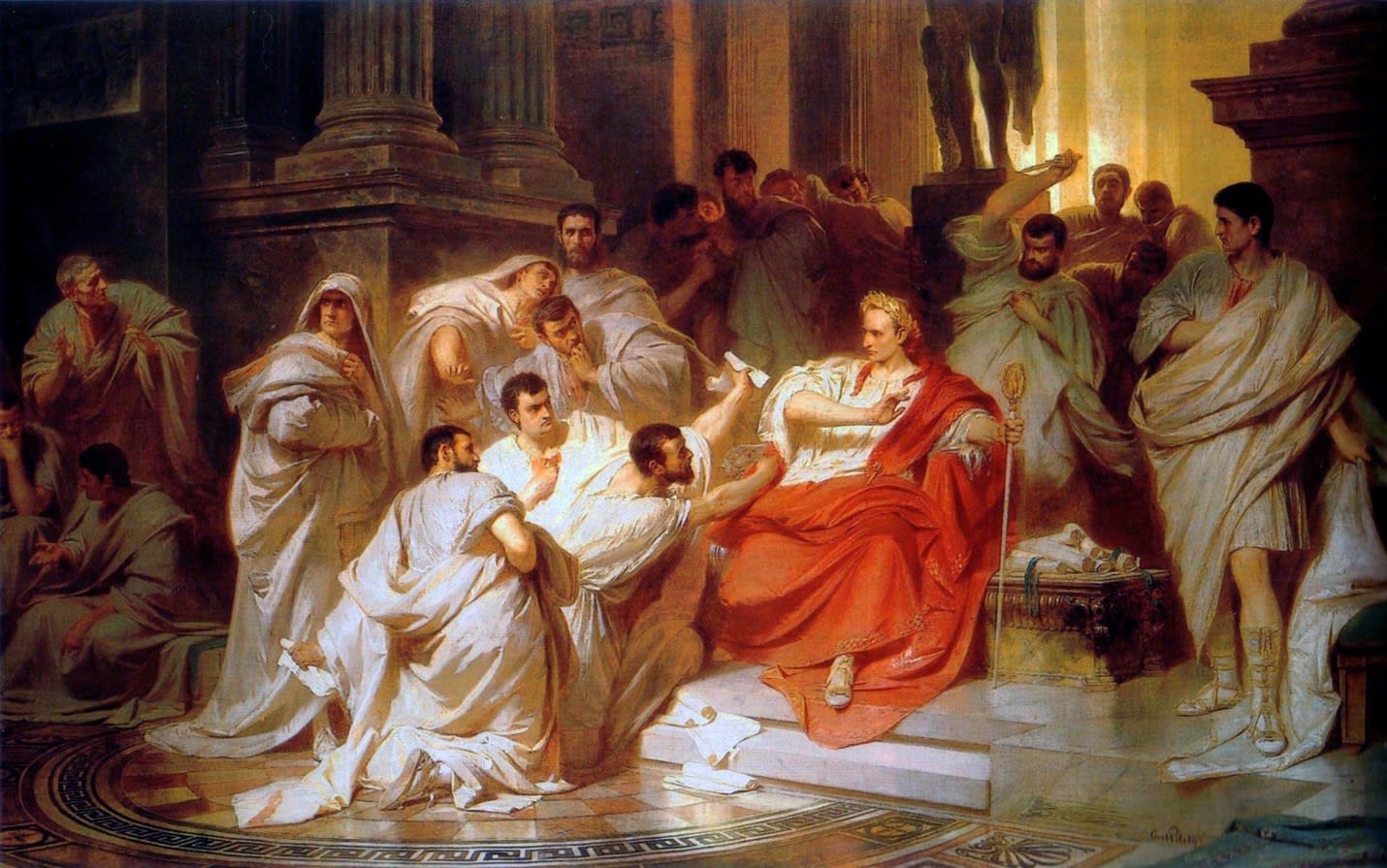
The assassination was set for 15 March, during a Senate meeting in the Curia of Pompey. Ancient authors recount many omens and warnings Caesar ignored. When he entered the hall, the conspirators surrounded him. At the signal, Lucius Tillius Cimber pulled down his toga and Publius Servilius Casca struck the first blow. Caesar tried to resist but, seeing Marcus Brutus among the conspirators, he is said to have uttered his last words in Greek: “You too, my child!” (καὶ σὺ τέκνον). Twenty-three wounds were found on his body.
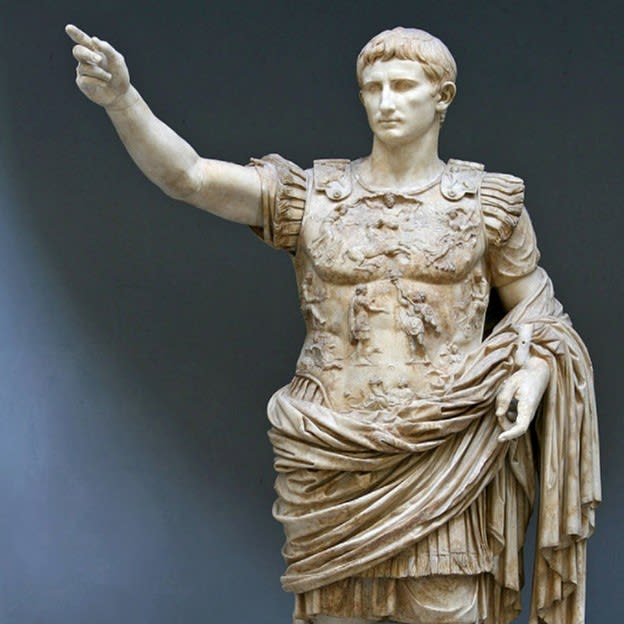
His body was cremated in the Forum. According to his will, every Roman citizen received 300 sesterces, and his gardens were given over for public use. Most surprising was that he had adopted his great-nephew Gaius Octavius and made him principal heir. Octavius known as Octavian would later become Rome’s sole ruler.
Soon after the murder, a bright comet appeared in the sky. In Rome it was believed to be the soul of the slain dictator, a final step toward his posthumous deification.


