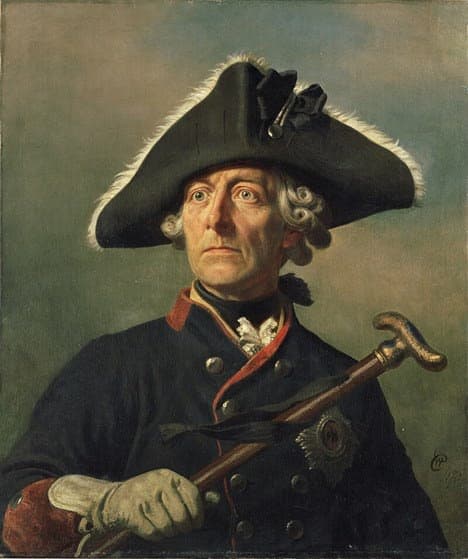
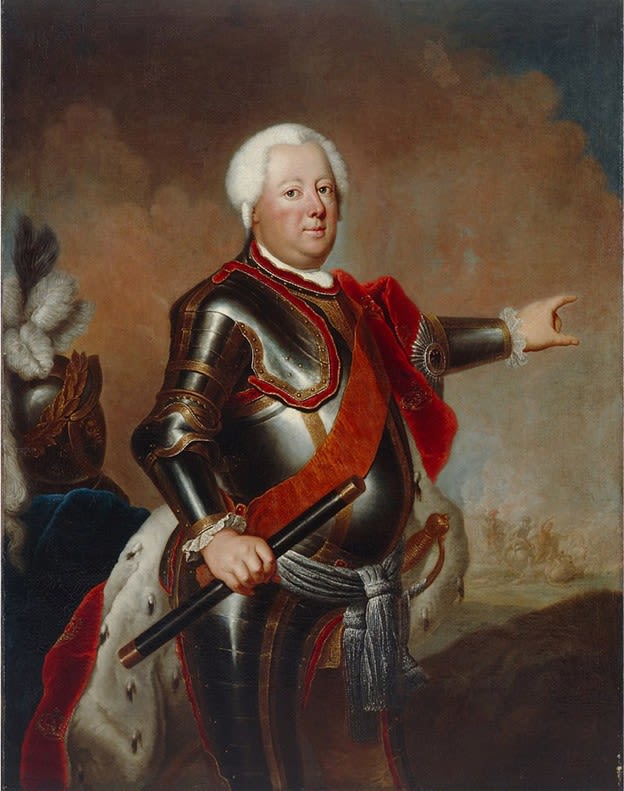
The future King of Prussia, Frederick II the Great, was born on January 24, 1712, in the Berlin Palace. He was the third but became the eldest surviving son in the large royal family of the Hohenzollerns. His father was Frederick William I, a stern and pragmatic “soldier-king,” and his mother was the educated Sophia Dorothea of Hanover, daughter of King George I of England. The conflict between his parents one valuing military discipline and asceticism, the other refined culture laid the foundation for a deep inner struggle in the young prince’s soul.

From early childhood, Frederick showed an exceptional inclination toward art and philosophy, which clashed with his father’s militaristic aspirations. While his father dreamed of raising a true warrior, the crown prince found comfort in music, literature, and French culture, which he learned from his Huguenot governess, Mademoiselle de Rocoulle. His interests deemed “effeminate” by Frederick William provoked rage and led to frequent beatings and humiliations. During this difficult period, his only close companion was his elder sister Wilhelmine, with whom he maintained a warm lifelong relationship.

Despite his father’s prohibitions, the young prince, with the help of his tutor Jacques Duhan, secretly amassed a vast library of more than 3,000 volumes, which included classical poetry and works on philosophy and history.
Tension between father and son reached its peak when eighteen-year-old Frederick, exhausted by his father’s despotism, decided on a desperate act to flee to England. He devised this plan with his close friend and possibly lover, Lieutenant Hans Hermann von Katte. The attempt, made in August 1730, failed. Both were arrested and imprisoned in the fortress of Küstrin. The enraged king accused them of desertion and high treason and intended to execute both.
The crown prince was offered pardon in exchange for renouncing the throne, but he refused. Ultimately, under pressure from European courts and his own advisers, Frederick William I was forced to spare his son, but Katte’s fate was far more tragic. On November 6, 1730, Frederick was forced to watch his friend’s execution. This event left a deep trauma and changed him forever.

After two years of exile in Küstrin, where Frederick studied public administration, he was finally pardoned and reinstated in the army in 1732.
His freedom came at a price: in 1733, Frederick was compelled to marry Elisabeth Christine of Brunswick-Bevern, a Protestant relative of the Austrian Habsburgs. Although politically advantageous, the marriage was loveless and childless. Frederick never harbored affection for his wife, and after ascending the throne, they lived apart.
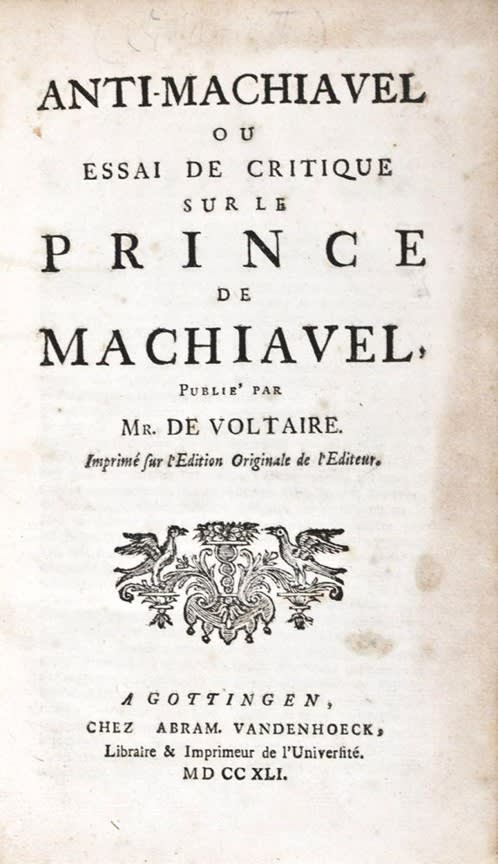
After the wedding, Frederick William I granted his son the Rheinsberg Castle, where the prince could finally devote himself to his passions. In Rheinsberg, he gathered a circle of musicians, philosophers, and intellectuals to discuss art and military strategy. He later called this the happiest time of his life. It was there, in 1739, that Frederick wrote his famous treatise Anti-Machiavel, refuting the cynical principles of power presented in Niccolò Machiavelli’s The Prince.

On May 31, 1740, after his father’s death, the twenty-eight-year-old Frederick ascended the Prussian throne. He inherited not only the crown but also a powerful army and a full treasury. His first actions marked the dawn of a new era. He invited leading philosophers such as Christian Wolff and Voltaire to Prussia, seeking to restructure the state according to the ideals of the Enlightenment. For his rational approach to governance, he earned the title of “philosopher-king,” in contrast to his father, the “soldier-king.”
Frederick II proved to be a farsighted and enlightened ruler. He abolished censorship, declaring that “Berlin journalists should be granted unlimited freedom.” He actively supported the arts and sciences, founding the Royal Opera in 1742 and the Berlin Academy of Sciences in 1744, which attracted geniuses such as Leonhard Euler.
As an “architect-king,” Frederick personally participated in the design of his buildings, including his beloved Sanssouci Palace in Potsdam, which became his summer residence and was informally called the “Prussian Versailles.”


Frederick was also a talented musician, playing the flute and composing works that are still performed today. In 1747, he invited Johann Sebastian Bach to Potsdam, which led to the creation of the magnificent Musical Offering.

From the moment he took the throne, Frederick II left Berlin forever it reminded him of his bitter youth and made Potsdam the center of his life.
Guided by the principle he himself articulated — “The sovereign is the first servant of the state” — Frederick the Great launched sweeping reforms. This ideal sharply contrasted with his father’s absolutism and became the foundation for Prussia’s modernization, transforming it from a backward land into one of Europe’s leading powers.
One of the king’s earliest and most significant acts was the abolition of torture on July 3, 1740. Together with the great chancellor Samuel von Cocceji, Frederick carried out a radical reform of the judicial system. Privileged noble courts were abolished, justice was centralized, and the executive and judicial branches were separated revolutionary measures for the time. In 1749, the Corpus Juris Fridericianum was adopted, and later, in 1781, work began on the General Code of Civil Law, laying the foundations for legal equality.
To strengthen the economy, Frederick protected domestic industry with high tariffs and promoted internal trade. In 1750, he appointed Johann-Philipp Graumann as head of all mints, who reformed the currency and stabilized the Prussian thaler, making it the standard in northern Germany. Although the Seven Years’ War disrupted finances, the “Monetary Edict” of 1763 restored stability. Frederick also regulated grain prices, creating state granaries to prevent famine during poor harvests. He founded the Emden Company to expand trade and established insurance and credit banks, introducing elements of enlightened mercantilism. Personally, overseeing projects to drain swamps, he created about 1,200 new villages and increased food supply earning the nickname “Potato King.”
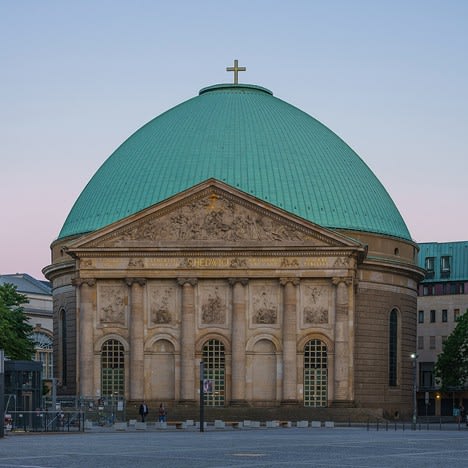
Frederick was also famous for his unprecedented religious tolerance. A skeptic himself, he declared, “All religions are equal and good if their followers are honest men.” In 1747, he laid the foundation for St. Hedwig’s Cathedral in Berlin—unthinkable in Protestant Prussia. He welcomed Jesuits and Huguenots, attracting skilled workers regardless of faith, which helped repopulate and rebuild the country after wars. His pragmatic tolerance extended even to Judaism, though he limited the number of Jews to prevent competition with Christian merchants.

Frederick’s reign was marked by a rapid territorial expansion Prussia’s lands nearly doubled. The king personally commanded his campaigns, demonstrating extraordinary strategic brilliance.
Immediately after his accession, in December 1740, Frederick seized the opportunity presented by Emperor Charles VI’s death and Austria’s weakness to invade rich, industrial Silesia. This began the War of the Austrian Succession. His first victory, at the Battle of Mollwitz, was achieved thanks to Field Marshal Schwerin’s genius. The subsequent Treaty of Breslau (June 11, 1742) secured all of Silesia and the County of Glatz for Prussia.
However, Austria’s renewed successes forced Frederick to resume the war. After victories at Chotusitz, Hohenfriedberg, and Soor, his triumph was complete. The Treaty of Dresden (December 25, 1745) confirmed Prussia’s full rights to Silesia. This conquest greatly strengthened Prussia, elevating it to the rank of a great European power.
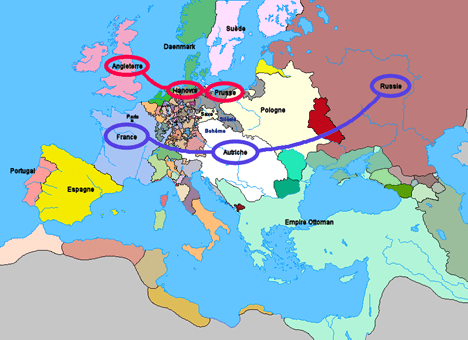
Ten years of peace followed, during which Frederick prepared for the next inevitable conflict. He fortified Silesia, expanded the army, and reorganized the finances. In 1756, he allied with Great Britain, triggering the Diplomatic Revolution an alliance of former enemies, Austria and France, joined by Russia.
On August 29, 1756, seeking a preemptive strike, Frederick invaded Saxony, starting the Seven Years’ War. Though he quickly occupied Saxony, his actions drew international condemnation. The Battle of Lobositz was his first, though indecisive, victory. In 1757, he suffered his first major defeat at Kolin, but soon achieved brilliant victories at Rossbach over Franco-Austrian forces and Leuthen over Austria, which brought him worldwide fame.


The later course of the war proved disastrous for Prussia. By 1759, Austria, Russia, France, Sweden, and the Holy Roman Empire gained the upper hand. At Kunersdorf (August 12, 1759), Frederick suffered a crushing defeat, losing nearly half his army. Berlin was captured and plundered by Russian and Austrian troops. The situation seemed hopeless, and Frederick even contemplated suicide. But the sudden death of Empress Elizabeth of Russia in January 1762 brought the so-called “Miracle of the House of Brandenburg.” Her successor, the Prussophile Peter III, immediately made peace and returned all occupied territories to Prussia. This persuaded Sweden to withdraw, allowing Frederick to fight Austria on equal terms.

The Treaty of Hubertusburg (1763) ended the war, restoring prewar borders. Though Prussia retained Silesia, it was exhausted its population and army decimated, and finances ruined by inflation.
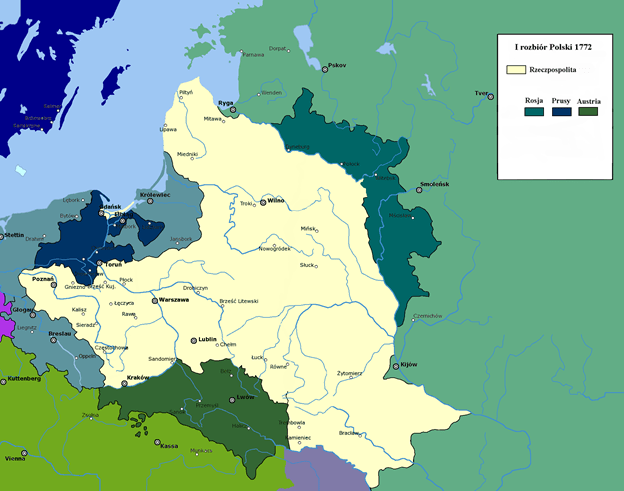
One of Frederick’s greatest diplomatic successes and his long-held dream of uniting his scattered lands came with the First Partition of Poland (1772). He had long called Poland “an artichoke to be eaten leaf by leaf.” He deliberately undermined the Polish economy, provoked inflation, and exploited religious discord between Catholics and Protestants.
After the Russo-Turkish War, to preserve the balance of power, Frederick, his brother Henry, and the courts of Russia and Austria agreed to partition the Polish-Lithuanian Commonwealth. Frederick received West Prussia, finally connecting East Prussia with Brandenburg. Though his share was the smallest, it was strategically invaluable granting control of the Vistula estuary and access to the sea. When Maria Theresa reluctantly accepted the division, Frederick sardonically remarked, “She weeps but takes.”
Afterward, he pursued a policy of Germanization in the annexed territories, considering the Polish population “uncivilized.”

Toward the end of his long life, aged and weary of war, Frederick the Great once again had to defend Prussia’s interests. In 1778, the War of the Bavarian Succession erupted when Emperor Joseph II of Austria sought to exchange parts of his realm for Bavaria. Frederick, always wary of Austrian expansion, would not allow it.

By then, Europe’s political landscape had shifted. Russia and Saxony, once Prussia’s enemies, were now allies. France, Austria’s traditional partner, was busy aiding the American Revolution and avoided new European conflicts. Frederick skillfully exploited this to leave Joseph II diplomatically isolated.
The war nicknamed the “Potato War,” since armies spent more time foraging than fighting soon reached stalemate. Joseph’s mother, Maria Theresa, unwilling to renew conflict with Prussia, secretly opened peace talks with Frederick. When Empress Catherine II of Russia threatened to intervene on Prussia’s side, Joseph II was forced to abandon his Bavarian ambitions.

When Joseph II renewed his claims in 1784, Frederick, unwilling to fight again, founded the Fürstenbund the “League of Princes” uniting many German states to protect their liberties against Austrian dominance. The alliance, supported by the influential Archbishop of Mainz, strengthened Prussia’s position in Germany. The ensuing Treaty of Teschen saw Austria renounce Bavaria in exchange for minor territories. Thus, even in old age, Frederick achieved another major diplomatic triumph.
As the years passed, Frederick grew increasingly lonely. His dear friends from Sanssouci had died, and he rarely formed new attachments. Living in solitude, he continued to work tirelessly rising before dawn, drinking many cups of coffee laced with mustard and pepper, and laboring over state affairs with characteristic determination.
Despite his isolation, Frederick remained immensely popular among his people, affectionately nicknamed Der Alte Fritz — “Old Fritz.” He shunned glory, preferring the company of his beloved greyhounds, whom he jokingly called “the Marquises de Pompadour.”

On August 17, 1786, Frederick the Great died at age 74 in his chair in the study of Sanssouci. His final wish was to be buried in the vault on the vineyard terrace beside his dogs, but his nephew and successor, Frederick William II, ignored this, interring him beside his father in the Potsdam Garrison Church.
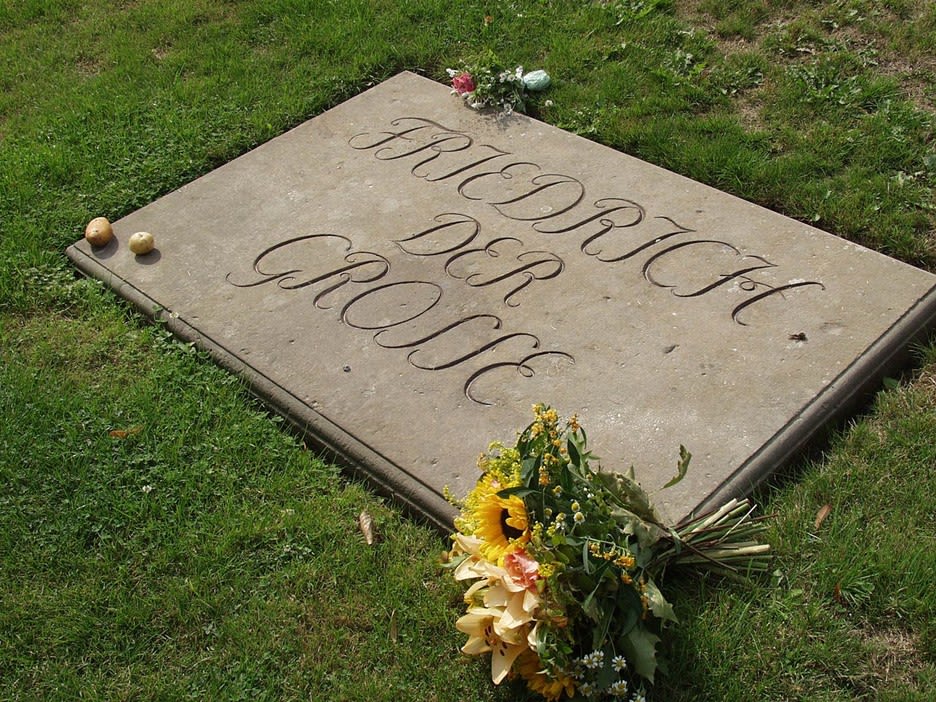
After World War II, Frederick’s coffin was hidden for protection and later moved to Hohenzollern Castle. Yet, on August 17, 1991 205 years after his death his wish was finally fulfilled. The coffin was displayed with honor at Sanssouci, and after nightfall, the king’s body was quietly reburied in the terrace vault.
To this day, visitors place potatoes on his grave in tribute to the man who made the plant a staple of Prussian life. The legacy of Old Fritz lives on, reminding us of the great philosopher-king, commander, and statesman who transformed Prussia and left an indelible mark on European history.


