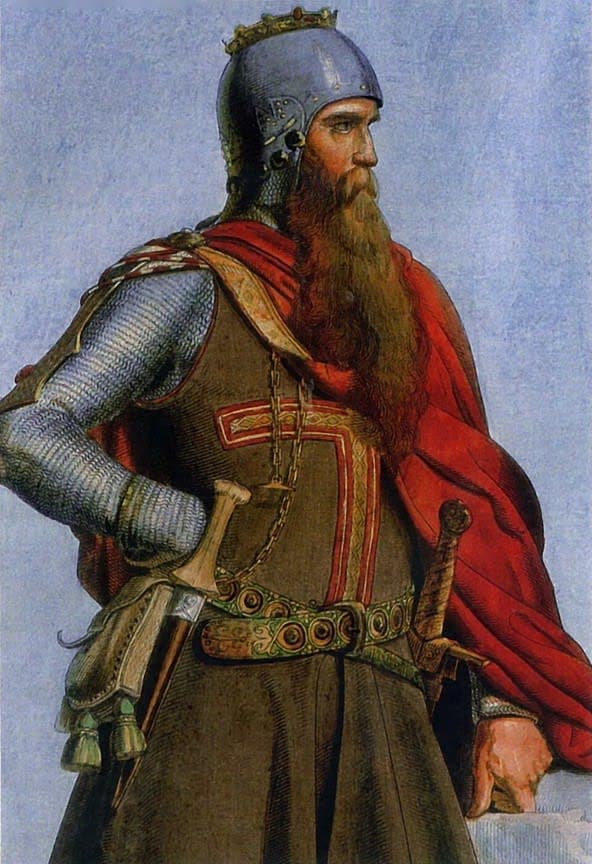

Frederick I Barbarossa was born to Frederick II the One-Eyed, Duke of Swabia, and Judith of Bavaria. He was the nephew of King Conrad III of Germany. In 1147, upon his father’s death, Frederick inherited the Duchy of Swabia. Soon after, he took part in the Second Crusade, where he proved himself a brave and gallant knight and won the esteem of his contemporaries. On his deathbed, King Conrad III recommended that the princes elect Frederick as his successor, and on 4 March 1152 Frederick ascended the throne.
The new king was physically powerful and quick-witted a consummate knight who sought glory and ruled justly. Yet, like many monarchs of his age, he could be harsh in anger and brooked no resistance. The central dream of his life was to restore the might of Charlemagne’s empire.
Frederick Barbarossa was a master of the military art. He forged and refined one of Europe’s strongest armies, built around heavy knightly cavalry. He revered chivalric custom and held that only men of knightly birth had the right to bear the emblems of knighthood.


In 1155 Frederick I became Holy Roman Emperor and set about strengthening imperial authority. He believed Italy by then effectively independent must be brought back under imperial control, which led to six Italian expeditions.
His first campaign began in 1154, aimed at subduing Rome, where the nobility had formed a senate and seized power. Frederick haughtily refused to accept the crown from the townsmen, considering himself heir to the emperors of old. On the night of 17–18 June his forces seized the approaches to St. Peter’s, where Pope Adrian IV solemnly crowned him. The very next day, however, the Romans rose in revolt, and Frederick was forced to quit the city.
In 1158 the second campaign opened. Frederick gathered a vast army to subdue Milan, the chief stronghold of Lombard resistance. The city surrendered almost without a fight, and Frederick promulgated his principles of rule, insisting that coinage and taxation were the exclusive prerogatives of imperial power.
These edicts provoked fierce opposition among the Lombard communes. In 1159 Milan rose again. Frederick besieged Crema and, after six months, captured and razed it. At the same time, he clashed with the papacy: his opponents supported Pope Alexander III, while Frederick backed the antipope Victor IV and was excommunicated in return.
In 1161 he again besieged Milan; a year later the city capitulated. The emperor ordered it demolished and its inhabitants dispersed among four undefended settlements.
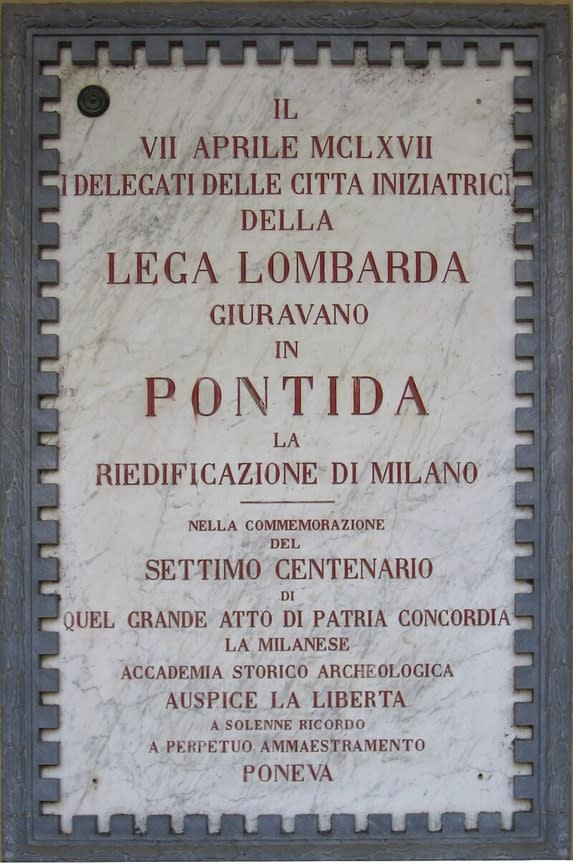
In 1167 sixteen rebellious cities formed the Lombard League, swearing to defend their liberties. Lacking the strength to overcome them, Frederick fled Italy and spent seven years in Germany raising a new army. In 1174 he undertook a fifth Italian campaign, but with too small a force to capture Alessandria.
Frederick appealed for aid to his cousin, Henry the Lion, the mightiest duke in Germany, but Henry refused a slight Barbarossa never forgot. On 29 May 1176 Frederick’s troops met the League’s army at Legnano. The German knights were routed; Frederick was unhorsed and narrowly escaped with his life.
After this defeat he was compelled to yield. In 1177, at Venice, he reconciled with Alexander III, recognizing him as the sole legitimate pope. In 1183, at Constance, he concluded peace with the Lombard League: the cities acknowledged the emperor as suzerain, and Frederick in turn confirmed their ancient liberties.


Back in Germany, Frederick used Henry the Lion’s refusal of aid as a pretext to strip him of his holdings. In 1181 Henry came to Erfurt to beg forgiveness; he received it, but had to go into three years’ exile.
In 1189 Frederick took the cross and joined the Third Crusade, leading his army overland through the Byzantine Empire. Emperor Isaac II Angelos, alarmed by the power of the German host, arrested Frederick’s envoys, provoking the emperor’s wrath. Frederick marched toward Constantinople, and only then did Isaac negotiate, providing supplies and ships for the crossing.

On 10 June 1190, while crossing the river Saleph, Frederick encased in heavy armor fell from his horse and drowned. Another tradition holds that, overcome by heat, he entered the river to bathe and died of a sudden seizure. Thus ended the life of one of the most formidable emperors of the Middle Ages, whose dream of reviving the empire ultimately went unfulfilled.


