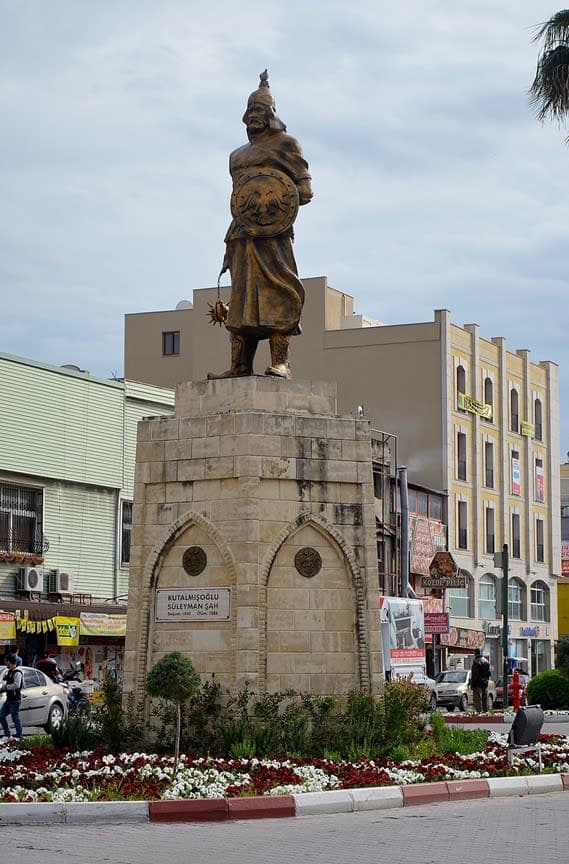

The story of Suleiman ibn Qutulmish is an epic narrative about a man who, on the ruins of great empires, managed to build his own state, displaying extraordinary military talent and the flexibility of a skilled diplomat. His path began in the shadow of a family tragedy: his father, Qutulmish, being the grandson of Seljuk himself, entered into a fierce struggle for power with his cousin Alp Arslan. Although Qutulmish was defeated in this civil conflict, Alp Arslan showed statesmanlike wisdom and foresight by refusing to exterminate his relatives. On the contrary, he saw potential in Suleiman and entrusted him with the administration of the western provinces of the Seljuk Empire, which became the starting point for the future sultan’s rise.
Suleiman’s real opportunity came after the fateful year of 1071, when the Byzantine army was crushed at the Battle of Manzikert. The captured emperor Romanos Diogenes signed a peace treaty, pledging to pay tribute and return prisoners, but upon his return to Constantinople he was overthrown. His successor, Michael VII Parapinakes, refused to honor the agreements, giving the Seljuks a legitimate pretext to launch large-scale raids into the undefended lands of Anatolia. Amid the paralysis of central authority in Byzantium, the empire’s borders became porous.


Suleiman skillfully maneuvered through the chaos of Byzantine civil wars. When the Norman mercenary Roussel de Bailleul rebelled and declared himself an independent ruler in Asia Minor, Suleiman initially entered into an alliance with him, helping him defeat Roman forces. However, showing pragmatism, he soon reached an agreement with the Byzantine basileus and handed the Norman over to the empire in exchange for a huge ransom, thereby strengthening his own position and replenishing his treasury.
By 1078, Byzantium had completely sunk into the abyss of turmoil. Two ambitious claimants rose against the unpopular emperor Doukas: Nikephoros Bryennios the Elder and Nikephoros Botaneiates. Suleiman backed Botaneiates, a powerful Anatolian magnate from the Phokas dynasty. With the help of Seljuk cavalry, Botaneiates captured Cyzicus and then the strategically important city of Nicaea. After proclaiming himself emperor and occupying Constantinople, Nikephoros Botaneiates effectively owed his throne to Suleiman.

However, stability was short-lived. Soon a new claimant, Nikephoros Melissenos, rebelled in Asia Minor. He too turned to Suleiman for military assistance. Having occupied Bithynia, the allies, however, failed to reach an agreement. While the Byzantine attempted to establish his own realm in the conquered territories, Suleiman acted on a broader scale. He reinforced his detachments with fellow Muslims, who formed the core of the region’s garrisons, effectively transforming the conquered lands into the stronghold of a new Muslim state.
In 1078, after the conquest of Lydia and Ionia, Suleiman ibn Qutulmish officially assumed the title of sultan, proclaiming Nicaea the capital of his state, which entered history as the Sultanate of Iconium, or the Sultanate of Rum. In 1081, the political landscape changed once again: Nikephoros Botaneiates was overthrown by the energetic Alexios Komnenos. Suleiman and Alexios had long-standing relations dating back to the time when the future emperor had been a mercenary commander.
Despite the Seljuk defeat at the Battle of Philomelion in 1083, after which Byzantium regained Nicomedia, the two rulers reached a mutually beneficial agreement. Alexios Komnenos, needing peace in the east in order to fight the Normans in the west, recognized Suleiman as his governor in Nicaea and generously rewarded him. In return, Suleiman undertook to restrain the nomadic Turkic tribes on the eastern bank of the Anamur River. This alliance was so strong that in 1083, after the difficult Battle of Larissa for the Romans, Suleiman sent 7,000 of his best warriors to help Alexios fight the Norman invasion.
Having reached the peak of his power in the west, Suleiman turned his gaze eastward — toward Syria and Egypt. In 1086, he triumphantly captured Antioch, which caused panic and anger among the Syrian emirs. A coalition formed against him, led by his relative Tutush. The decisive battle took place on the road to Aleppo.
The battle took a turn Suleiman had not expected. When the fighting turned into brutal hand-to-hand combat, his warriors faltered and fled. Finding himself in a hopeless position, the sultan left the battlefield and stopped at a place he considered safe. Sources describe a dramatic scene: Suleiman threw his shield to the ground and sat upon it, deep in thought about the collapse of his hopes. He was discovered by Tutush’s satraps, who demanded that he appear before their lord. Realizing that only disgrace and captivity awaited him, Suleiman ibn Qutulmish drew his sword and pierced himself through, choosing death over humiliation. As chroniclers of the time noted, this “wicked man died a wicked death,” leaving chaos behind him.


The founder’s death plunged the sultanate into anarchy. The supreme Seljuk ruler Malik-Shah did not fail to take advantage of this. He established direct control over the territory, appointing his generals to govern Suleiman’s lands, while the young sons of the fallen sultan were taken to Isfahan as honorable hostages. Thus ended the first chapter in the history of the Sultanate of Rum — a chapter that began with the ambitions of one man and ended in tragedy on the battlefield near Aleppo.


