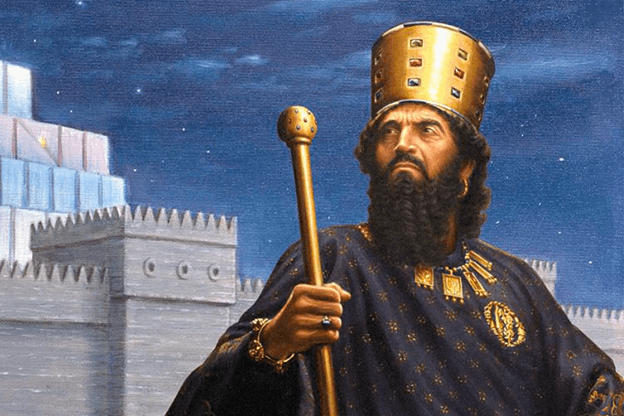

The exact date of Cyrus’s birth is hidden in the depths of time; however, historical scholarship, relying on indirect evidence, places it between 600 and 590 BC. The most probable year of his birth is considered to be 593 BC. His origins are surrounded by a mystical aura, while the stories of his youth that have reached us through Greek authors — Herodotus, Xenophon, and Ctesias — often contradict one another, reflecting the variety of traditions that were already circulating in Asia in the 5th century BC.

According to the most famous version recorded by Herodotus, Cyrus was the son of the Persian king Cambyses I and Mandane, the daughter of the powerful Median ruler Astyages. Astyages had a prophetic dream: his grandson would become ruler of the world, crushing Media and subjugating all of Asia. Trying to deceive fate, the king first married his daughter to an “insignificant” Persian, and when the child was born, he ordered his official Harpagus to kill the infant. However, providence decided otherwise: Harpagus, unable to bring himself to commit infanticide, handed the boy over to a shepherd named Mithridates. By a tragic coincidence, the shepherd’s wife, named Spaco — which in Median meant “dog” — had given birth to a stillborn child that same day. The parents decided to raise the royal heir as their own, while the body of their dead son, dressed in Cyrus’s luxurious clothes, was presented to Harpagus as proof that the order had been carried out.
The truth was revealed when Cyrus was ten years old. During a game with his peers, he was chosen as “king” and harshly punished the son of a noble Mede for disobedience. When the boy was brought before Astyages for judgment, the king recognized family features in him. Under torture, the shepherd confessed to the substitution. Astyages’s anger was terrible: he cruelly took revenge on Harpagus by serving him the flesh of his own son at a feast. Yet Cyrus himself, on the advice of the Magi, was spared, since Astyages believed that the prophecy of his becoming king had already been “fulfilled” in the children’s game. The young prince was sent to Persia to his real parents.
There were other versions as well. Ctesias, for example, claimed that Cyrus came from the nomadic tribe of the Mardians, that he was the son of a robber named Atradates and a goat-herding woman named Argoste, and that he rose to power solely through his bravery and his service at the court of Astyages as a cupbearer. Even his name caused debate: some connected it with the Sun (“Khur”), others with the name of the Pulvar River, and still others with the word “shepherd.” Yet despite all these legendary layers, it remains a historical fact that Cyrus possessed exceptional charisma and leadership talent, which allowed him to unite scattered tribes.
In 559 BC, Cyrus became leader of the settled Persian tribes, whose center was the city of Pasargadae. At that time, Persia was a vassal of Media. To inspire his people to struggle, Cyrus, according to tradition, resorted to a clever trick: on the first day, he forced the Persians to work themselves to exhaustion clearing bushes, while on the second day he arranged a luxurious feast for them. The choice between slave labor for the Medes and the free, well-fed life of a warrior was obvious.


In 553 BC, Cyrus openly rose against Astyages. This was aided by a conspiracy within Media itself: Harpagus, who had not forgotten the cruel insult inflicted upon him, secretly persuaded the nobility to overthrow the tyrant. The war lasted three years and was extremely bloody. The Babylonian chronicles, specifically the Chronicle of Nabonidus, confirm that in 550 BC the Median army rebelled against Astyages and handed their king over to Cyrus. The Persians captured Ecbatana, the capital of Media, and plundered its treasures.

Cyrus showed a wisdom unusual for that time: he not only spared the life of the captured Astyages, but also preserved Media’s status as a privileged part of the state. Ecbatana remained one of the capitals, while the Median administrative system became the foundation of the governmental structure of the new empire. Over the following two years, from 550 to 548 BC, Cyrus subjugated Parthia, Armenia, Hyrcania, and Elam, expanding the borders of his influence to the east and north.
The next great challenge for Cyrus was the Kingdom of Lydia, ruled by the fabulously wealthy King Croesus. In 547 BC, Croesus crossed the Halys River and invaded Cappadocia. After the indecisive Battle of Pteria, Croesus retreated to his capital, Sardis, expecting help from his allies in Egypt, Babylon, and Sparta. However, Cyrus made a lightning march through winter Anatolia and caught the enemy by surprise beneath the walls of his capital.

In the decisive battle on the plain before Sardis, Cyrus used a military stratagem suggested by Harpagus: he placed camels in the vanguard, whose smell terrified the Lydian horses. The Lydian cavalry was thrown into disorder, and after a fourteen-day siege, the supposedly impregnable acropolis of Sardis fell. Cyrus spared Croesus, turning the defeated enemy into his adviser.
The conquest of Asia Minor continued under the command of the Median generals Mazares and Harpagus. The revolts of the Lydians were suppressed, including the rebellion of Pactyes in 546 BC, and a systematic siege of the Greek cities of Ionia, Aeolis, and Caria began. Many Greeks, such as the inhabitants of Phocaea and Teos, preferred to leave their homeland and found colonies in Italy and Thrace rather than submit to the Persians. The Lycians, however, offered desperate resistance: the defenders of Xanthus, realizing that defeat was inevitable, burned their city together with their families and fought to the last man. By the end of this campaign, all of Asia Minor had come under Achaemenid rule.
The peak of Cyrus’s conquests was the campaign against Babylon in 539 BC. By that time, the Neo-Babylonian Kingdom had been weakened by internal conflicts between King Nabonidus and the priesthood of the god Marduk. In addition, the influential governor of the region of Gutium, Ugbaru, went over to Cyrus’s side.

The road to Babylon was blocked by powerful engineering structures and the flooding of the Diyala River. Herodotus recounts that Cyrus spent an entire summer digging 360 canals and diverting the river’s water, making it passable. At the end of September 539 BC, the decisive battle took place near the city of Opis, where the Babylonian army was utterly defeated. Soon after, Sippar fell without a fight, and on October 12, Ugbaru’s troops entered Babylon.
According to legend, the Persians entered the city through the bed of the Euphrates, whose water level had been artificially lowered, while the Babylonians were indulging in feasting. Nabonidus’s son, Belshazzar, was killed during the capture, while Nabonidus himself later surrendered and was exiled to Carmania. On October 29, 539 BC, Cyrus personally entered Babylon, where he was greeted as a liberator and as the chosen one of the god Marduk.
After seizing Mesopotamia, Cyrus did not destroy its social structure. He accepted the title “King of Babylon” and patronized the ancient cults. One of the most significant acts of his reign was the decree of 538 BC, issued in Ecbatana, according to which the Jews were allowed to return from the Babylonian captivity to Jerusalem in order to rebuild their Temple. Similar measures were also taken with regard to other deported peoples.
Cyrus understood that a stable empire was built not only on swords, but also on the loyalty of its subjects. By restoring destroyed cities, such as the Phoenician city of Sidon, and by ensuring the security of trade routes, he created conditions for the prosperity of the entire Near East. By this point, the only serious opponent remaining in the region was Egypt, and preparations for a campaign against it became the main strategic task of the final years of the great conqueror’s life.
The conquest of Babylon marked not merely a change of power, but the birth of a new imperial philosophy, most fully reflected in the famous “Manifesto of Cyrus.” This unique document, inscribed on a clay cylinder in the Akkadian language, was composed by pro-Persian Babylonian nobles and priests. The text of the “Manifesto” opens with a lengthy and severe denunciation of the defeated king Nabonidus: he is accused of neglecting the gods, ruining temples, and oppressing his own people. In this interpretation, the god Marduk, whose patience had run out, personally found Cyrus, king of Anshan, and, taking him by the hand, granted him power over the world, entrusting sacred Babylon to his care.
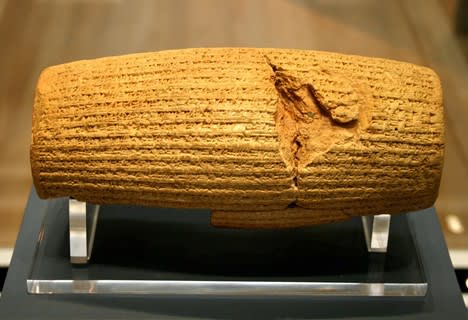

The text itself, written in Cyrus’s name, is filled with magnificent titles composed in the finest traditions of Mesopotamian monarchy. He calls himself “king of multitudes, great and mighty king, king of Babylon, Sumer and Akkad, and king of the four corners of the world.” Cyrus’s genealogy emphasizes his nobility and continuity: he is the son of Cambyses, a descendant of Teispes, the “eternal royal seed,” whose rule is pleasing to the gods Bel and Nabu. Cyrus emphasized that his troops entered the city peacefully, without allowing plunder or violence, which is also confirmed by other historical evidence.
As an outstanding strategist, Cyrus understood that the longevity of an empire could not rest on fear alone. He proclaimed a policy of returning gods and people to their original dwellings. Between November 539 and March 538 BC, the statues of gods that Nabonidus had forcibly brought to Babylon were solemnly returned to their ancient sanctuaries in Ashur, Susa, Eshnunna, and other cities. Cyrus also gathered displaced peoples and allowed them to return to their settlements, restoring their familiar way of life. This policy of mercy and respect for foreign traditions created Cyrus’s reputation as a “father” and deliverer, becoming an exceptional case in the history of the ancient Near East.
In the shadow of Cyrus’s great achievements stood his family, which became the foundation of the new Achaemenid dynasty. The king’s wife was Cassandane, who also came from the Achaemenid clan. According to historians, Cyrus mourned her death with great sorrow and ordered the entire empire to observe mourning. From this union were born two sons: the elder Cambyses II, who became heir to the throne, and the younger Bardiya. In addition, Cyrus had three daughters: Atossa, who was destined to play a key role in the future history of Persia, Artystone, and, presumably, Roxana. These children formed the core of the new ruling elite, called to govern the boundless expanses of Asia.

Despite his triumph in the west, the northeastern borders of the empire remained unstable. Cyrus, considering war with Egypt premature, directed his army against the nomadic tribes of Central Asia. During this period, Bactria, Sogdiana, and the lands of the Saka entered the empire. On the banks of the Jaxartes River, the modern Syr Darya, the city of Cyropolis was founded — the outermost outpost of civilization, intended to restrain nomadic raids.
In 530 BC, Cyrus undertook his final and fatal campaign against the Massagetae. Herodotus preserves the dramatic legend of Queen Tomyris of the Massagetae. In the decisive battle on the banks of the Jaxartes, the Persian army suffered defeat, and the great conqueror himself fell in battle. According to tradition, Tomyris, avenging the death of her son, ordered Cyrus’s body to be found and dipped his head into a skin filled with blood, saying: “You thirsted for blood, so drink your fill!” However, this version is disputed by many scholars, since it is known with certainty that Cyrus’s body was not desecrated and was brought back to his homeland.
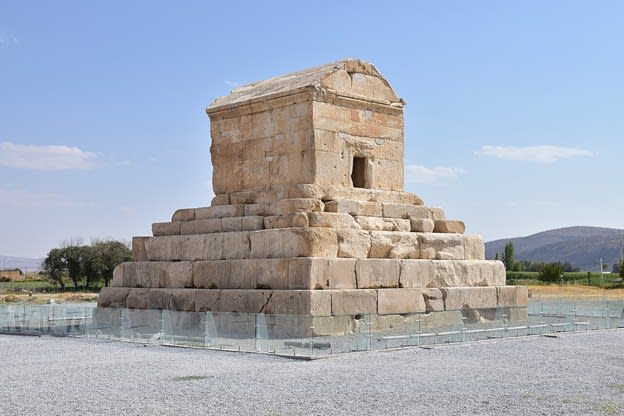
Cyrus II the Great died in early August 530 BC and was buried in his first capital, Pasargadae. His tomb, which has survived to the present day, is a restrained and majestic structure made of white limestone, resembling the mausoleums of Asia Minor. On the wall of the palace at Pasargadae, a modest inscription was carved: “I am Kurush, the king, an Achaemenid.” Two centuries later, the tomb was visited by Alexander the Great, who was struck by the simplicity and modesty of the burial place of such a great man. When, during Alexander’s Indian campaign, the tomb was plundered, he ordered the guilty to be executed and the sepulcher of his great predecessor to be restored.
The image of Cyrus left an indelible mark on world culture. For the Persians, he was the “Father of the People”; for the Jews, he was the anointed one of the Lord, the Messiah who returned them from captivity; for the Greeks, he was the model of a wise ruler, whose path Xenophon described in his Cyropaedia. Diodorus Siculus noted that Cyrus surpassed his contemporaries in courage, wisdom, and humanity. His legacy lives on to this day: he was admired by Enlightenment thinkers, founders of states, and modern politicians, who saw in him a man who managed to unite the world not only by the sword, but also through deep respect for human dignity and freedom of religion. Cyrus II the Great ended the era of Assyrian cruelty and opened a new chapter in the history of humanity, becoming the first true builder of a world empire.


