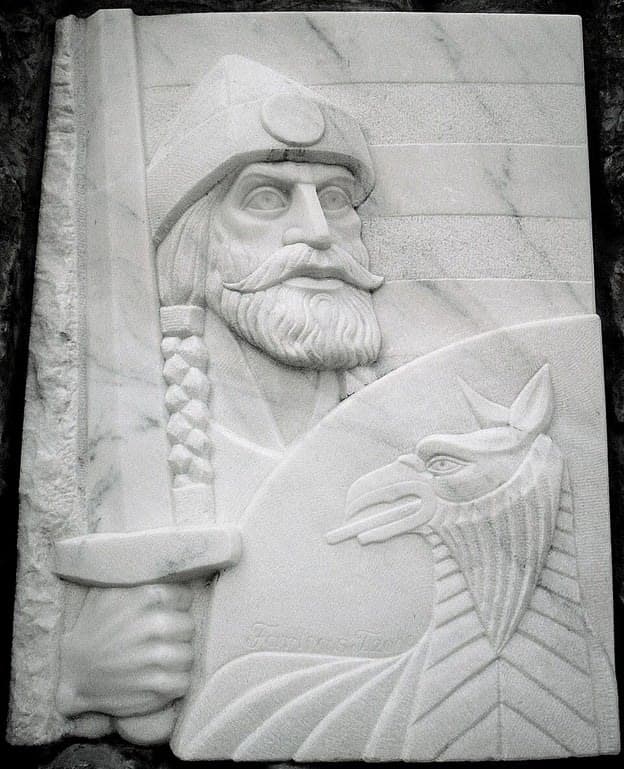

Surprisingly, the famous Hungarian chronicle Gesta Hungarorum (The Deeds of the Hungarians) remains completely silent about the fact that Fajsz ever occupied the throne of Grand Prince.
Had we relied solely on Western and Magyar sources, this ruler might have remained forever in obscurity.
However, the truth was preserved for future generations through the meticulous diplomatic records of Byzantium.
In his monumental treatise De Administrando Imperio (On the Governance of the Empire), Emperor Constantine VII Porphyrogenitus provided a detailed account of the genealogy of the Hungarian chieftains.

Constantine carefully listed the four sons of the great Árpád: the eldest, Tarkacsu (Tarhos), the second, Jelek (Üllő), the third, Jutocsa (Jutas), and the youngest, Zalta (Zsolt).
The emperor also recorded the next generation: Tarkacsu had a son named Tevel, Jelek had Ezel, and the youngest, Zsolt, had Taksony.
But the son of the third brother, Jutocsa, was none other than Falicsi, or Fajsz, about whom the Byzantine emperor explicitly wrote:
"...who is now reigning."

Why, then, did power pass from the abdicated Zsolt not to his own son Taksony, but to his nephew Fajsz?
The answer lies in the ancient traditions of the nomads.
The Hungarians, like many other peoples of early medieval Europe whom contemporary sources described as barbarians, did not follow the European principle of primogeniture, under which authority passed from father to eldest son.
Instead, they strictly adhered to a system of seniority-based succession, in which power was inherited by the eldest male member of the dynasty.
At that moment, Fajsz was the oldest surviving descendant of Árpád.
Incidentally, this archaic system was also practiced for centuries in Rus', where it remained one of the principal causes of endless princely disputes and fratricidal wars until the 15th century.

Fajsz assumed the reins of government during a difficult period.
Hungary remained politically fragmented. Tribal chieftains acted independently, while the central authority of the Grand Prince was weak.
Beyond its borders, however, tectonic political changes were taking place.
The neighboring German Kingdom, exhausted by decades of devastating Hungarian raids, was being consolidated with an iron hand under the new Saxon dynasty.
The Germans no longer wished to hide behind the walls of their fortified strongholds. They were going on the offensive.
For the Hungarians, whose appearance had for generations caused the peoples of continental Europe to pray in terror, "From the arrows of the Hungarians, deliver us, O Lord," the year 950 came as a rude awakening.
Henry I, Duke of Bavaria, crossed the frontier and treacherously invaded deep into Hungarian territory.
After carrying out a swift and devastating raid, he returned home unopposed, leading long columns of prisoners and wagons laden with valuable plunder.
The psychological blow was enormous.
It was the first successful enemy invasion of Hungarian territory since the Battle of Pressburg in 907.

The outraged Magyars thirsted for revenge.
In 951, they assembled their forces for another large-scale offensive against the West.
Realizing that Germany was now bristling with steel, the Hungarian cavalry undertook an extraordinarily daring maneuver.
Bypassing the German territories from the south, they descended upon Northern Italy, crossed the Alps, and swept through the entirety of Aquitaine with fire and sword, reaching the gray waters of the Atlantic Ocean.
It was a triumph reminiscent of the old days, but one that ended in disaster.
On their return journey, burdened with enormous quantities of plunder, the Hungarian army was intercepted by the German king Otto I the Great and completely defeated.
The catastrophic failures in the West forced the Hungarian elite to reconsider their strategy.
The nomads turned their attention southward, toward the magnificent Byzantine Empire.
But this was no longer simply the greedy interest of raiders in wealthy foreign lands.
The growing German threat had triggered crucial processes of political centralization within Hungary.
Confronted by a powerful enemy, the scattered tribes began uniting into a single state.
As among other peoples of Europe, this process became inseparably connected with the adoption of a new monotheistic religion — Christianity.
In 948, a Hungarian embassy of unprecedented importance arrived on the shores of the Bosporus.
It was led by the celebrated military commander Bulcsú, who bore the chilling nickname "the Bloody" (Vérbulcsú).
Bulcsú held the prestigious title of harka, ranking fourth in the complex Hungarian hierarchy after the Grand Prince himself, the supreme military commander (gyula), and the priestly co-ruler (kende).
In Constantinople, a historic event took place: the formidable harka was baptized according to the Orthodox Christian rite.
Byzantine diplomacy was working flawlessly.
In 950, an imperial embassy arrived in Hungary in return.
Under the influence of the Byzantine envoys, and with the support of Bulcsú himself, Grand Prince Fajsz made a momentous decision: he too embraced Christianity.
Moreover, in 952, the military chieftain known as the gyula visited Constantinople and received baptism.
The highest ranks of the Magyar elite had made their choice in favor of the Cross.
However, there was still no question of a mass conversion of ordinary people and common warriors.
The steppe continued to live according to the traditions of its ancestors.
Despite these diplomatic successes in the south, the conflict with Germany remained unresolved.
In 954, Fajsz and his military commanders decided to launch one final, enormous offensive.
A massive army, unprecedented in size for Hungary at that time, invaded Bavaria in an attempt to settle the question of supremacy in Central Europe once and for all.
The Hungarian forces surrounded the city of Augsburg in a tight siege.
However, the German king Otto I refused to abandon the Bavarians to their fate.
He assembled the combined forces of the German principalities and marched to relieve the besieged city.
On August 10, 955, a battle erupted on the banks of the Lech River, near Augsburg, that would forever enter the annals of world history.
It was a clash between two military eras: heavily armored knightly cavalry and lightly equipped mounted archers of the steppes.
The Hungarians suffered an absolute and devastating defeat.
The famous harka Bulcsú, godson of the Byzantine emperor, lost his life alongside thousands of his warriors.
On the banks of the Lech, an entire historical era finally came to an end — the age of the great Hungarian raids into Western Europe.

For Grand Prince Fajsz, the catastrophe at Augsburg marked the end of his political career and, most likely, his life.
Although the prince himself apparently did not personally participate in the bloodbath, the anger of the people and the surviving nobility fell squarely upon him.
A defeat of such magnitude could not be forgiven.
Fajsz disappeared amid the bloody chaos of a palace coup. He was either deposed or brutally murdered by his own tribesmen.
From the ruins of his reign, a new ruler emerged to save Hungary from complete collapse — Taksony, son of Zsolt.
It was he who would turn the next, no less dramatic page in Hungarian history.


