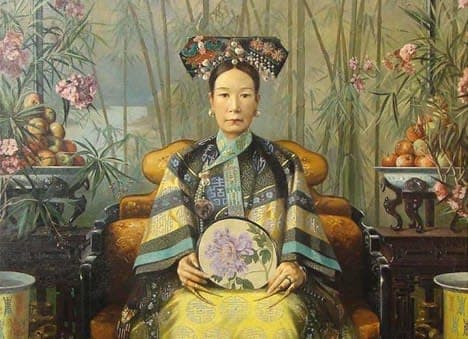
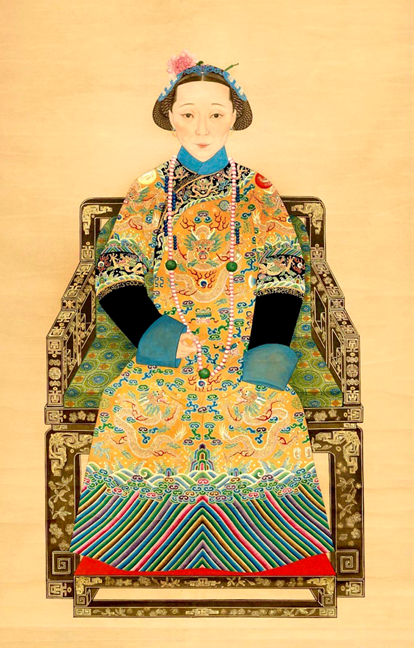
Cixi was born in November 1835 into the family of a Manchu official. In childhood, she was nicknamed “Little Orchid.” From an early age, Cixi displayed remarkable intelligence and curiosity. Unlike most Manchu aristocratic women, she learned the Chinese language and script, understanding that this was the key to influence in an empire where the majority of the population and officials were Han Chinese.
Her fate changed dramatically in June 1852, when she passed the imperial concubine selection and entered the palace as a concubine of the fifth (lowest) rank under Emperor Xianfeng. Her status rose quickly: in 1854, she became a fourth-rank concubine, and in 1856, third-rank. She developed a close relationship with Empress Zhen (Cian), who was unable to bear children. According to some accounts, Cian herself chose Cixi to bear the emperor a son and elevated her to the title of Noble Consort.

In 1856, Cixi gave birth to a boy named Zaichun, which made her the mother of the heir to the throne. This status greatly strengthened her influence, and the emperor gradually began entrusting her with more state affairs.
In 1861, the gravely ill Emperor Xianfeng, fearing Cixi’s growing power, appointed a regency council of eight senior ministers led by Sushun. He also issued an edict forbidding Cixi from influencing her son’s political decisions. However, Cixi retained control of the imperial seal, which allowed her to negotiate with powerful allies. With the support of Prince Gong, she organized a palace coup Sushun was executed, and the other regents were ordered to commit suicide.

After the emperor’s death, Zaichun was proclaimed heir under the reign title Tongzhi (“Joint Rule”). Cixi and Empress Cian became co-regents. Although Cian held the higher rank, real power was shared equally: Cixi managed political affairs, while Cian oversaw the young emperor’s upbringing.

In 1881, Empress Cian died suddenly. Rumors spread that Cixi had poisoned her to secure sole power, though no direct evidence was ever found. After Cian’s death, Cixi became the sole regent.
Her regency was meant to end once Emperor Tongzhi came of age. However, in 1874, he died suddenly of smallpox. This enabled Cixi to select a new heir her four-year-old nephew, Zaïtian. Thus, she ensured her family’s continued dominance. The child was enthroned under the name Emperor Guangxu.

Cixi continued to rule in Guangxu’s name until 1886, when he turned nineteen. She announced that he was henceforth free of her guardianship and retired to her Summer Palace. However, she continued to control all his actions from behind the scenes.
In 1898, Emperor Guangxu, under the influence of reformer Kang Youwei, launched the “Hundred Days’ Reform”, a bold modernization program aimed at transforming the empire’s government, economy, and education. Although Cixi did not initially oppose the reforms directly, she grew alarmed by their radical nature.
When she learned of a reformist plot to have her arrested, Cixi struck first. She swiftly returned to Beijing, arrested the emperor, and placed him under house arrest. The reforms were abolished, and the leading reformers were executed. From that moment on, Cixi never again relinquished power.
In 1900, China was shaken by the Boxer Rebellion an uprising directed against foreigners and Christians, but also against the Manchu Qing dynasty itself. Cixi, while publicly supporting the Boxers, in reality sought to let both sides the Boxers and the foreign armies weaken each other. In June 1900, she declared war on the Eight-Nation Alliance.


When the Allied forces advanced on Beijing, Cixi fled with Emperor Guangxu to Xi’an, where she began peace negotiations. During the flight, fearing that Consort Zhen, Guangxu’s beloved concubine, could be used against her, Cixi ordered that Zhen be thrown into a well.
In 1901, the Boxer Protocol was signed, officially ending the war. Cixi returned to Beijing and began publicly calling for the suppression of the Boxers.
The Empress Dowager Cixi remains one of the most controversial figures in Chinese history. For decades, she was portrayed as a tyrannical despot, responsible for the decline and fall of the Qing dynasty. However, modern historians have revised this view, portraying her as a pragmatic survivor in a collapsing empire.
Cruelty or Necessity? Her political opponents accused her of ruthlessness, yet modern studies show that her political executions numbered only a few dozen relatively few for that era.
Reactionary or Reformer? Though often branded a conservative, it was under Cixi that China began to modernize. She supported the construction of railways and telegraphs, promoted Western medicine, and encouraged the formation of a modern army and navy. She abolished cruel corporal punishments, banned foot-binding, and granted women the right to education. Her final project was the introduction of universal suffrage.
The German painter Katharine Carl, who spent ten months at Cixi’s court, described her as a kind, intelligent, and charming woman who loved dogs, flowers, and Chinese opera.
Cixi died in 1908, just one day after Emperor Guangxu, who was likely poisoned on her orders. Her successor was the two-year-old Puyi. The Chinese monarchy did not outlive her for long in 1911, the Xinhai Revolution toppled the Qing dynasty, marking the end of imperial China.


