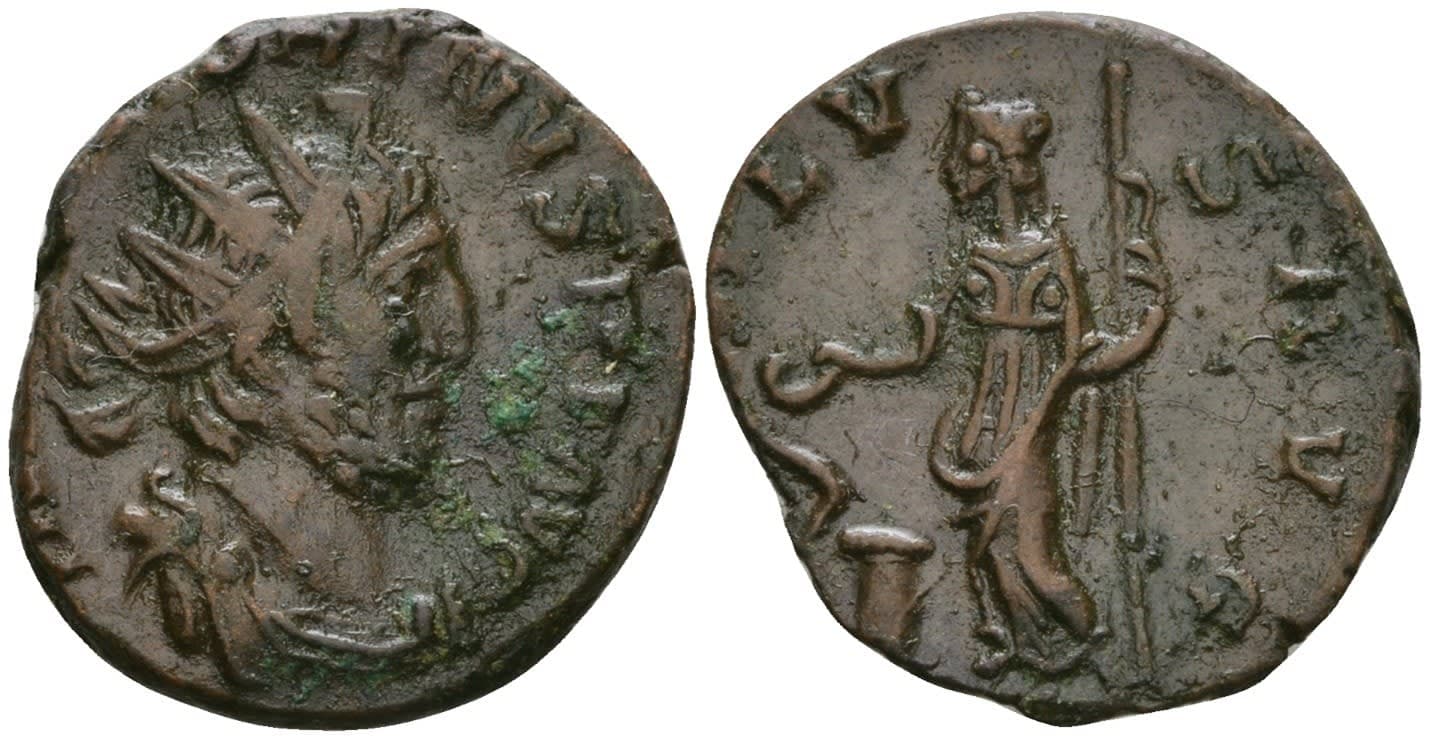
The third century of the Roman Empire was an age of enormous upheaval, fragmentation, and usurpation, and it was against this dramatic background that the vivid yet deeply contradictory story of Marcus Piavonius Victorinus unfolded. His biography is more than a simple chronicle of a rise to power; it is a historical testimony to the way personal ambition, family connections, and military valor became intertwined with fatal human weaknesses.
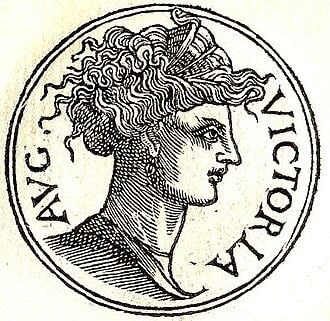
The origins of Marcus Piavonius Victorinus remain somewhat obscured by the limited testimony of ancient sources, yet his very name strongly suggests that his family was deeply rooted in the western provinces of the Roman Empire. The foundation of his future power was his mother, Victoria, who is also called Vitruvia in some accounts. She was a woman of extraordinary influence and was reportedly a cousin of Postumus himself, the powerful founder of the breakaway Gallic Empire.
It is impossible to determine with certainty whether Victorinus’ family had always been fabulously wealthy, whether it accumulated its fortune while serving under Postumus, or whether the wealth was acquired during Victorinus’ own reign. Yet the fact that, after her son’s death, Victoria was able to spend enormous sums bribing entire armies demonstrates the extraordinary prosperity of the family. Archaeological excavations at Augusta Treverorum, modern Trier, strongly support this image of wealth: a residence associated with Victorinus and decorated with magnificent mosaics has been regarded as one of the most luxurious homes of the Gallic aristocracy of the period.
The young Marcus appears to have owed his rapid rise largely to his mother’s patronage. Victoria is known to have visited Rome and may, through her considerable influence, have obtained an audience with Emperor Gallienus himself. The result of this diplomacy was the appointment of her son to an elite cavalry corps commanded by the celebrated general Aureolus.
When Postumus’ revolt broke out in Gaul, Victorinus was apparently serving far to the east, in Moesia. The decisive turning point in his life came in 264 CE. As part of the Roman forces, he participated in a punitive expedition to Gaul. After witnessing what he regarded as cruelty and senseless bloodshed, Victorinus made a momentous decision: together with some of the troops loyal to him, he defected to the rebel Postumus.
Trebellius Pollio, the author of Victorinus’ biography in the famous Historia Augusta, later described him as “a man energetic in military affairs,” an assessment that his subsequent career appears to justify.
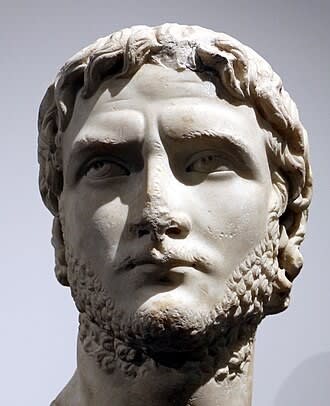
At the court of Postumus, Victorinus’ abilities fully emerged. He was initially appointed tribune of the Praetorians and then rose rapidly to the crucial office of praetorian prefect. He became the emperor’s right-hand man, tirelessly carrying out his orders: supervising large-scale efforts to strengthen the vulnerable Rhine frontier and personally repelling fierce raids by Germanic tribes.
When the legitimate Roman emperor Gallienus personally came to Gaul in an attempt to crush the rebellion by force, Victorinus became one of his principal opponents on the battlefield, having reinforced his army with contingents of recruited Germanic mercenaries.
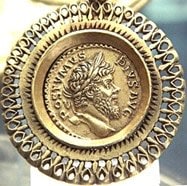
Trebellius Pollio claims that in the face of such a serious threat, Postumus even elevated Victorinus to the status of co-emperor. Direct documentary evidence for this is limited, and their joint consulship of 267 CE can be interpreted in different ways. Nevertheless, an important piece of numismatic evidence has survived: a coin of Postumus bearing the legend [SEC]VLVM AVGG, which appears to indicate the existence of two Augusti.
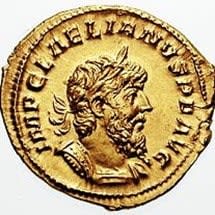
Victorinus’ military responsibilities eventually contributed indirectly to disaster for the state. When, as praetorian prefect, he left to pursue the dangerous rebel Laelianus, his absence from Mogontiacum proved fatal. Deprived of the protection of his best commander, Postumus was killed.
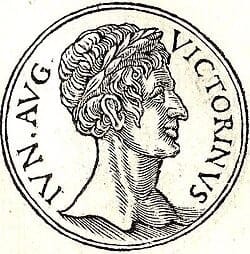
This catastrophe not only brought Marius to power but also plunged the Gallic Empire into deep instability. Marius’ reign was brief. He was murdered, and only two days after his death, at the end of 269 CE—but no later than December 10—the troops proclaimed Marcus Piavonius Victorinus emperor. On January 1, 270 CE, he formally assumed the consulship, taking upon himself the heavy burden of ruling a fragmented state.
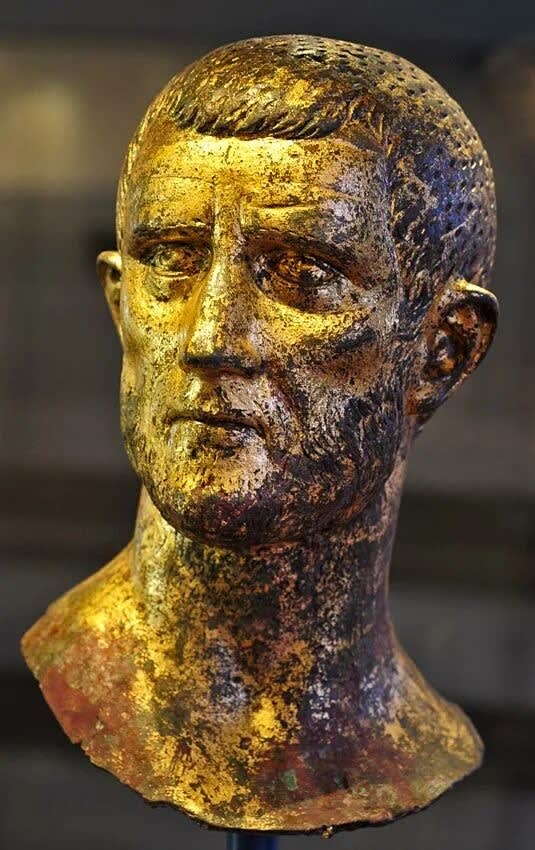
Victorinus was forced to devote most of his reign to desperate attempts to reunite the territories of the Gallic Empire, which had begun gradually breaking away and returning to the control of the central Roman government.
He succeeded in establishing his authority in Gaul and Britain and, through his outstanding personal and military qualities, won the loyalty of fourteen legions. Augusta Treverorum remained the official capital of the state, but Victorinus made strategically important Colonia Agrippina, modern Cologne, his personal residence.
Despite his efforts, Hispania was almost entirely lost, with the possible exception of some northwestern regions. Another serious setback was the loss of the eastern part of Gallia Narbonensis, where the cavalry forces of Julius Placidianus, prefect of the vigiles and a supporter of the Roman emperor Claudius II, firmly established themselves.
The remainder of Gallia Narbonensis appears to have adopted a cautious and uncertain position, while Raetia, according to some interpretations, may still have remained loyal to the Gallic throne.
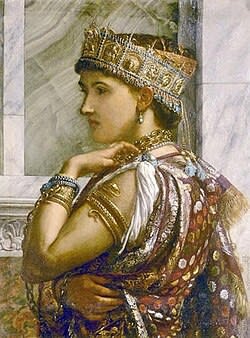
Victorinus attempted to pursue a complex geopolitical strategy. There is a plausible hypothesis that he sought to establish a strategic alliance with the distant Palmyrene Kingdom in the east. The famous Palmyrene queen Zenobia is said to have maintained secret correspondence with Victorinus’ mother, Victoria.
It is also possible that cautious contacts with the official Roman government were maintained simultaneously. Coinage of the period deliberately portrayed Victorinus as the genuine protector and savior of the civilian population of Gaul from the chaos of military anarchy. He sincerely attempted to preserve the state created by Postumus and continued many aspects of his predecessor’s political program.
Yet the resources required for large-scale policy were becoming desperately scarce. External pressure increased as Germanic peoples intensified their destructive raids, threatening the prosperous Moselle Valley. Internal support, particularly among the hardened armies of the Rhine, also began to deteriorate rapidly.
The reason was partly the emperor himself. Victorinus’ undeniable military abilities and positive qualities were overshadowed by what ancient authors presented as serious moral failings. They explicitly claim that his authority was undermined by excessive sexual behavior and an uncontrolled passion for other men’s wives.
The situation was aggravated by the emperor’s taste for theatrical display. His public appearances and elaborate receptions became increasingly pompous spectacles, reportedly irritating the battle-hardened legionaries.
The culmination of the political and military crisis was a major revolt at Augustodunum, modern Autun. For reasons that remain unclear, this important city broke with Victorinus, closed its gates against him, and openly declared its allegiance to the Roman emperor Claudius II.
The situation was further complicated by the simultaneous outbreak of a major Bagaudae uprising. Interestingly, the forces of Julius Placidianus stationed in Gallia Narbonensis chose not to intervene in the conflict, leaving the rebels to face the fury of the Gallic ruler alone.
Victorinus concentrated substantial forces around Augustodunum and began an exhausting siege that lasted seven long months. Only after the city had completely exhausted its food supplies and famine had begun did the rebellious stronghold finally fall.
Victorinus’ revenge was ruthless. Augustodunum was thoroughly plundered and devastated. The city remained in ruins for decades and recovered only in the fourth century.
Having achieved this grim victory, the emperor returned to his residence at Colonia Agrippina, unaware that he had very little time left to live.
His death came not from the sword of an enemy on the battlefield but, according to the ancient tradition, from the consequences of his own behavior. A conspiracy formed against Victorinus, led directly by an actuarius, an official responsible for army provisions, named Attitianus.
The motive was entirely personal: revenge for the emperor’s alleged affair with Attitianus’ wife.
Since resentment against Victorinus’ conduct had already been simmering among the Rhine legions for some time, Attitianus reportedly encountered little difficulty in gathering a group prepared to assassinate the ruler.
At the beginning of 271 CE, shortly after Victorinus once again assumed the powers of consul, the conspirators struck. The emperor was murdered, and on the same day, or shortly afterward, the life of his heir, Victorinus the Younger, also came to a tragic end.
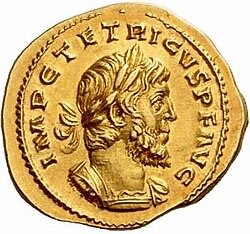
Yet the story did not end there. The death of the emperor once again brought the formidable Victoria onto the political stage.
Using her immense wealth, she bribed the legions and secured the election of Tetricus I as the new emperor. It was probably under her continuing influence that Tetricus formally deified the murdered Victorinus and granted him posthumous honors.
The historian Trebellius Pollio vividly relates that near Colonia Agrippina there stood a modest grave containing father and son, crowned by the severe inscription:
“Here lie the two Victorini — tyrants.”
Modern historians generally regard this epitaph as a literary invention of an ancient moralizing author rather than a genuine inscription. Nevertheless, it provides a striking conclusion to the story of a ruler whose life was marked by great battles, immense ambitions, and fatal passions, securing his name a permanent place in the complex and turbulent history of the Roman world.


