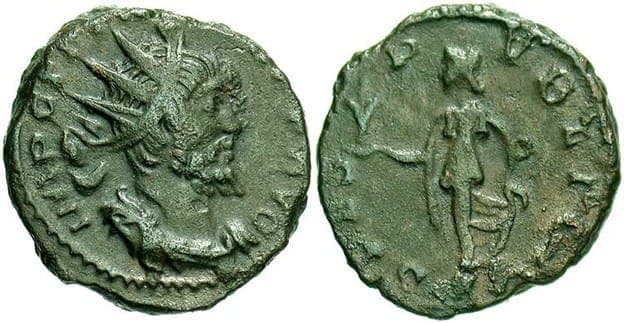
The third century CE entered the history of the Roman state as an age of profound crisis, chaos, and fragmentation. Against this grand historical backdrop unfolded the dramatic fate of Gaius Pius Esuvius Tetricus, the man destined to become the final ruler of the independent Gallic Empire.
The exact date of his birth has been lost in the darkness of the centuries, but it is known with certainty that he came from a wealthy and highly influential Gallic aristocratic family. His family name itself—Esuvius—served as a clear marker of his connection with the old Gallic nobility, which carefully preserved its ancient traditions. Historians continue to debate the origins of this name: some derive it from the Celtic tribe of the Esuvii, who lived along the coast of Brittany and were mentioned in the writings of Gaius Julius Caesar, while others see in it an echo of the name of the powerful Gallic deity Esus.
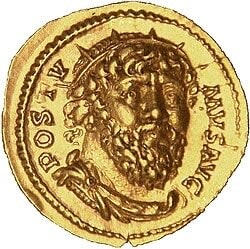
The sources preserve references to Tetricus holding the high rank of senator. Most likely, as an immensely wealthy landowner, he had been admitted to the senate under Postumus, the founder of the Gallic Empire. Modern scholars, however, remain divided on this point. The prominent Soviet historian of antiquity E. M. Shtaerman questioned the reliability of this information, whereas the French historian J. Colin regarded it as entirely credible.
There is also a third version, reported by the ancient author Aurelius Victor. According to him, Tetricus received senatorial rank much later, from the Roman emperor Aurelian, as a generous reward for his voluntary surrender.
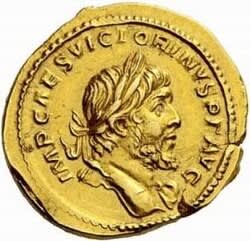
His path to supreme power was highly unpredictable. By 271 CE, when the Gallic emperor Victorinus fell victim to conspirators, Tetricus was far removed from the intrigues of the imperial court, serving as praeses, or governor, of the province of Aquitania.
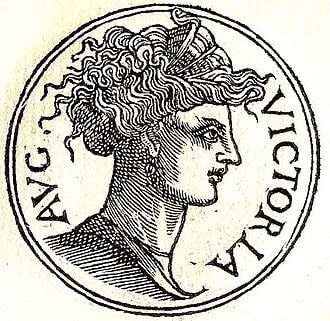
The death of the ruler threatened to plunge Gaul into complete anarchy, causing panic among the population and unrest within the army. At this critical moment, the mother of the murdered Victorinus—the powerful and enormously influential Victoria—entered the political stage. Taking control of the situation, she insisted that the vacant throne be given to Tetricus.
As historians have noted, this choice appeared rather surprising. Tetricus was a complete outsider to the hardened legionaries, and his residence at Burdigala, modern Bordeaux, lay at a safe distance from the principal centers of political and military unrest.
Moreover, his province of Aquitania appears to have maintained strict neutrality for a long period toward both the Gallic and Roman Empires. This is clearly suggested by the complete absence in the region of inscriptions honoring either Victorinus or the Roman emperor Claudius II.
At the same time, it is known that Aquitania provided a safe refuge for fugitives from Augustodunum, modern Autun, the city that had been ruthlessly devastated by Victorinus’ army.
For the army to accept a distant aristocrat as its ruler, enormous payments had to be distributed. Rumors also began to circulate that Tetricus was related to Victoria. Most likely, this connection was either extremely distant or deliberately invented in order to strengthen his legitimacy in the eyes of the soldiers.
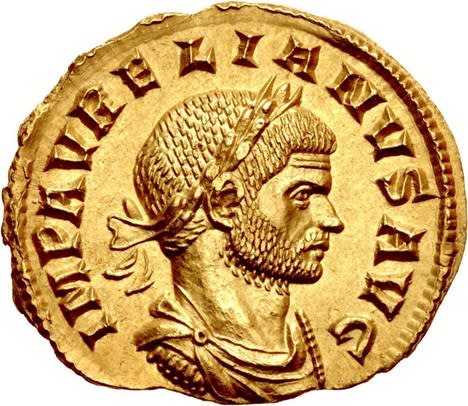
According to the Roman historian Eutropius, Tetricus was crowned directly at Burdigala. The German scholar I. König even proposed the bold hypothesis that during this unstable period a form of “dual principate” may have existed.
Whatever the case, the accession of the wealthy and refined aristocrat Tetricus symbolized a political reaction: the landowning nobility of Gaul, exhausted by the endless succession of brutal “soldier-emperors,” had taken its revenge.
The burden of power inherited by Tetricus, however, was extraordinarily heavy. He took control of the empire at a moment when its position was balanced on the edge of total catastrophe. The economy was in severe decline, the frontiers were collapsing under constant barbarian raids, and revolts repeatedly erupted in the provinces, both among local populations and dissatisfied legions.
In practice, the new emperor’s authority was recognized only in Gaul and Britain. In Hispania, despite incorrect claims made in the ancient Historia Augusta, he was no longer regarded as the legitimate ruler.
Nevertheless, Tetricus’ administration began working actively. Milestones and inscriptions bearing his name began to appear throughout Gallia Lugdunensis and Aquitania. By the second year of his reign, he had even managed to extend his sphere of influence as far as the Mediterranean coast.
No comparable evidence, however, has been found in either of the German provinces or in Belgica, strongly suggesting that the German legions stationed there had rebelled against the new emperor. In Britain, by contrast, his authority was recognized without serious resistance, as confirmed by numerous surviving inscriptions.
In foreign policy, Tetricus displayed exceptional caution. He made no attempt to expand his realm beyond Gaul and Britain, effectively surrendering the strategic initiative to Rome under the legitimate emperor Aurelian.
Tetricus had an excellent opportunity: while Aurelian was conducting a difficult war in the East against the Palmyrene Kingdom, the Gallic ruler could have attempted to recover southeastern Aquitania and the western part of Gallia Narbonensis, territories that had returned to Roman control during the reign of Claudius II. Instead, he chose not to provoke his powerful neighbor.
Leaving Burdigala, Tetricus traveled north toward the capital of the Gallic Empire, Augusta Treverorum, modern Trier. Along the way, he conducted a successful military campaign against Germanic peoples who had taken advantage of the disorder following Victorinus’ death to break through the Rhine frontier and engage in widespread raiding.
Only at the end of 271 CE did the emperor finally establish himself in the capital. The respite was brief. At the beginning of the following year, 272 CE, he was once again forced to lead troops against restless Germanic raiders.
After successfully completing this campaign toward the end of 272, Tetricus returned to Augusta Treverorum, which remained his principal residence until the final collapse of the Gallic Empire.
In the capital, on January 1, 273 CE, Tetricus solemnly celebrated his assumption of a second consulship. On the same significant day, he elevated his heir, Tetricus II, to the high rank of Caesar, thereby attempting to secure dynastic continuity.
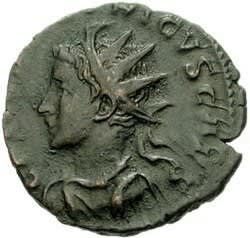
Another subtle political move was his order to deify the deceased Victorinus. Through this gesture, commemorated on coins bearing the portraits of both Tetricus and Victorinus, the new ruler sought to demonstrate his legitimacy and his loyalty to the political legacy of his predecessor.
Yet the clouds over Gaul continued to darken. Toward the end of Tetricus’ reign, a dangerous rebellion broke out under Faustinus, governor of the province of Belgica.
The crisis was made even worse when Augusta Treverorum itself openly supported the rebel. Tetricus and his son were forced to abandon their own capital in great haste.
Caught between military mutinies, uninterrupted barbarian incursions, and provincial rebellions, Tetricus resorted to a desperate measure.
According to the unanimous testimony of ancient historians, he secretly appealed to the Roman emperor Aurelian, asking him to take control of Gaul and rescue him. The writer Trebellius Pollio reports that in his message Tetricus quoted a dramatic line from Virgil:
“Unconquered one, deliver me from these troubles.”
It should be noted that the ground for negotiations had already been prepared for some time. Even under the Roman emperor Claudius II, senators had apparently attempted to intercede on Tetricus’ behalf in the hope of reaching a peaceful settlement, but Claudius’ premature death destroyed these plans.
Now, however, the Roman throne was occupied by the formidable Aurelian, determined to restore the unity of the Roman Empire and fresh from his triumphant recovery of the eastern provinces.
A secret correspondence began between the two rulers and eventually culminated in a personal meeting. During this meeting, Tetricus reportedly expressed his complete willingness to submit to Rome in exchange for firm guarantees protecting both his life and his family property.
The final act came swiftly.
On January 1, 274 CE, Tetricus and his son entered their third consulship and marched south with their army to meet the Roman legions.
In February or March of that year, near Durocatalaunum, modern Châlons-en-Champagne, the two armies came face to face.
According to the traditional version of events, Tetricus arranged his troops in battle formation merely for appearances and defected to Aurelian’s camp at the very beginning of the battle.
Deprived of their commander, the Gallic legions were quickly overwhelmed, scattered, and decisively defeated.
On that day, the Gallic Empire ceased to exist forever.
Aurelian proved true to his word: he spared the lives of Tetricus and his son.
In the spring of 274 CE, during the magnificent triumphal procession held in Rome to celebrate the reunification of the empire, both Tetrici were publicly paraded in humiliation before the victor’s chariot.
Immediately afterward, however, the fate of the former emperor took an extraordinary turn. Aurelian appointed him to the prestigious office of corrector, or governor, of the province of Lucania. Some sources go even further and claim that he became corrector of all Italy.
Rome evidently had need of an experienced administrator to help restore order in the provinces.
Tetricus lived peacefully in Italy for many more years and eventually died at a very advanced age.


