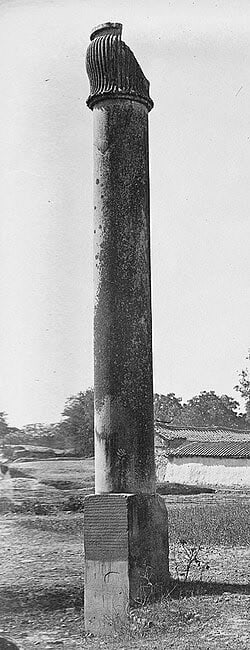
The early years of Skandagupta remain the subject of intense scholarly debate, at the center of which lies the mystery surrounding the identity and social status of his mother. The famous inscription of Skandagupta on the Bhitari Pillar carefully lists the chief queens, or mahadevis, of his illustrious predecessors—Chandragupta I, Samudragupta, and Chandragupta II—yet, paradoxically, it omits the name of the chief queen of his own father. This silence gave rise to the hypothesis that the future emperor’s mother may have been a junior wife or even a concubine.
Historian J. F. Fleet, interpreting one line of the Bhitari inscription as stating that Skandagupta had been “raised to Aryan status by the praises of bards,” proposed a bold theory later supported by A. L. Basham: the ruler’s mother may have belonged to the lower Shudra caste. This interpretation, however, was strongly criticized by several other distinguished scholars.
Dasharatha Sharma and Jagannath Agrawal argued convincingly that Skandagupta’s mother enjoyed immense respect from her powerful son. Agrawal challenged Fleet’s translation and proposed an alternative, more poetic reading: “He before whom nobility itself blushes when his deeds are celebrated in songs and words of praise.” The scholar noted that the line was probably inspired by Kalidasa’s Raghuvamsha and that the Bhitari inscription itself was a prashasti, a eulogistic text in which any degrading reference to the king’s mother would have been unthinkable. Historian Jappen Oberoi supports this interpretation, insisting that Skandagupta’s mother was a legitimate queen, even if she was not the principal one.
The inscription also contains a deeply symbolic and emotional episode: after defeating his enemies, Skandagupta visited his widowed mother, whose eyes filled with “tears of joy,” just as the legendary hero Krishna came to his mother Devaki. Some scholars took this comparison literally and suggested that the king’s mother may actually have been named Devaki. Historian R. C. Majumdar, however, sees a subtler metaphor: the comparison with Devaki was intended to emphasize her initially humiliated position within the palace hierarchy until her victorious son restored her rightful prestige and supreme status.
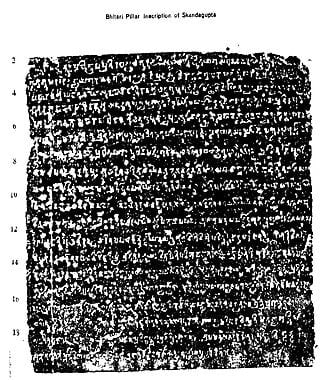
Skandagupta’s accession to the throne took place in Year 136 of the Gupta Era, approximately 455–456 CE, and was accompanied by major upheavals. The Bhitari inscription vividly states that the young commander had to restore the “shaken fortunes of his family.” Preparing for decisive battles, he spent nights sleeping on the bare ground and then unleashed his fury upon enemies who had already grown powerful and wealthy.
Who were these enemies? Many scholars read their name as the Pushyamitras, a tribe mentioned in the Puranas and associated with the Narmada River valley. Another linguistic interpretation proposes the reading “Yudhyamitras,” which simply means “enemies.” Did they invade the empire during the final years of Kumaragupta I, or did they exploit the chaos following his death?
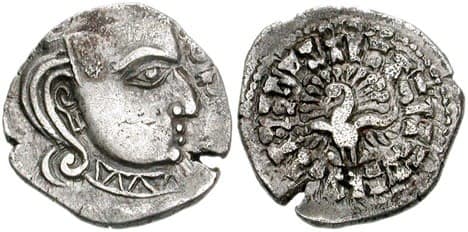
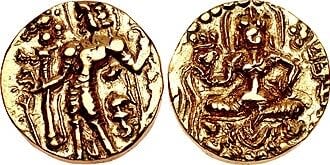
There is also a substantial theory that the conflict arose from a violent dynastic civil war. An inscription carved into the Junagadh Rock at Mount Girnar states that after his father’s death Skandagupta became “ruler of the earth” solely through his own valor, while the goddess of fortune, Lakshmi, chose him as her husband and rejected the other “royal sons.” This theme also appears in numismatic imagery: some coins depict a woman—probably Lakshmi, although some scholars identify her as a queen—presenting the ruler with a garland or ring as a symbol of divine sanction for his kingship.
The theory of civil war is indirectly supported by the fact that the Bhitari inscription refers three times to a crisis of the royal family itself, using the words kula or vamsha, rather than to a crisis of the state as a whole. Indeed, after Kumaragupta’s death, several figures appear to have asserted their independence: his brother Govindagupta, his relative Ghatotkachagupta, and a certain Prakashaditya, whose name survives only on gold coins. Skandagupta therefore had to prove his right to the throne by force of arms.
This may also explain why Skandagupta’s name is absent from the genealogies of later Gupta rulers, such as the seal of Kumaragupta III from Bhitari. Power ultimately passed to the line of his half-brother Purugupta, whose descendants listed only their own direct ancestors.
No sooner had Skandagupta suppressed the internal disturbances than he faced a terrifying external threat. From the northwest, having reached the Indus River, hordes of Indo-Hephthalites—the White Huns—invaded India.
The scale of the confrontation was extraordinary. The Bhitari inscription preserved for later generations an echo of that great battle:
“Skandagupta, by whose two arms the earth trembled when he entered close combat with the Hunas, creating a disturbance like a terrible whirlpool... among the enemies... the arrows... proclaimed... as though it were the roar of the River Ganges sounding in their ears.”
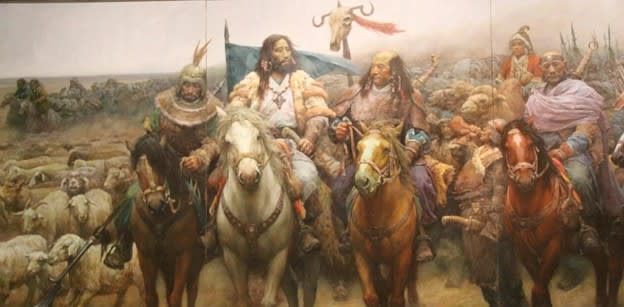
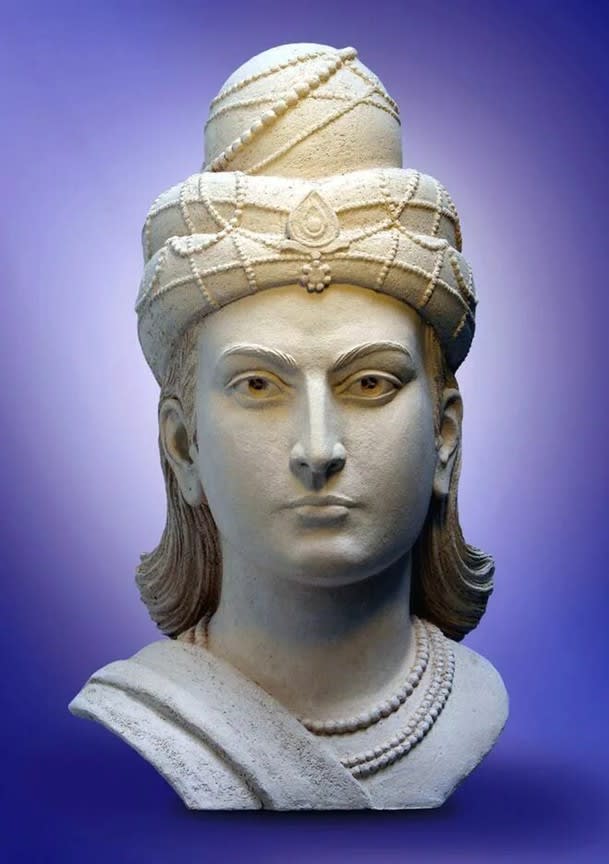
The exact date of this epic confrontation remains unknown. The inscription mentions it after the victory over the Pushyamitras, suggesting that it occurred at a later stage of his career. However, the Junagadh inscription, dated to Year 138 of the Gupta Era, or 457–458 CE, refers to the total defeat of the mlechchhas, or foreigners, whose pride had been completely crushed.
Since no other major foreign invasion is recorded for this period, these mlechchhas were almost certainly the Huns. Remarkably, this victory appears to have occurred before Year 136 of the Gupta Era, when Skandagupta appointed a governor in Saurashtra. This creates an intriguing scenario: Prince Skandagupta may have been sent to the frontier to repel the Hunnic advance, and during the campaign his father died in the capital. Returning as a victorious commander, Skandagupta suppressed his rivals and seized the throne.
The memory of his triumph survived for centuries. The seventh-century Sanskrit grammatical treatise Chandra-vyakarana contains the phrase Ajayad-Gupto Hunan—“the Gupta defeated the Huns”—although K. P. Jayaswal proposed the alternative reading Jato. The famous eleventh-century collection Kathasaritsagara also contains a legend about King Vikramaditya, a title associated with Skandagupta, who after the abdication of his father Mahendraditya, a title of Kumaragupta I, inflicted a crushing defeat upon the mlechchhas.
Having secured his position, the emperor turned to the restoration of the state. The Junagadh inscription states that Skandagupta carefully selected his provincial governors. Parnadatta was appointed to the strategically vital province of Saurashtra, being the only official who supposedly satisfied the emperor’s exceptionally strict requirements. Whether these requirements constituted an actual formal code or merely rhetorical praise of Parnadatta remains uncertain.
Parnadatta, in turn, entrusted the administration of Girinagara, the capital of Saurashtra in the region of modern Junagadh and Girnar, to his son Chakrapalita.
Chakrapalita soon faced a serious challenge. Around 456–457 CE, corresponding to Year 137 of the Gupta Era, the dam of the ancient Sudarshana Lake catastrophically collapsed. This enormous reservoir had first been constructed under Chandragupta Maurya and Ashoka and had later been rebuilt by Rudradaman around 150 CE. Sparing “immeasurable wealth,” Chakrapalita constructed a new and powerful dam and built a temple of Vishnu to commemorate the achievement.
Control over the western territories had to be defended not only against natural disasters. An inscription of Narendrasena, a ruler of the Vakataka dynasty and a contemporary of Skandagupta, boldly declares that Kosala, Mekala, and Malava obeyed his commands.
Since Malava had long formed part of the Gupta Empire, Narendrasena evidently exploited the period of disorder to invade neighboring Gupta territories. Skandagupta, however, quickly restored these lands to imperial control. An inscription dated to 460–461 CE already confidently praises the “peaceful reign of Skandagupta, lord of a hundred kings.”
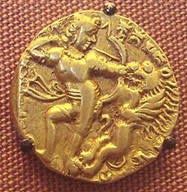
Wars on such an unprecedented scale inevitably affected the economy of the empire. This is clearly reflected in the numismatic evidence. Compared with his great predecessors, Skandagupta issued fewer gold coins, while some of them contained a reduced proportion of pure precious metal, indicating growing pressure on the imperial treasury.
As a result, during his reign the emperor introduced an important monetary reform, adopting a new suvarna standard weighing approximately 9.2 grams. All later coins were issued exclusively in the “Archer” type under this new standard, which was subsequently adopted by later Gupta rulers.
The last securely known date associated with Skandagupta is Year 148 of the Gupta Era, corresponding to 467–468 CE, although he probably continued to rule for several years afterward.
With his death, the empire entered another succession crisis. Skandagupta died without direct heirs, or perhaps a hypothetical son of his was overthrown. The throne passed to Purugupta, his half-brother and the son of Kumaragupta I’s chief queen. It is possible that Purugupta’s youth at the time of their father’s death had originally allowed Skandagupta to seize power.
Thus ended the age of Skandagupta—a commander, savior, and reformer. He inherited an empire standing at the edge of catastrophe, defended it against foreign hordes and internal upheaval, and left behind a state whose greatness would continue to illuminate the history of ancient India for generations.


