At the dawn of an age destined to become the Golden Age of India, the Gupta Empire gained a ruler whose name would be forever written into history as a symbol of military valor and cultural flourishing. Samudragupta, son of Emperor Chandragupta I and Queen Kumaradevi of the ancient and noble Lichchhavi clan, seemed destined for great achievements. His accession to the throne is described in a partially preserved stone inscription from Eran, which states that his elderly father chose him as successor because of his “devotion, righteous conduct, and valor.” The same solemn scene is commemorated on the famous Allahabad Pillar: in the presence of the entire court, Chandragupta I declared his son to be a noble man and entrusted him with the mission of “protecting the earth.”
The transfer of power, however, was not entirely smooth. When the emperor announced his decision, the faces of other claimants of “equal birth” darkened. Historians still debate who these disappointed figures were: neighboring rulers who recognized the threat posed by the new emperor, or other Gupta princes whom Samudragupta had surpassed because of his prestigious descent through the Lichchhavi princess.
Closely connected with this dynastic mystery is the enigma of coins bearing the name of a king called Kacha, who carried the title “destroyer of all kings.” These coins bear a striking resemblance to those of Samudragupta. Was Kacha a rival brother who ruled briefly, or was it an early name of Samudragupta himself, who only later, after expanding the empire as far as the ocean, adopted the majestic throne name Samudra—“Ocean”? There is no definitive answer. One fact, however, is beyond dispute: supreme power had passed into the hands of a man of extraordinary energy.
Samudragupta’s principal political objective became dharani-bandha—the “unification of the earth.” He aspired to the ancient ideal of the chakravartin, the universal sovereign whose authority extended to the boundaries of the known world. His extraordinary military career, described in detail by his minister and commander Harishena in the eulogistic prashasti engraved on the Allahabad Pillar, was without parallel. The inscription claims that the emperor passed through a hundred battles and received a hundred wounds, which shone upon his body like marks of glory, earning him the title Prakrama—“the Valiant.” In a later Mathura inscription issued by his son Chandragupta II, he is described as a man whose “fame was tasted by the waters of the four oceans.”
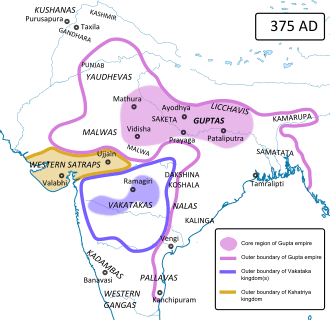
His first blows fell upon the kings of the North. Early in his career, Samudragupta “uprooted” Achyuta, Nagasena, and a ruler whose name is reconstructed as Ganapati-naga, probably the leader of the Mathura branch of the Naga dynasty. After defeating these rulers of the western part of modern Uttar Pradesh, the emperor initially showed mercy and restored them to their thrones.
Later, however, they apparently rebelled, forcing Samudragupta to crush them decisively during his conquest of Aryavarta. Meanwhile, the Gupta army captured an unidentified ruler of the Kota lineage, possibly from Punjab, while the emperor himself, according to the inscription, was casually “playing” or resting in the city of Pushpa, identified with Pataliputra. Scholars disagree over whether this “play” refers to the king’s youth, his deliberate absence from an insignificant theater of war, or simply a literary device intended to emphasize the ease of the victory.
If Samudragupta acted ruthlessly in the north, his southern campaign into the region of Dakshinapatha became a masterpiece of military strategy and diplomacy. After crossing the forested regions of Central India, his army reached the eastern coast in modern Odisha and advanced southward along the Bay of Bengal. The campaign, perhaps motivated by a desire to control the prosperous trade routes leading toward Southeast Asia, resulted in the capture of twelve southern rulers.
Among them were Mahendra of Kosala, possibly Mahendraditya of the Nala dynasty; Vyaghra-raja of the wild forest region of Mahakantara; Mantaraja of Kurala; Mahendragiri of Pishtapura; and Svamidatta of Kottura. Also defeated by Gupta forces were Damana of Erandapalla, Vishnugopa of the Pallava dynasty at Kanchipuram, Nilaraja of the mysterious Avamukta, and Hastivarman of Shalankayana Vengi. The list of defeated rulers was completed by Ugrasena of Palakka, Kubera of Devarashtra in Kalinga, and Dhananjaya of Kusthalapura.
After capturing these rulers, Samudragupta performed an unexpected act of clemency: he released them and granted them anugraha—favor and protection—restoring them to their thrones as tributary vassals.
The French Indologist Georges Dubreuil believed that the emperor encountered a powerful coalition near the Krishna River and was forced to retreat, while his chroniclers merely transformed a defeat into a victory. Most modern historians, including Ashvini Agrawal, reject this interpretation. Samudragupta’s actions were consistent with the ancient Indian ideal of the dharma-vijayin, the righteous conqueror described by Kautilya. Like the legendary King Raghu of Kalidasa’s epic Raghuvamsha, he deprived defeated rulers only of their royal glory, rather than their kingdoms, transforming former enemies into a dependable buffer along the southern frontier.
In Aryavarta in the north, his policy was fundamentally different: it followed the model of the asura-vijayin, or demonic conqueror. There, Samudragupta “forcibly uprooted” eight rulers whose territories were directly incorporated into the empire. Among the victims of imperial expansion were Rudradeva, sometimes associated with the Shaka Western Kshatrapas; Matila; Nagadatta; Chandravarman of Pushkarana; the Naga rulers Ganapati-naga, Nagasena—who, according to the Harshacharita, was betrayed by a sarika bird—and Achyuta-nandin; as well as Balavarman, possibly a ruler of Kaushambi or an ancestor of the Maukhari dynasty.
The kings of the forest regions, or atavikas, in Central India also experienced the emperor’s power. According to some accounts, eighteen forest kingdoms were completely subdued. At Eran, Samudragupta apparently overthrew the local Shaka ruler Sridharavarman and established his own authority, as indicated by a stone inscription discovered there that praises the emperor and records the installation of an image of Vishnu in a temple.
The empire grew so powerful that numerous frontier kings and tribal communities submitted voluntarily, paying tribute and appearing at the imperial court. Among the frontier kingdoms were Samatata and Davaka in Bengal and Assam, Kamarupa, the kingdom of Nepal—possibly connected with his Lichchhavi relatives—and Kartripura in Uttarakhand.
Proud tribal oligarchies also submitted to Gupta authority: the Malavas, Arjunayanas, Yaudheyas, who controlled the lands between the Sutlej and Yamuna rivers, Madrakas, Abhiras, Sanakanikas, Kakas, Prarjunas, and the mysterious Kharaparikas, whose name has been interpreted as “thieves.” The empire now extended from the Ravi River in Punjab to the Brahmaputra in the east, and from the Himalayan foothills southward to the Vindhya Mountains and Eran.
Samudragupta’s fame spread far beyond the Indian subcontinent. Powerful neighboring states sought his favor, offering gifts, princesses in marriage, and requesting permission to use the Gupta seal bearing the image of Garuda. Among them were rulers of the northwest—the Daivaputra-Shahi-Shahanushahi, possibly descendants of the Kushans or Sasanian vassals, and the Shaka-Murundas.
Historians such as S. R. Goyal and A. Agrawal have suggested that Samudragupta formed a powerful alliance with the Central Asian ruler Kidara I against the formidable Sasanian shah Shapur II, and that their joint victories in 367–368 CE permanently altered the regional balance of power. Echoes of these major conflicts may even have reached Rome, where one Roman historian mentioned the arrival of an Indian embassy in 351 CE.
Diplomacy in the south was equally successful. Meghavarna, king of Simhala, or Sri Lanka, sent lavish gifts in order to obtain permission to construct a monastery for pilgrims at Bodh Gaya—a fact later confirmed centuries afterward by the Chinese traveler Xuanzang. Relations were also maintained with the “other islands,” meaning the states of Southeast Asia, where Indian culture and Sanskrit spread along maritime routes from the port of Tamralipti.
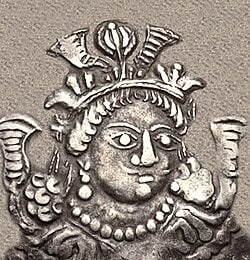
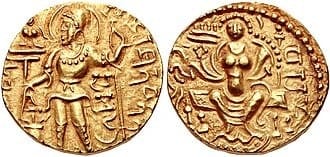
The economic power of the empire was reflected in a brilliant numismatic reform. Samudragupta became the first Gupta ruler to issue coinage. Initially adopting Kushan minting technologies, weight standards, and even the term dinar, derived from the Roman denarius aureus, he quickly gave his coinage a distinctly Indian character.
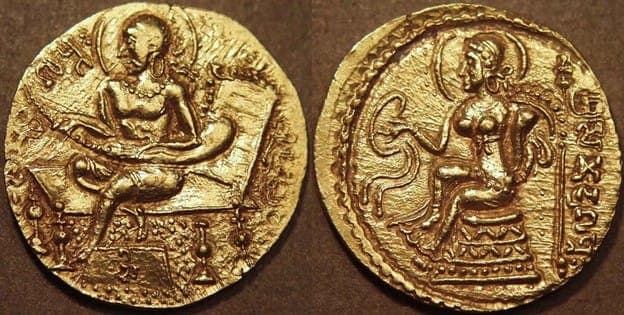
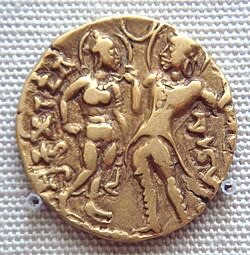
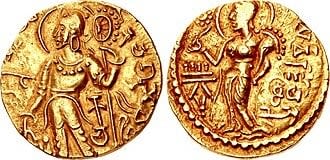
Pointed Kushan caps and the Kushan trident were replaced by close-fitting Indian headgear, elegant jewelry, and the Garuda standard. His gold coins were genuine works of art: the “Archer” type proclaimed him invincible in chariot warfare; the “Battle-Axe” type compared him with Kritanta, the god of death; another type showed him as the “Tiger-Slayer”; and especially notable were commemorative coins depicting his parents, Chandragupta I and Kumaradevi.
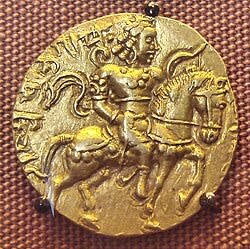
The culmination of Samudragupta’s reign was the performance of the ashvamedha, the ancient horse-sacrifice ritual symbolizing undisputed imperial supremacy. Unlike the rulers of the Bharashiva or Vakataka dynasties, whose rituals were primarily religious in nature, Samudragupta’s ashvamedha, performed according to the elaborate chirotsanna tradition, became a triumph on a universal scale.
Special gold coins were issued to commemorate the ritual, bearing an inscription proclaiming:
“Lord of kings... having protected the earth, conquers heaven.”
As a parama-bhagavata, an ardent devotee of Vishnu, Samudragupta performed Brahmanical rituals such as sattra and diksha, donating millions of cows and mountains of gold to Brahmins. In the eyes of his subjects, he resembled the Supreme Being, the Parama-Purusha, and was compared with the gods: Kubera, or Dhanada, in enjoyment; Yama, or Antaka, in anger; as well as Indra and Varuna.
Yet behind the image of the stern ruler—the prachanda-shasana—and the tall, muscular warrior lay a refined and cultivated personality. The Allahabad prashasti praises his compassion toward the weak, the poor, and the sick. He was an unrivaled poet who bore the title “King of Poets,” as well as a gifted musician.
Coins of the “Musician” type depict the king seated cross-legged and playing the vina. According to his contemporaries, his skill surpassed even that of the celestial musicians Tumburu and Narada, while the sharpness of his intellect exceeded that of Brihaspati, the teacher of the gods.
Samudragupta represented a Hindu response to the pacifist ideals associated with King Ashoka. Whereas Ashoka had sought greatness through moral supremacy and dhamma, Samudragupta restored the traditional image of the warrior-king, the armed defender of dharma. He was possibly the first historical ruler to adopt the title Vikrama, thereby contributing to the later legends surrounding the great King Vikramaditya.
Around 375 CE, the brilliant age of Samudragupta came to an end. According to official records, the throne was inherited by his son Chandragupta II, born to Queen Dattadevi.


