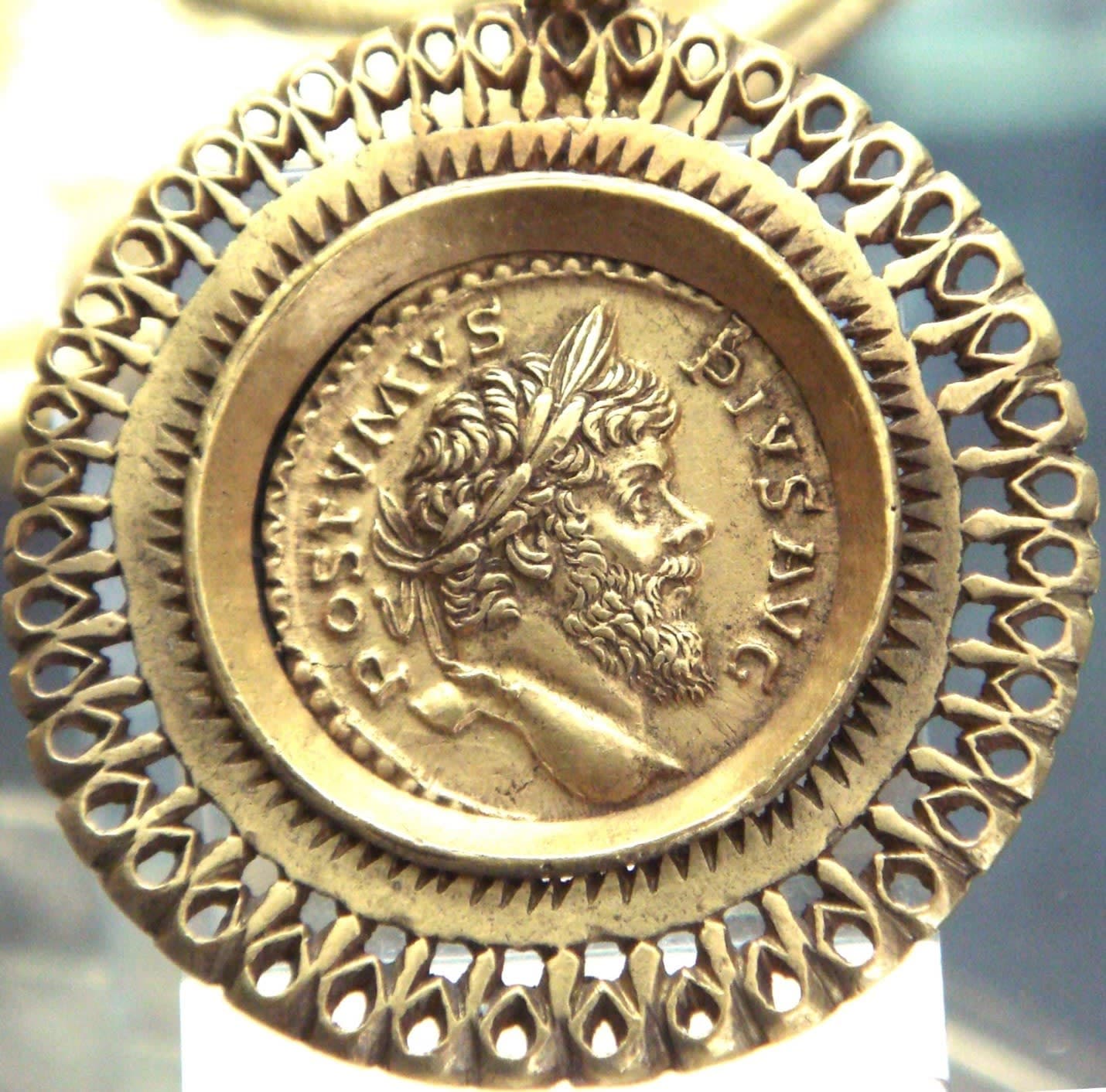

The third century CE became one of the most severe periods of crisis in the history of the Roman Empire—a time of endless civil unrest, fragmentation, and foreign invasions. It was against this dramatic historical background that the fate of Marcus Cassianius Latinius Postumus unfolded: a man of humble origins who was destined to become the founder and ruler of a vast independent state that entered history as the Gallic Empire.
Postumus was probably a Gaul and appears to have come from relatively modest social circumstances. Yet the harsh school of military service in the Roman legions stationed along the turbulent Germanic frontier transformed him into an outstanding commander. Through his abilities, he gradually rose from an ordinary soldier to a high-ranking governor, eventually receiving authority over two strategically crucial provinces—Germania Superior and Germania Inferior.
When the empire entered yet another phase of internal chaos, the legitimate emperor Gallienus, forced to leave the region in order to address other crises of state, placed his young son Saloninus on the Rhine frontier. The defense of the border and the protection of the imperial heir were entrusted to several experienced commanders, among them Postumus and Silvanus, commander of the Praetorian Guard.

Freed from the emperor’s direct supervision, Postumus distinguished himself brilliantly on the battlefield. He successfully repelled several fierce raids by Germanic peoples, including the Alemanni and the Franks. These victories not only secured the frontier but also brought Postumus enormous prestige among the legionaries.
Aware of his growing strength and supported by loyal troops, the commander became increasingly confident. His relations with the representatives of central imperial authority—Saloninus and the prefect Silvanus—deteriorated rapidly until they developed into open confrontation.
Gathering the German legions loyal to him, Postumus marched against Colonia Agrippina, modern Cologne, where Saloninus and Silvanus had taken refuge, and placed the city under siege. The assault succeeded: the city fell, and the emperor’s young son together with the commander of the Praetorian Guard were executed on the victor’s orders.
Immediately after this triumph, the army proclaimed Postumus emperor. To commemorate the event, he ordered the construction of a magnificent triumphal arch in Cologne and made the city the splendid capital of his new state.
Postumus’ authority was recognized not only by his own legions. Vast territories in the western part of the Roman Empire came under his control: all of Gaul, Germania Superior and Germania Inferior, Hispania, Britannia, as well as parts of several frontier provinces.
Postumus did not simply seize power—he began constructing a fully functioning state independent of Rome. An administration modeled closely on the Roman system was established in Cologne. A separate senate was convened, an independent Praetorian Guard was created, and the office of two annually elected consuls was maintained. Postumus himself held this highest magistracy five times.
Under the new ruler, the capital experienced genuine prosperity: Cologne expanded considerably and underwent extensive reconstruction.
One of the most important sources of information concerning Postumus’ politics and ideology is his coinage, which was produced on an extraordinary scale. At this stage, the economy of the Gallic Empire proved stronger than that of Rome itself. The gold aurei issued by Postumus appeared considerably more substantial than those minted by Gallienus in Rome and contained significantly more precious metal.
The numismatic art of the period also produced unusual artistic innovations. Whereas the overwhelming majority of Roman rulers were depicted in profile, some of Postumus’ coins portrayed the emperor facing directly toward his subjects.

These same coins bore the proud title “Restorer of the Gauls” (RESTITVTOR GALLIARVM). This fitted perfectly into Postumus’ political propaganda: he claimed that he had no intention of seizing control of the entire Roman Empire and was merely fulfilling the duty originally entrusted to him by Gallienus—to defend Gaul from barbarian attacks.
His actions supported this claim. In 261 CE, Postumus successfully repelled another major assault by Germanic tribes, providing a strong justification for his celebrated title.

The legitimate emperor Gallienus, however, had no intention of accepting such a division of the Roman state. In 263 CE, after assembling sufficient forces, he launched a major military campaign against Postumus.
Initially, fortune favored the Roman army, but during one of the crucial engagements an unexpected event changed the situation: Gallienus suffered a severe wound. Forced to preserve his life and health, the emperor withdrew.
After this incident, Gallienus redirected his attention toward other equally dangerous regions of his empire, which was already breaking apart under the pressure of multiple crises. He made no further serious attempt to destroy Postumus.
It seemed that every path now lay open before the ruler of the Gallic Empire. Around 268 CE, Aureolus, one of Gallienus’ commanders stationed with troops at Mediolanum, modern Milan, rebelled against the emperor, openly declared his support for Postumus, and even began issuing coins bearing the image of the Gallic ruler.
This created an ideal bridgehead for an invasion of the Italian Peninsula and potentially even for the seizure of Rome itself. Postumus, however, remained committed to his defensive strategy. He did not exploit this remarkable opportunity, did not send his army into Italy, and left Aureolus without support, allowing him to be besieged in Mediolanum.

This period of stability did not last long, and the end of Postumus’ story proved as sudden as it was tragic.
In the same year, 268 CE, or perhaps in 269, a mortal threat emerged against the ruler of Gaul himself. One of his senior and most trusted commanders, Laelianus, rebelled. Supported by local garrisons and the celebrated Legio XXII, he was proclaimed emperor in the city of Mogontiacum, modern Mainz.

Postumus reacted immediately. He transferred his army to Mogontiacum, placed the city under a severe siege, and after a successful and bloody assault captured it, ordering the execution of the rebel Laelianus.
The revolt had been crushed, but this victory proved fatal for Postumus himself.
The soldiers, excited by battle, demanded permission to plunder the conquered city. Postumus, however, regarded Mogontiacum as part of his own empire and its inhabitants as his own citizens, and therefore categorically prohibited looting.
This decision cost him his life. The mutinous troops, furious at being deprived of the expected spoils, murdered their undefeated commander.
The death of Marcus Cassianius Latinius Postumus marked the beginning of the end for the state he had created. Immediately after his death, Hispania broke away from the Gallic Empire, followed soon afterward, most likely, by Britannia.
The greatly reduced territories were inherited by Marcus Aurelius Marius, but the former power of the Gallic Empire was never fully restored.
Postumus himself entered the annals of Roman history forever. In the famous work Historia Augusta, he was included among the so-called Thirty Tyrants—the audacious military leaders who dared to challenge the authority of Rome itself.


