
His path to a shadowy throne began long before his birth, amid the intricate web of political intrigue between Romans and barbarians. Romulus was born around 460 or 461 and was named after his maternal grandfather, Romulus, the comes of the province of Noricum, who came from Poetovio (modern-day Ptuj). Yet the true architect of his fate was his father — Flavius Orestes, a native of Pannonia and a Roman patrician. Orestes was a man with a remarkable and dangerous past: he had once served as a notarius (secretary) at the court of the “Scourge of God” himself — Attila, king of the Huns.
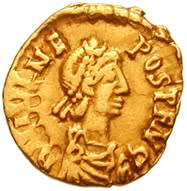
In 475, the legitimate emperor Julius Nepos, desperately attempting to preserve his crumbling authority, made a fatal mistake: he appointed Orestes commander of the Italian army in place of Ecdicius Avitus. Feeling the strength of the troops loyal to him, Orestes immediately launched a rebellion. In August 475, his forces triumphantly captured Ravenna, the capital of the Western Empire. Emperor Julius Nepos fled across the Adriatic Sea to Dalmatia, where his uncle Marcellinus had established a semi-independent state.

After capturing the capital, Orestes paused. For approximately two months, he waited, probably assessing the possible reaction of the imperial court in Constantinople.
Why he did not place the imperial diadem upon his own head remains a mystery. The Byzantine historian Evagrius Scholasticus claimed that Orestes proclaimed himself king, but most scholars believe that the cunning commander concluded that the Romans would be more willing to accept his young son as emperor, since through his mother the boy had more noble Roman blood in his veins.
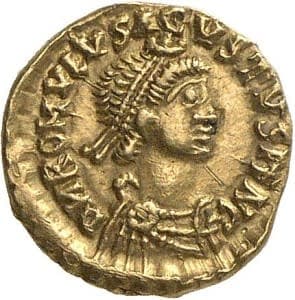
Thus, on October 31, 475, the boy was officially elevated to the throne under the name Romulus Augustus. The inscription on his coins proudly proclaimed: “Dominus Noster Romulus Augustus Pius Felix Augustus” (“Our Lord Romulus Augustus, Pious, Fortunate Augustus”), demonstrating that he bore the name “Augustus” from the very beginning of his nominal reign.
Naturally, real power remained in the hands of Orestes. Yet what he ruled was little more than a miserable fragment of Rome’s former greatness. By the time of Romulus’s coronation, the Western Roman Empire had shrunk to Italy itself and a tiny strip of territory in southern Gaul.
The legitimacy of the new dynasty was negligible. Afranius Syagrius, the ruler of northern Gaul, flatly refused to recognize the authority of Ravenna. The Eastern emperor Zeno likewise regarded Romulus as a usurper and continued to recognize Julius Nepos as the legitimate Western emperor. After all, Zeno’s predecessor, Leo I “the Thracian,” had previously played a decisive role in placing both Nepos and Procopius Anthemius on the Western throne.

Because of his youth and his status as an absolute puppet, Romulus Augustus left virtually no record of independent governmental activity. The only material traces of his ten-month reign are his coins.
Gold solidi were minted in Rome, Mediolanum, Ravenna, and Arelate, largely to finance the loyalty of barbarian troops. Several silver coins from Ravenna are also known, whereas historians have found no bronze coinage attributable to the reign of Augustulus at all — a fact that vividly reflects the collapse of the everyday monetary economy.

It was precisely the question of money and land that became the catalyst for the final catastrophe.
By this time, the Western Roman army consisted largely of a diverse collection of Germanic soldiers and mercenaries — Heruli, Rugii, and Sciri. Revenues from devastated Italy were declining, the treasury was being emptied, and the financing of the army was deteriorating catastrophically.
The barbarians were well aware of precedents elsewhere in the empire. Earlier in the fifth century, Emperor Honorius had reached an arrangement with the Visigoths that allowed them to settle on Roman territory in Gaul. The Germanic soldiers stationed in Italy now demanded something similar: they wanted one-third of the Italian lands to be allocated to them for permanent settlement.
There is also a theory that Orestes had originally promised them these lands in return for helping him overthrow Julius Nepos, only to break his promise afterward. Whatever the truth, when Orestes firmly rejected their demands, the army rebelled.
The enraged soldiers chose a new leader. He was one of Orestes’s senior officers — Flavius Odoacer. A Scirian, or possibly a Rugian, by origin, he was the son of a man who had once served as an envoy of Attila to Constantinople. Odoacer had previously served under Emperor Anthemius and had fought alongside Orestes during the overthrow of Julius Nepos. Now he turned his weapons against his former commander.

Realizing the scale of the rebellion, Orestes attempted to seek refuge behind the powerful walls of Ticinum, modern-day Pavia. But the walls could not save him: the city was stormed and brutally plundered.
Orestes escaped, but on August 28, 476, he was captured near Placentia and executed. His brother Paulus attempted to fight the rebels but was killed in a wooded area near Ravenna.
The fate of the young emperor was now sealed. Entering Ravenna, Odoacer forced the frightened boy-emperor to abdicate. This took place on September 4, 476.
Immediately after the coup, Odoacer carried out a remarkably skillful diplomatic maneuver.
Having learned that Zeno had once again firmly secured the throne in the East, he compelled the Roman Senate to send a humiliating but potentially lifesaving delegation to Constantinople. The senators carried the imperial insignia and a message in which it was declared that Rome no longer required an emperor of its own. Zeno alone, as a common emperor, would be sufficient for both parts of the Roman state.
The Senate requested that Odoacer, described as “a man capable of protecting the state through his political wisdom and military ability,” be granted the title of patrician and entrusted with the government of Italy.
Zeno made certain concessions. In theory, the Empire was once again united under a single emperor, while Odoacer acknowledged the authority of the Eastern imperial court and began to govern Italy under imperial sanction.
The date of Romulus Augustus’s abdication — September 4, 476 — became permanently embedded in history textbooks as the traditional date of the fall of the Western Roman Empire and the end of Antiquity.
But what happened to Romulus himself?
Here the historical record becomes less certain. According to the Anonymus Valesianus, the otherwise ruthless Odoacer, “taking pity on him because of his youth and being moved by his beauty,” displayed a degree of mercy unusual for the age.
He not only spared the boy’s life but also granted him a generous annual pension of 6,000 solidi. Romulus was sent into honorable exile together with his mother and a large entourage of relatives to the Misenum promontory in Campania, where he was allowed to live in the luxurious Villa of Lucullus.
This magnificent residence had originally been constructed during the Roman Republic by the celebrated consul of 74 BC, Lucius Licinius Lucullus, and had at one point also served as a residence associated with Emperor Tiberius.



