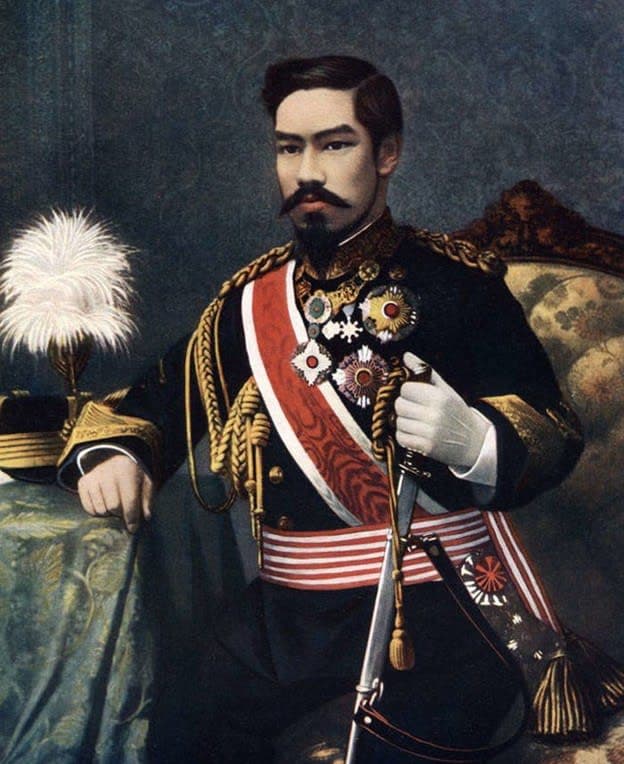

At the beginning of the 17th century the Tokugawa shogunate was established in Japan and for two and a half centuries became the de facto ruler of the country. The head of state was the shogun, under whom there were about 180 feudal lords known as daimyō. The daimyō held autonomous domains, but their marriages and rights to land depended on the shogun. In 1615 the first shogun of the Tokugawa dynasty, Tokugawa Ieyasu, and his son Tokugawa Hidetada—who by then was already shogun—issued the “Regulations for the Emperor and Court,” according to which the emperor was to devote himself to scholarship and the arts.
The emperors lived in the Gosho palace in Kyoto, hardly ever leaving it, and their chief duty was the performance of rituals. Although the shogun made decisions independently, he was formally considered appointed only after an imperial edict.
In the early 19th century the situation began to change. In 1853 a squadron of American “black ships” commanded by Commodore Matthew Perry arrived in Japan and threatened military action if Japan refused to open its ports to trade.

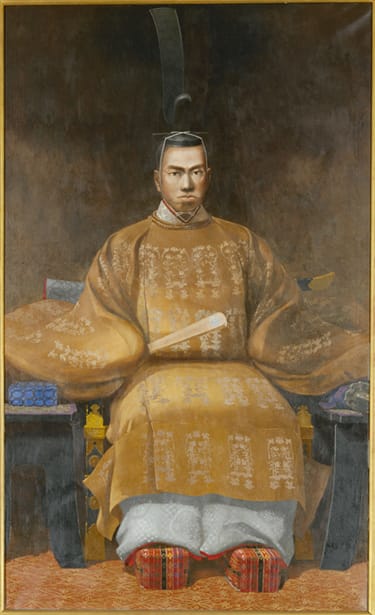
Confronted with this crisis, the shogunate for the first time in 250 years sought advice from the Imperial Court. After the death of Shogun Tokugawa Ieyoshi in June 1853 and the accession of his successor Tokugawa Iesada, the Japanese government concluded “unequal treaties” with Western powers. The first such treaty was signed with America on March 3, 1854. On February 7, 1855 the Treaty of Shimoda—the first diplomatic agreement with Russia—was concluded, opening the ports of Shimoda, Hakodate, and Nagasaki to Russian ships. Emperor Kōmei was angered by these actions and threatened to abdicate.
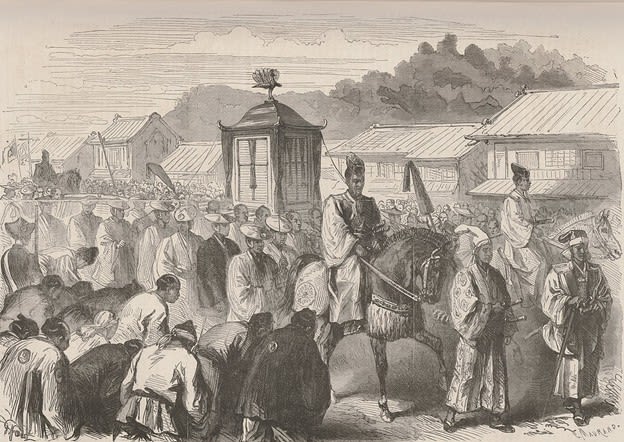
The future emperor Mutsuhito was born on November 3, 1852, and received the childhood name Sachi-no-miya. His mother, Nakayama Yoshiko, was a lady-in-waiting to Emperor Kōmei. The prince was raised by his great-grandmother. Mutsuhito was born at a time when Japan was facing a crisis brought on by the appearance of European and American ships. On August 16, 1860 he was recognized as heir and received the adult name Mutsuhito. During this period he began a classical education, though he was noted to be indifferent to study.
In the early 1860s the Tokugawa shogunate came under threat. Foreign powers were seeking to expand their influence, and many daimyō and young samurai known as shishi opposed the shogunate and advocated restoring imperial rule. In 1863 the shishi persuaded Emperor Kōmei to issue the “Edict to Expel the Barbarians,” which put the shogunate in a difficult position since it could not carry it out. In 1866 Tokugawa Yoshinobu became shogun and tried to implement Western-style reforms, but met resistance. In January 1867 Emperor Kōmei died, arousing suspicions of poisoning, since his death greatly benefited the revolutionaries.
On February 3, 1867 Mutsuhito formally ascended the Chrysanthemum Throne. At the end of 1867 political confrontation reached a peak when insurgents seized the imperial palace. On January 4, 1868 the emperor solemnly proclaimed the “restoration” of imperial rule. This event became known as the Meiji Restoration. In September 1868 the new era name Meiji (“Enlightened Rule”) was proclaimed, and the city of Edo was renamed Tokyo (“Eastern Capital”). In 1889 Tokyo officially became the nation’s capital.
In 1869 Mutsuhito married Ichijō Haruko, who became the first empress to bear the title kōgō (“emperor’s consort”).
After the Meiji Restoration, a state council was formed, later headed by three principal ministers. On April 7, 1868 the emperor promulgated the Five-Article Oath, which abolished feudalism and proclaimed a modern, democratic government. Although a parliament was formally created, real power remained in the hands of the genrō (an oligarchy) composed of the daimyō and samurai who had led the Restoration. In 1871, by imperial decree, the daimyōs’ autonomous domains were abolished and the country was divided into 72 prefectures. The samurai gradually lost their privileges, which led to their financial hardship.
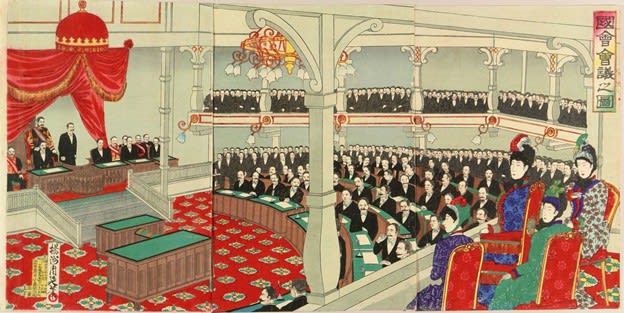

The Meiji era became a period of rapid modernization and industrialization that enabled Japan to become a powerful regional state. It was also the era in which Japanese militarism and colonial expansion began. The role of Emperor Meiji himself in these developments remains a matter of debate. Although he was formally head of state, it is unclear how much he influenced political and military decisions. Some of his poems depict him as a pacifist who wished to avoid war.

Emperor Meiji suffered from diabetes, nephritis, and gastroenteritis, and died of uremia. Although official sources gave his death as July 30, 1912, he actually died on the evening of July 29. After his death the parliament passed a resolution to commemorate him. On the site of a garden he loved, the Meiji Jingū shrine was built.


