The story of Kumaragupta I’s accession to the throne of the great Gupta Empire begins at the meeting point of two eras, when the achievements of his predecessors had already brought extraordinary glory to the Indian subcontinent. The son of the celebrated Emperor Chandragupta II and Queen Dhruvadevi, he assumed control of the empire at the height of the dynasty’s power. The last known inscription of his father dates to 412 CE, while the earliest evidence of Kumaragupta’s own sovereign authority dates to 415 CE, corresponding to Year 96 of the Gupta Era. It is therefore the year 415 CE that is generally regarded as the point at which the new ruler assumed the imperial crown.
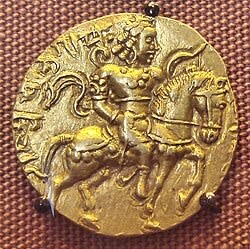
Upon ascending the throne, he adopted a series of magnificent titles: Maharajadhiraja (“Great King of Kings”), Parama-bhattaraka (“Supreme Lord”), and Paramadvaita. He also entered history under the name Mahendraditya. On his numerous coins, this name appears in several forms: Sri-Mahendra, Mahendra-simha, and the ceremonial Ashvamedha-Mahendra. Buddhist chronicles preserved yet another name for him—Shakraditya.
Kumaragupta inherited a vast empire whose borders had been forged by the swords of his father Chandragupta II and his grandfather Samudragupta. Remarkably, the records of his own reign contain relatively few descriptions of major and bloody wars. Nevertheless, the geographical distribution of archaeological evidence speaks for itself.
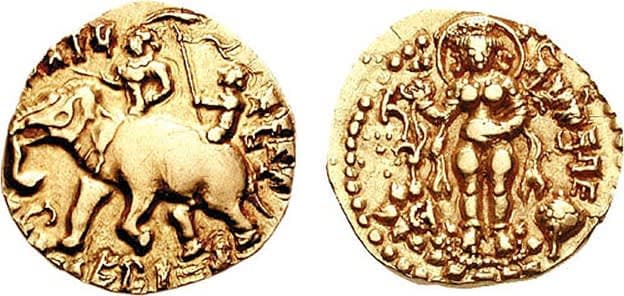
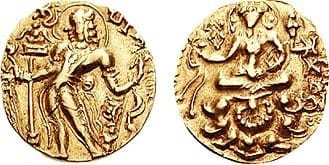
Inscriptions from the reign of Kumaragupta have been discovered across the enormous territories of the modern Indian states of Madhya Pradesh, Uttar Pradesh, and West Bengal, as well as in Bangladesh. An inscription of his son has been found in Gujarat. Coins bearing the image of Garuda are widely distributed throughout western India, while coins depicting the peacock occur across the entire Ganges Valley. This clearly demonstrates that Kumaragupta was not merely an heir to a great empire, but a strong and determined monarch capable of preventing that enormous state from disintegrating.
Although no clear records of major campaigns have survived, the empire did not enjoy absolute peace. The most striking demonstration of Kumaragupta’s military prestige was his performance of the ashvamedha, the grand and sacred horse sacrifice through which ancient Indian monarchs proclaimed their unquestioned supremacy over neighboring rulers.
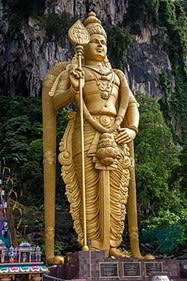
The king was also an ardent worshipper of Karttikeya, the formidable god of war. Some historians nevertheless remain cautious, noting that in the absence of direct textual evidence, the ashvamedha may have functioned primarily as a symbolic affirmation of inherited sovereignty rather than as proof of new military conquests.
The sound of warfare nevertheless reached the borders of the empire. One indication is an invasion into the territory of the Traikutaka dynasty in what is now Maharashtra. To the southwest of the Gupta heartland, large concentrations of Kumaragupta’s coins have been discovered: thirteen examples at Achalpur and an enormous hoard of 1,395 silver coins at Samand in Satara district.
Their obvious resemblance to the coinage of the local Traikutaka rulers gives historians substantial grounds for believing that Gupta armies advanced through southern Gujarat and brought these territories under their authority by force.
The history of the incorporation of Dashapura, modern Mandsaur, is considerably more complex. The inscription on the Bilsad Pillar, dated to 415–416 CE, or Year 96 of the Gupta Era, provides the first evidence for this period, but the Mandsaur inscription of 423 CE complicates the picture.
It mentions the Aulikara dynasty, whose kings bore names ending in -varman, such as Naravarman and Vishvavarman. During this period, a wealthy guild of silk weavers migrated to Dashapura from the region of Lata.
The guild’s inscription suddenly shifts into a panegyric describing the period “when Kumaragupta ruled the entire earth” and records that around 436 CE, during the reign of King Bandhuvarman, a magnificent temple of the Sun was constructed. The temple was later destroyed but was rebuilt by the guild around 473 CE.
Was Bandhuvarman a vassal of Kumaragupta I? Historian R. C. Majumdar argued otherwise. He pointed out that Bandhuvarman’s ancestors had ruled independently and suggested that Dashapura entered the Gupta Empire only sometime between 424 and 473 CE, either through military conquest or through Kumaragupta I’s skillful diplomacy. The restoration of the temple, meanwhile, took place during the reign of his namesake, Kumaragupta II.
The king’s coins also tell stories of other, more exotic campaigns. According to Tej Ram Sharma, an image of the monarch killing a rhinoceros may symbolize the conquest of Kamarupa, modern Assam, a region famous for these animals.
Coinage depicting Kumaragupta killing a tiger led H. C. Raychaudhuri to propose a theory of military expansion south of the Narmada River. Skeptics such as S. R. Goyal, however, reject these bold interpretations and consider the scenes on the coins to be artistic imagery rather than evidence of actual campaigns.
Governing such an enormous state alone would have been impossible. Kumaragupta therefore constructed an effective administrative hierarchy. Provinces, or bhuktis, were governed by officials known as uparikas, who bore the prestigious title of maharaja.
The provinces were divided into districts, or vishayas, administered by vishayapatis. At the local level, authority relied on councils composed of leading members of society: the nagara-shreshthin, or chief of the city; the sarthavaha, representing the merchant community; the prathama-kulika, head of the artisans; and the prathama-kayastha, head of the scribal officials.
History has preserved the names of several loyal servants of the throne. Chiradatta governed the province of Pundravardhana-bhukti in Bengal from 443 to 447 CE, corresponding to Years 124–128 of the Gupta Era.
The Karamdanda inscription of 436 CE praises Prithivishena, the son of Shikharasvamin, who had previously served as a minister under Chandragupta II.
Prithivishena began his career as a mantrin and kumaramatya, or minister, under Kumaragupta, but his abilities eventually elevated him to the office of mahabaladhikrita, the supreme military commander.
Members of the royal family also played an important role. Ghatotkachagupta governed the region of Eran. His inscription of 435–436 CE and a seal discovered at Vaishali indicate that he held exceptionally high status. He may have been a son or younger brother of Kumaragupta, and after the emperor’s death he may even have briefly attempted to proclaim himself an independent ruler.
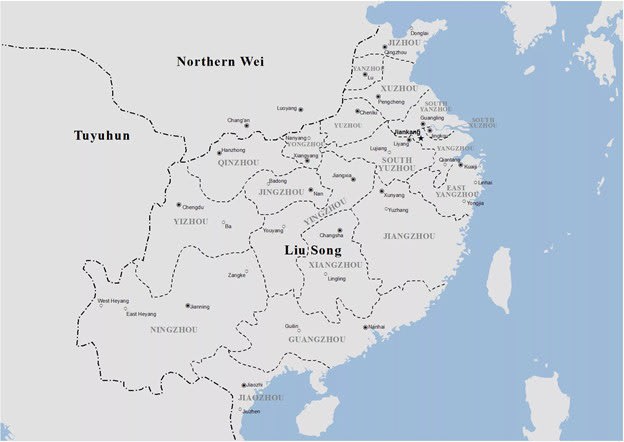
Beyond domestic affairs, the emperor’s attention extended far beyond the Indian subcontinent. He established strong diplomatic relations with China, exchanging embassies with the powerful Liu Song dynasty.
The emperor’s personal life was inseparably connected with politics. He had at least two prominent sons: Skandagupta and Purugupta.
Purugupta was born to the chief queen, or mahadevi, Anantadevi. R. N. Dandekar, drawing upon the Talagunda inscriptions, proposed that she was a princess of the Kadamba dynasty.
The mother of Skandagupta is not mentioned in the surviving records, an unusual departure from dynastic tradition. An inscription on a pillar in Bihar, however, suggests that Kumaragupta was also married to the sister of one of his ministers.
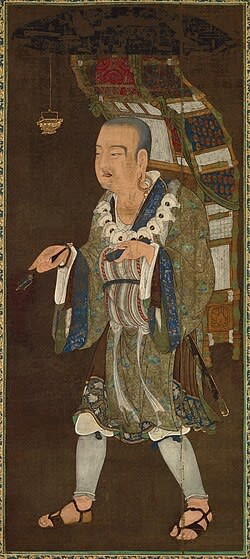
As for Prince Budhagupta, whom the Chinese pilgrim Xuanzang mistakenly described as a son of Kumaragupta I, modern epigraphic evidence clearly demonstrates that he was actually the son of the later ruler Kumaragupta II.
In religious matters, Kumaragupta represented a model of ancient Indian tolerance. Shaivism, Vaishnavism, Jainism, and Buddhism coexisted peacefully and flourished throughout his territories.
Judging from his silver coinage, the monarch himself was a parama-bhagavata, an ardent devotee of Vishnu. He ordered Garuda, Vishnu’s divine mount, to be depicted on his gold and copper coins.
At the same time, Kumaragupta deeply revered Karttikeya, or Skanda, the god of war who rides upon a peacock. His heir Skandagupta was named in honor of this deity, while the emperor’s own name, Kumara, was itself one of the names of Karttikeya.
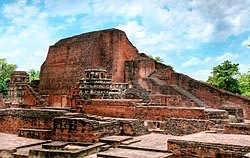
Kumaragupta also left a major mark on the history of Buddhism. Chinese chronicles of the seventh and eighth centuries state that the world-famous university and monastic complex at Nalanda was founded by a king named Shakraditya.
Since the names Shakra and Mahendra are both epithets of the god Indra, historians have confidently identified Shakraditya with Kumaragupta, or Mahendraditya.
This interpretation is also supported by chronological reasoning. The traveler Faxian, who visited the region between approximately 400 and 411 CE, made no mention of Nalanda. The institution therefore appears to have been founded later, during the reign of Kumaragupta.
The end of Kumaragupta’s long reign is surrounded by darkness and anxiety. The earliest inscription of his successor Skandagupta dates to 455 CE, or Year 136 of the Gupta Era. Kumaragupta’s reign must therefore have ended shortly before that date, although the numismatist P. L. Gupta argued for an earlier date of approximately 450 CE, challenging the conclusions of V. A. Smith.
Historians believe that in the final years of his life, the aging emperor may have experienced a series of bitter reverses.
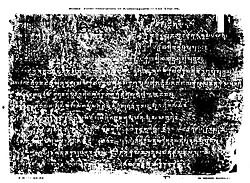
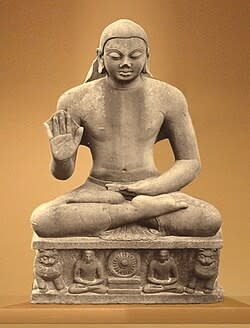
One piece of evidence is the famous Buddha statue from Mankuwar, created in 448 CE, or Year 129 of the Gupta Era. In its dedicatory inscription, Kumaragupta is referred to merely as a maharaja, a title associated with subordinate rulers, rather than by the grand imperial title Maharajadhiraja.
Was this simply a careless mistake by the stone carver, or was the empire already trembling under the blows of its enemies?
A possible answer lies in the Bhitari inscription of his successor Skandagupta. It dramatically describes how, after the death of his father, Skandagupta was forced to restore the “shaken fortunes” of the dynasty through a brutal struggle against its enemies.
Who were these enemies? Were they the Pushyamitras, or possibly the Yudhyamitras according to alternative linguistic readings? Or were they the fierce armies of the White Huns, the mlechchhas mentioned in the Junagadh inscription, who had begun invading the borders of India?
It is entirely possible that Skandagupta was holding back the Hunnic advance on the northern frontier at the very moment when Kumaragupta died in the imperial capital.
His death triggered an almost inevitable succession crisis. A struggle for the throne erupted. Perhaps the legitimate heir Purugupta, son of the chief queen, was still too young, allowing the battle-hardened Skandagupta, possibly the son of a junior wife, to seize power.
After defeating the empire’s enemies and returning to the capital, Skandagupta rushed to his mother, whose “eyes were filled with tears of joy.” Skandagupta became a great ruler who successfully defended the empire, but after his death the throne ultimately returned to Purugupta and his descendants.
Thus ended the approximately forty-year era of Kumaragupta I. Leaving behind at least eighteen invaluable inscriptions—including the earliest Gupta inscriptions from Bengal—as well as countless gold coins, he entered history as a monarch whose reign represented the zenith of the great Indian empire, standing on the threshold of new and severe trials.


