According to the official genealogy of the Guptas, Chandragupta, born to Queen Dattadevi, inherited the throne directly after his great father Samudragupta. However, the famous Sanskrit play Devichandraguptam lifts the veil of mystery surrounding the actual events. Although modern historians continue to debate whether its plot is a work of fiction or a reflection of genuine historical events, the drama presents a fascinating account of the succession to the throne.
According to the play, the throne was initially occupied by Chandragupta’s elder brother, Ramagupta, around 375 CE. Finding himself in a grave military situation and under siege, the weak-willed Ramagupta agreed to humiliating terms: he was prepared to surrender his wife, Queen Dhruvadevi, to the leader of the enemy Shakas, or Western Kshatrapas. Upon learning of this disgrace, Chandragupta took a desperate step. Disguised in the magnificent garments of the queen, he entered the enemy camp and personally killed the Shaka ruler. Having washed away the dishonor of the dynasty, Chandragupta soon overthrew his incompetent brother and ascended the imperial throne himself.

Dhruvadevi—referred to in some sources, such as a clay seal from Basarh, as Dhruvasvamini—later became the wife of Chandragupta II and the mother of his heir Kumaragupta I, as well as Prince Govindagupta.
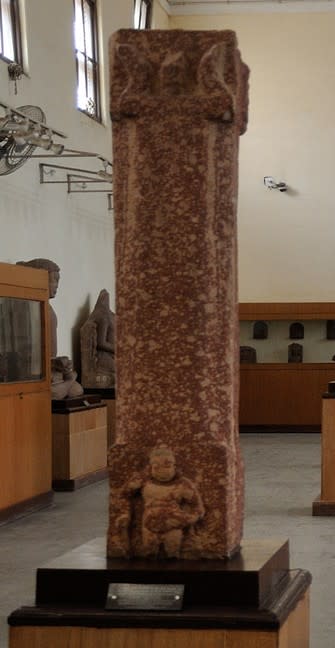
Determining the precise dates of Chandragupta II’s reign long remained a complicated epigraphic puzzle. A crucial document in this debate was the inscription on a pillar at Mathura recording the installation of two Shiva lingams by Udita Acharya. The text refers to the reign of “Chandragupta Vikramaditya, son of Samudragupta.”
The mystery lay in the inscription’s double dating system, in which the letters preceding the words kālānuvarttamāna-saṃvatsare had been badly damaged.
In 1931–1932, historian D. R. Bhandarkar reconstructed the erased word as gupta and translated the phrase as “in the 61st year after the Gupta Era,” corresponding to 380–381 CE. Later, in 1942, D. C. Sircar proposed that the missing characters represented either the word “fifth” ([paṃ]cāme) or “first” (prathame) year of Chandragupta’s own reign. On this basis, the beginning of his rule was traditionally dated to either 376 or 380 CE.
In 2004, however, Indologist Harry Falk proposed an entirely different theory. He rejected Sircar’s reconstruction as impossible given the condition of the stone and argued that the kālānuvarttamāna system represented a direct continuation of the Kushan calendrical era, calculated from the coronation of Emperor Kanishka in 127 CE. A distinctive feature of this era was that the numerical count reset after reaching one hundred years.
Falk compared four Gupta inscriptions:
Mathura Pillar — dynastic year erased; kālānuvarttamāna year 61
Lintel inscription — no dynastic date given; kālānuvarttamāna year 70
Yaksha statue — Kumaragupta I, Gupta year 112 / kālānuvarttamāna year 5
Buddha pedestal — Kumaragupta I, Gupta year 121 / kālānuvarttamāna year 15
Earlier historians such as K. K. Thaplyal and R. C. Sharma had struggled to explain the final inscription, suggesting that the scribe may simply have written the numbers incorrectly. Falk’s theory, however, resolved the difficulty: the difference between 121 and 15 is 106 years, which fits perfectly with a system that reset after every century.
By calculating backward, Falk concluded that the kālānuvarttamāna era used during the reign of Chandragupta II began in 327 CE. The Mathura inscription, therefore, corresponding to 327 + 61, dates to approximately 388 CE and cannot be used to determine the first year of Chandragupta’s reign.
The last securely dated document from Chandragupta’s reign is the stone inscription from Sanchi, dated to Year 93 of the Gupta Era, or 412–413 CE. Since his son Kumaragupta had ascended the throne by 415–416 CE, the end of Chandragupta’s reign can confidently be placed between 412 and 415 CE.
The inscriptions in the Udayagiri Caves, composed by Foreign Minister Virasena, proclaim that Chandragupta had “purchased the earth,” paying for it with his extraordinary valor, and had reduced his rivals to the status of slaves.
The geographical extent of his empire was astonishing: from the mouth of the Indus in the west to Bengal in the east, and from the Himalayas in the north to the Narmada River in the south. Interestingly, unlike his father and his son, Chandragupta apparently did not perform the imperial ashvamedha horse sacrifice. A stone sculpture of a horse discovered at Varanasi and supposedly bearing the inscription “Chandramgu” was later shown to have been misread.
The emperor’s greatest military achievement was the final destruction of the power of the Western Kshatrapas, or Shakas, in Central and Western India. Whereas his father Samudragupta had merely compelled the “Shaka-Murundas” to pay tribute, Chandragupta II pursued their complete conquest.
Epigraphic evidence clearly confirms the personal presence of the emperor on the western front. Virasena’s inscription at Udayagiri describes Chandragupta as a king who had arrived from Pataliputra in order to “conquer the whole world.” This invasion was supported by his vassals. The inscription of the commander Amrakardava at Sanchi, dated to 412–413 CE, and the inscription of Maharaja Sanakanika at Udayagiri, dated to 401–402 CE, both explicitly record their service to the emperor in these territories.
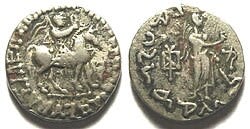
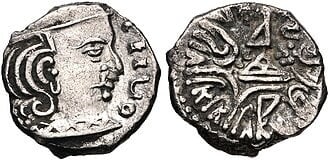
Chandragupta’s victory, achieved sometime between 397 and 409 CE, is brilliantly documented by numismatic evidence. The production of distinctive Shaka coins abruptly ceased at the end of the fourth century. The final coin of King Rudrasimha III is dated to Year 310 or 319 of the Shaka Era, corresponding to 388 or 397 CE.
When coin production resumed in the region during the second decade of the fifth century, coins dated to 409 CE showed that the Shaka Buddhist symbol of the vihara had been replaced by Garuda, the mythical eagle and dynastic emblem of the Guptas. By conquering Malwa and Gujarat, Chandragupta gave his empire direct access to the Arabian Sea and its exceptionally wealthy trade routes.
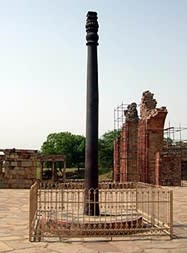
The greatness of the king is immortalized on the famous Iron Pillar of Delhi, which was moved to the Qutb complex in the thirteenth century by Sultan Iltutmish. Its inscription praises an invincible monarch named “Chandra.” Most modern historians, apart from a few supporters of alternative theories, confidently identify this ruler with Chandragupta II.
There are several pieces of evidence supporting this identification. Gupta coins abbreviate his name to Chandra; the inscription praises the king as a devotee of Vishnu who erected the pillar, or Vishnu-dhvaja, on the hill of Vishnu-pada; and its statement that the southern ocean was “perfumed by the winds of his valor” appears to refer to the Arabian Sea. Finally, the poetic comparison of the king’s face with the brilliance of the full moon closely resembles metaphors found in the Mandsaur inscription of his grandson Skandagupta.
The Iron Pillar credits Chandra with extraordinary achievements: the defeat of an enemy coalition in the land of Vanga, or Bengal, and a victory over the Vahlikas of Bactria after crossing the “seven mouths” of the Sindhu, or Indus River.

The Northwestern Campaign: Chandragupta’s crossing of the Indus has generated considerable scholarly debate. Sten Konow believed that the inscription referred to the seven mouths of the river, whereas R. C. Majumdar and K. P. Jayaswal argued that it referred instead to tributaries of the Indus—the Jhelum, Ravi, Sutlej, Beas, Chenab, and possibly the Kabul and Kunar rivers.
Gupta influence reached as far as Gilgit-Baltistan. On the Sacred Rock of Hunza in present-day Pakistan, inscriptions written in Gupta script have been discovered bearing the names “Chandra,” “Harishena,” and the title “Vikramaditya.” Although direct annexation of Punjab appears unlikely, since local chiefs later issued coins in Kidarite style, this digvijaya—the “conquest of all directions”—demonstrated the unmatched power of the empire.
The Bengal Campaign: In the east, Chandragupta crushed an alliance of semi-independent rulers of Vanga, finally transforming Bengal from a subordinate kingdom, as Samatata had been under Samudragupta, into an integrated imperial province. Gupta control over the region continued into the sixth century.
Chandragupta II was not merely a warrior, but also a brilliant diplomatic strategist who bound the subcontinent together through a network of dynastic marriages.
By marrying Kuvera-naga, or Kuberanaga, he established an alliance with the powerful Naga clan, whose influence in Central India was essential for the successful campaign against the Shakas.
Chandragupta’s daughter from this marriage, Prabhavatigupta, was married to Rudrasena II, ruler of the Vakataka dynasty in the Deccan. After her husband’s premature death around 390 CE, she became full regent on behalf of her young sons.
Gupta influence at her court became overwhelming. In official Vakataka documents, the imperial titles of her Gupta ancestors were solemnly placed before the more modest titles of the Vakataka maharajas. In the memorable words of historians Hermann Kulke and Dietmar Rothermund, during her twenty-year regency the Vakataka state was “practically part of the Gupta Empire.”
The diplomatic reach of the empire extended even farther south. The Talagunda inscription records that daughters of Kakusthavarman, ruler of the southern Kadamba dynasty, married members of the Gupta dynasty. Although Kakusthavarman himself was a contemporary of Chandragupta’s son, the alliance left a lasting legacy. Many medieval chiefs of Karnataka proudly traced their ancestry back to Chandragupta II himself.
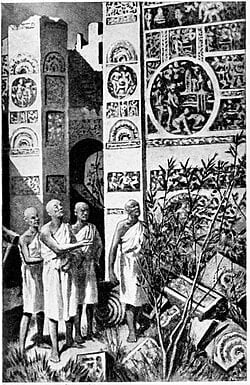
The administration of the enormous empire depended upon loyal officials and vassals. Historical records preserve the names of Foreign Minister Virasena, the victorious commander Amrakardava, and Minister Shikhara-svamin, whom K. P. Jayaswal regarded as the author of the famous political treatise Kamandakiya Niti.
The imperial frontier regions were governed by loyal maharajas: Sanakanika at Udayagiri, Trikamala at Gaya, Vishvamitra Svami at Vidisha, and Svamidasa at Valkha.
The most vivid description of daily life in the empire was left by the Chinese Buddhist pilgrim Faxian, who spent approximately six years within the Gupta state. His travel account presents an almost utopian picture of Madhya-desha, the “Middle Kingdom.”
Faxian was astonished by the mildness of its laws. Residents were not required to register their households, and severe corporal punishments were largely absent. Criminal offenses were punished primarily through proportionate fines, with only hardened rebels having their right hands cut off. Government officials and guards regularly received stable salaries. The economy prospered, while cowrie shells were used as small change in local marketplaces.

The Chinese monk was particularly impressed by Pataliputra and its magnificent annual festival. Twenty enormous chariots carrying statues of the Buddhas were drawn through the streets while being greeted by local Brahmins.
Faxian also described with amazement charitable hospitals funded by wealthy Vaishyas, where orphans, people with disabilities, and the poor received free food and medical treatment.
Faxian further claimed that the population—with the exception of the untouchable hunters and butchers known as Chandalas, who were required to strike wooden clappers when entering a city—strictly abstained from meat, alcohol, garlic, and onions.
Historian R. C. Majumdar, however, reasonably pointed out that this picture may have been somewhat distorted. The pilgrim moved primarily within strict Buddhist circles and may have projected their ascetic practices onto the population as a whole.
Chandragupta II was a sincere parama-bhagavata, a devoted worshipper of Vishnu. It was during his reign that the magnificent Udayagiri Caves were created, decorated with the monumental relief of the god Varaha, the boar incarnation of Vishnu, rescuing the Earth from the cosmic ocean.
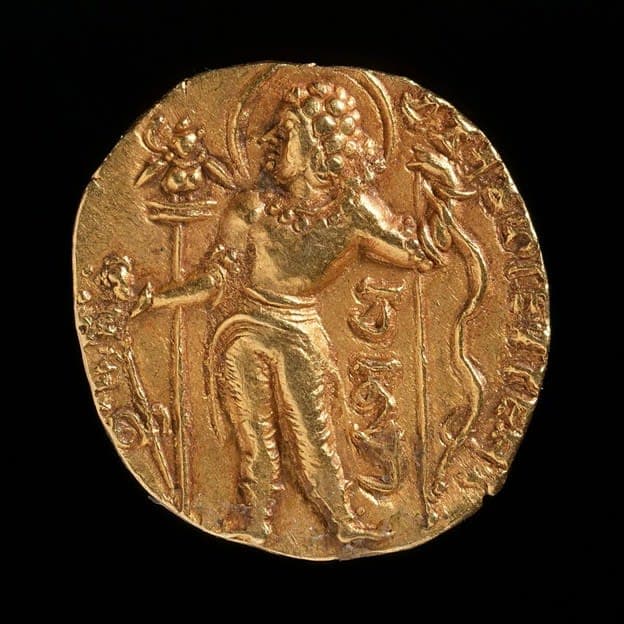
On a unique gold coin discovered at Bayana, Chandragupta bears the title chakra-vikramah, meaning “mighty through possession of the discus,” and is depicted receiving the divine chakra directly from Vishnu himself.
At the same time, the king displayed complete religious tolerance. His minister Virasena constructed temples dedicated to Shiva, while General Amrakardava donated entire villages to a Buddhist monastery at Sanchi.
The court culture of this period became a model of classical Indian civilization. The later treatise Jyotirvidabharana claims that the famous navaratnas, or “Nine Jewels,” flourished at the king’s court, including the physician Dhanvantari, the astronomer Varahamihira, and the grammarian Amarasimha.
Although D. C. Sircar and other critical scholars regard the idea that all these figures lived at the same court as a literary invention, many influential researchers—including William Jones, A. B. Keith, and V. V. Mirashi—believed that India’s greatest poet and dramatist Kalidasa genuinely lived and worked at the court of Chandragupta II.
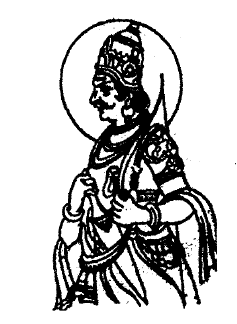
For his extraordinary achievements, Chandragupta, who bore the titles “King of Kings” and wise royal sage, or rajadhirajarshi, acquired the epithet Vikramaditya, confirmed by his coins and by the Supia inscription.
In historical memory, he gradually merged with the image of the ideal Indian monarch—the legendary Vikramaditya, patron of learning and destroyer of foreign invaders.
D. R. Bhandarkar, V. V. Mirashi, D. C. Sircar, and other scholars agreed that the folkloric image of the king who defeated the Shakas and acquired the title Shakari, meaning “Enemy of the Shakas,” was modeled on Chandragupta II, who liberated Malwa from the Western Kshatrapas and Mathura from the Kushans.
Legends frequently identify Ujjain as the capital of Vikramaditya, even though the Guptas ruled from Pataliputra. D. C. Sircar explained this by arguing that after the conquest of Malwa, Ujjain became the second, western capital of the Gupta Empire, administered on behalf of Chandragupta by his son Prince Govindagupta.
This association became so powerful that the rulers of the later Gutta dynasty of Guttavala in Karnataka, who proudly traced their ancestry to the Guptas—a tradition that Vasundhara Filliozat regarded as a direct echo of Chandragupta’s influence in southern India—explicitly referred in their inscriptions to Vikramaditya of Ujjain.
According to legend, it was to the king of Kuntala, probably a Kadamba ruler, that Vikramaditya sent Kalidasa as an ambassador.
Even the Indian calendrical era known as Vikrama Samvat, beginning in 57 BCE and originally known as the Krita Era or the era of the Malava tribe, was renamed centuries later, by approximately the ninth century, in honor of Vikramaditya.


