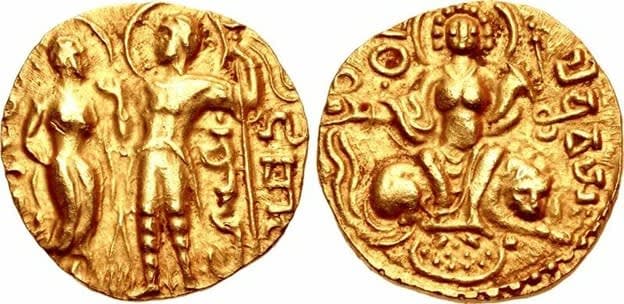

During the first quarter of the fourth century, events unfolded on the political stage of ancient India that would permanently alter the course of its history. At the center of these tectonic changes stood Chandragupta I, a ruler destined to transform a relatively small principality into a powerful empire. He was the son of the Gupta king Ghatotkacha and the grandson of the dynasty’s founder himself. In the historical record preserved on the famous Allahabad Pillar, both of his predecessors are modestly referred to by the title Maharaja, meaning “Great King.” Chandragupta’s ambitions, however, extended far beyond local power. Upon ascending the throne, he adopted the unprecedented dynastic title Maharajadhiraja—“Great King of Kings”—and marked this triumph by beginning the minting of his own gold coins. This symbolic and political act gives historians strong grounds to regard him as the first genuinely imperial ruler of the Gupta dynasty.
Despite Chandragupta’s obvious importance, the exact date of his accession and the duration of his reign remain among the most intriguing problems of Indian historiography. What is certain is that his rule belongs to the first quarter of the fourth century. His adoption of such an exalted title led many scholars to suggest that Chandragupta himself founded the famous Gupta Era, with its opening date corresponding to the day of his coronation. On the basis of this hypothesis, prominent historians such as Vincent Arthur Smith and P. L. Gupta date the beginning of his reign to 319–320 CE. In the academic world, however, this interpretation remains only one possibility, since the true founder of the Gupta chronological era has never been definitively identified. Several distinguished scholars, including D. C. Sircar and R. C. Majumdar, proposed a counter-theory, arguing that the Gupta Era began instead with the coronation of Chandragupta’s great son, Samudragupta.
It is known that Chandragupta ruled for a considerable period of time. The inscription on the Allahabad Pillar preserves a moving and historically important account of how the king, apparently already advanced in age, solemnly transferred authority to his son. Nevertheless, attempts to determine the exact chronological limits of his reign have produced extensive scholarly debate. A. S. Altekar placed his reign between 305 and 325 CE, while S. R. Goyal extended it from 319 to 350 CE.
The decisive event in Chandragupta’s life, and one that predetermined the rise of his dynasty, was a political and dynastic alliance: his marriage to Kumaradevi, a princess of the ancient and powerful Lichchhavi clan. The center of this celebrated lineage had already been located at Vaishali, in the territory of the modern Indian state of Bihar, during the lifetime of Gautama Buddha. By the first millennium CE, a Lichchhavi kingdom also existed in the lands of present-day Nepal, although historians continue to debate exactly which branch of the family Kumaradevi belonged to.
An inscription of the Nepalese Lichchhavi dynasty dating to the eighth century states that their legendary ancestor Supushpa had been born into the royal family of Pushpapura, or Pataliputra, in Magadha. This led V. A. Smith to suggest that the Lichchhavis ruled Pataliputra during the age of Samudragupta. A closer examination, however, weakens this theory considerably. The same inscription states that Supushpa lived thirty-eight generations before King Manadeva of the fifth century, placing him many centuries before the birth of Chandragupta. The text therefore cannot serve as proof that the Lichchhavis ruled Pataliputra in the fourth century. It is equally unlikely that Kumaradevi’s homeland was in Nepal, since Samudragupta’s Allahabad inscription clearly identifies Nepal as a separate subordinate kingdom.
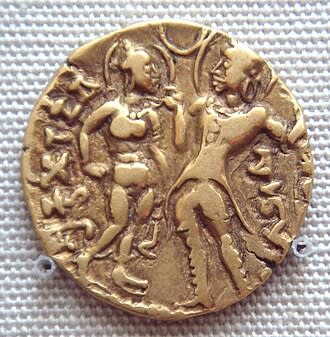
The significance of this marriage for Gupta history can hardly be overstated. The union of the two dynasties was immortalized on unique gold coins depicting Chandragupta and Kumaradevi together, alongside the proud inscription Lichchhavayah—“the Lichchhavis.” Even more strikingly, their son Samudragupta referred to himself in official inscriptions with the highly respectful title Lichchhavi-dauhitra, meaning “the son of a daughter of the Lichchhavis.” Remarkably, no other Gupta queen received comparable recognition of her paternal lineage. This strongly suggests that the Guptas regarded the alliance as an event of exceptional dynastic importance.
It is possible that Chandragupta defeated the Lichchhavi kingdom of Vaishali by force and that his marriage to Kumaradevi served as the seal of a subsequent peace agreement. According to Allan, the Guptas emphasized this relationship solely because of the ancient and noble ancestry of the queen. Yet this interpretation encounters difficulties. The ancient Indian legal text Manusmriti disparagingly describes the Lichchhavis as vratyas, presenting them as heterodox and ritually impure. It is therefore difficult to imagine that the Guptas would have emphasized the ancestry of their heir merely for reasons of questionable social prestige, or that they would have allowed the name of a defeated enemy to appear prominently on their dynastic coinage.
A different interpretation appears more convincing: the marriage may have constituted an alliance between political equals, enabling Chandragupta to expand his power and territory on a vast scale and thereby justifying his adoption of the title Maharajadhiraja. The appearance of the Lichchhavi name on Gupta coinage may have been a deliberate acknowledgment of their major contribution to the formation of the empire. It is possible that Chandragupta inherited Lichchhavi territories through the marriage, or that the two states formed a powerful political alliance in which Chandragupta and Kumaradevi ruled jointly until their son Samudragupta eventually brought the combined territories under his own sole authority.
Chandragupta I ended his earthly life with the same political wisdom that had characterized his reign. The texts preserved on the Allahabad Pillar and in a stone inscription from Eran state that the king personally selected Samudragupta as his successor, solemnly entrusting him with the duty to “protect the earth.” This voluntary transfer of power in old age helped preserve stability within the state, although history has left behind one intriguing mystery.
The discovery of coins bearing the name of a certain ruler named Kacha generated considerable speculation. Who was he? Perhaps Kacha was simply another name used by the great Samudragupta. Alternatively, he may have been Samudragupta’s elder brother, who briefly occupied their father’s throne. The Kaliyuga-raja-vrittanta section of the Bhavishyottara Purana adds further complexity by claiming that Kacha, the son of the Lichchhavi princess, served as his father’s co-ruler and that Samudragupta seized the throne through patricide. Modern scholars, however, treat this dark narrative with substantial skepticism, since the relevant passages, and possibly the text itself in its surviving form, have been regarded as a sophisticated modern fabrication.
Whatever the precise details, Chandragupta I entered history as far more than a successful warrior or a skilled dynastic diplomat. He became the architect of a great state, bringing previously fragmented territories under a single authority and laying the enduring foundations for one of India’s most celebrated golden ages—the age of the great Guptas.


