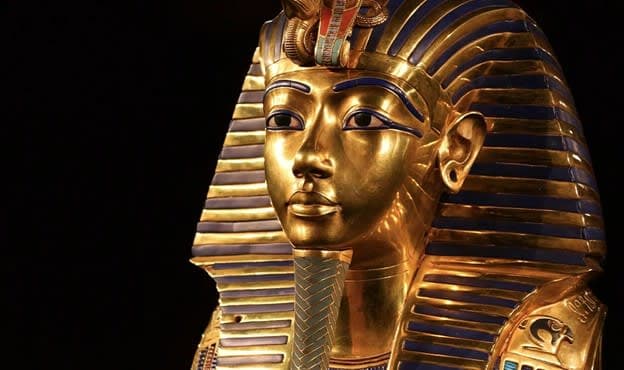

The origin of Tutankhamun long remained the subject of fierce debate. Prior to his coronation, the only direct evidence of his existence was a stone from Hermopolis, where he was mentioned as the “beloved son of the pharaoh of his body, Tutankhaton.” Egyptologists constructed hypotheses: was he the son of the “heretic” Akhenaten or of his successor Smenkhkare?
An attempt to settle this question was made through large-scale studies conducted between 2007 and 2009, the results of which were announced by Zahi Hawass in 2010. Combined DNA analysis and radiological scanning of the mummies showed that Tutankhamun was the son of the man from tomb KV55 (with a high probability — Akhenaten himself) and the “Younger Lady” from tomb KV35, who, according to genetic markers, was the full sister of her husband. This incestuous union, typical of Egyptian royal houses in order to preserve the “purity of blood,” became the cause of numerous hereditary ailments of the young king. Researchers from the company iGENEA even suggested that the pharaoh belonged to haplogroup R1b1a2, linking him with a considerable portion of modern Europeans.
Nevertheless, in later documents of his reign, Tutankhamun diplomatically referred to his grandfather Amenhotep III as his father, deliberately distancing himself from the odious figure of Akhenaten within the framework of the new state ideology.
At birth, the prince received the name Tutankhaton (“Living Image of Aten”), emphasizing devotion to the cult of the solar disk. However, already in the second year of his reign, when the pendulum of history swung back toward the old gods, the young king and his wife Ankhesenpaaton changed their names to Tutankhamun (“Living Image of Amun”) and Ankhesenamun.


Upon ascending the throne, he adopted the throne name Nebkheperure (“Lord of the Manifestations of Ra”), under which he officially appears in the diplomatic correspondence of the Amarna archive. His full name sounded majestic: Tutankhamun Hekaiunushema, meaning “Ruler of Southern Iunu.”
Tutankhamun became pharaoh at approximately ten years of age. Given his youth, real power was in the hands of experienced regents: the regent Ay (brother of Queen Tiye) and the talented military commander Horemheb. During the first three years, the court remained in Akhetaten, but soon the capital was transferred to Memphis, under the patronage of the god Ptah.
The pharaoh proclaimed a policy of “Restoration.” According to the famous Restoration Stela found at Karnak, Egypt at the beginning of his reign was in a deplorable state: sanctuaries were abandoned, and the gods had turned away from the country. Tutankhamun restored the temples of Amun and other deities throughout the land and in Nubia (Kawa, Faras).
He granted enormous privileges and wealth to the priesthood of the traditional cults.
He ordered the manufacture of new ritual barques from Lebanese cedar, covered in gold.
At the same time, he did not display fanatical intolerance: the cult of Aten continued to exist, and the pharaoh himself sometimes called himself “son of Aten,” demonstrating flexibility in religious matters.
Despite his short reign, Tutankhamun managed to leave his mark in architecture. He completed the magnificent colonnade of Amenhotep III at Luxor and built the temple of Hauron at Giza. In Nubia, the temple complex at Soleb was completed. His mortuary temple in Thebes, adorned with colossal statues, was later usurped by his successors — Ay and Horemheb.
In foreign policy, the reign was marked by the successes of the military commander Horemheb. At Karnak, images have been preserved testifying to victories in Syria, and the viceroy of Nubia, Amenhotep (Huy), confirmed the regular receipt of tribute from Syrian and Nubian tribes.


Tutankhamun died in his nineteenth year of life, leaving no heirs. His marriage to Ankhesenamun was overshadowed by tragedy: in the pharaoh’s tomb were found the mummies of two stillborn daughters.
Theories of his death changed over decades:
For a long time, it was believed that the pharaoh had been murdered by a blow to the back of the head (an opening in the skull pointed to this, which, as was established in 2005, had been made during mummification).
Studies in 2010 revealed in his body the pathogens of a severe form of malaria. In addition, the young man suffered from Köhler disease (necrosis of the bones of the foot), had a cleft palate and clubfoot.
The most probable version today is considered to be a fall from a chariot during a hunt. A broken leg (the bone had not had time to heal before death), combined with the general weakening of the body by infections, led to a rapid fatal outcome. The abundance of walking sticks (more than 130 pieces) in his tomb confirms that the pharaoh had difficulty moving independently.

The death of Tutankhamun provoked a crisis. His widow Ankhesenamun, in desperation, wrote to the Hittite king Suppiluliuma I, begging him to send her one of his sons as a husband, since she “feared becoming the wife of her servant.” The Hittite prince Zannanza was sent to Egypt but died (likely was killed) at the border. After this, Ankhesenamun disappears from the pages of history, and the elderly Ay occupies the throne.
If not for Howard Carter, Tutankhamun would have remained in the shadow of history as an insignificant ruler. On November 4, 1922, Carter discovered the entrance to tomb KV62, which proved to be almost untouched. The haste with which the king was buried (the tomb is unusually small for a pharaoh), and the fact that its entrance was later covered with construction debris during the building of the tomb of Ramses VI, saved it from looting.
Inside were found immeasurable treasures: a golden throne, chariots, the famous golden mask (weighing more than 10 kg), and thousands of everyday objects. This discovery gave rise to the legend of the “curse of the pharaoh” after the death of Lord Carnarvon in 1923. However, dry statistics indicate the opposite: most members of the expedition lived long lives (on average 74 years), and Carter himself died only in 1939.



