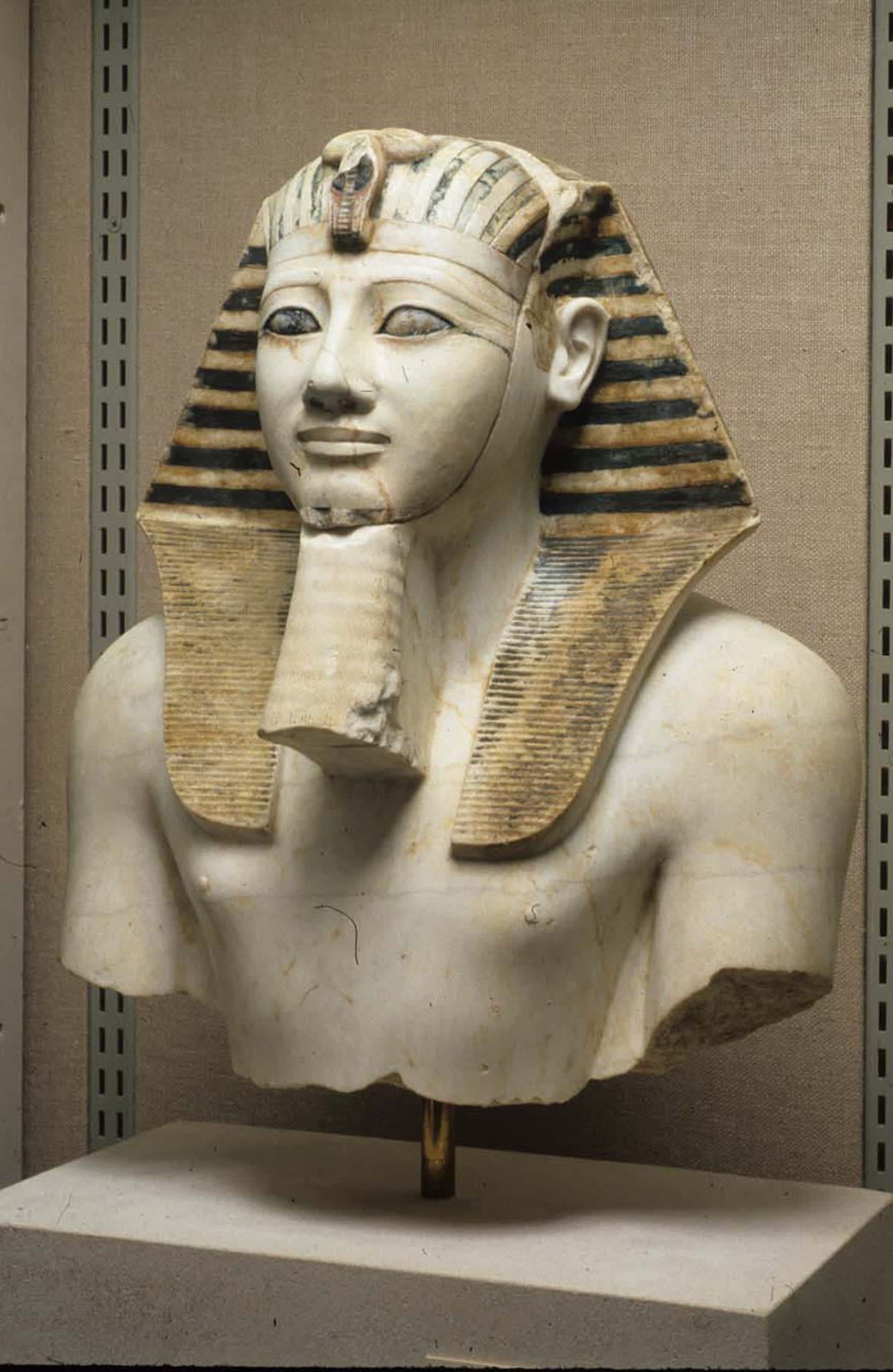

The story of Thutmose III’s rise is full of paradoxes. According to the laws of the Eighteenth Dynasty, succession was traced through the female line, and the young prince — being the son of Thutmose II and the concubine Iset — had no legitimate claim to the crown. True authority belonged to Hatshepsut, daughter of Thutmose I. Nevertheless, fate intervened: during one of the festivals, the oracle of the god Amun unexpectedly proclaimed the boy pharaoh. The priesthood likely saw in him the only male candidate capable of continuing the dynasty.
In the third year of his formal reign, Thutmose showed his first independence by erecting a temple at Semna and restoring the boundary stelae of the Middle Kingdom. Soon, however, his ambitious stepmother Hatshepsut assumed full control. For twenty long years Thutmose was pushed into the background, devoting this period to military training and the study of statecraft, until the queen’s death in 1458 BCE opened the path to sole rule.

Having assumed power, Thutmose III expressed it through a complex system of royal titulary emphasizing his connection to the gods:
Horus name: Kanakht Khaemwas (“Mighty Bull Appearing in Thebes”), sometimes supplemented by the epithet “Beloved of Maat.”
Nebty name: Wahnesu Merempet, proclaiming his reign eternal like the sun.
Golden Horus name: Sekhempahti Djeserkhau (“Mighty in Strength, Exalted in Appearances”).
Throne name: Menkheperre (“Established Is the Manifestation of the Sun God”), rendered in the cuneiform archives of the Near East as the formidable Manahpiria.
Personal name: Thutmose (“Born of the God Thoth”), to which he added epithets such as “Ruler of Thebes” and “Beautiful in Forms.”
Upon becoming sole ruler, Thutmose III initiated a fierce campaign to erase the memory of Hatshepsut, seeking to assert his exclusive legitimacy. Yet his true passion was warfare. We know of his campaigns from the “Annals” inscribed on the walls of the Karnak temple. Their author is believed to have been the military scribe Tjaneni, who accompanied the pharaoh and recorded events on leather scrolls. These records form a unique document, transforming dry history into a vivid battlefield chronicle.
In the spring of his 22nd regnal year, Thutmose marched out from the fortress of Tjaru. Opposing him was a coalition of 330 Syro-Palestinian princes led by the king of Kadesh. Against the advice of his generals, Thutmose chose the shortest and most dangerous route through the narrow Aruna pass in the Carmel range, personally leading the column.
In the decisive battle on the 26th day of the campaign, the enemy was defeated. The Egyptians could have captured the city immediately but were distracted by plundering the rich enemy camp. This resulted in a seven-month siege of Megiddo. Ultimately the city fell, and the spoils were immense: 924 chariots, 2,238 horses, and thousands of cattle. Thutmose showed unusual clemency for the age by sparing the captured princes, but sent them home in humiliation — mounted on donkeys — while taking their sons as hostages to be educated in Thebes.
In total, Thutmose III conducted at least 15 (according to other estimates, 17) campaigns in Asia.
5th campaign: Creation of a powerful fleet under the noble Nebamun, capture of Phoenician ports, and transformation of the land of Djahy into a supply base for the army.
6th and 7th campaigns: Siege of Kadesh and capture of Ullaza. Egyptians began systematic use of maritime supply routes.
8th campaign (the peak of glory): In the 33rd year of his reign, Thutmose accomplished the unprecedented — he crossed the Euphrates (“the Great Inverted River of Naharina”). He ordered ships built from Lebanese cedar, transported overland on oxen to the river, and defeated the state of Mitanni. After this campaign even the great powers of the Hittites and Assyria sent gifts — effectively acknowledging Egyptian supremacy.

During this campaign occurred the famous episode of the elephant hunt in the valley of Niy. The massive leader of the herd nearly trampled the pharaoh, but his loyal shield-bearer Amenemheb cut off the elephant’s trunk, saved his master’s life, and commemorated the deed in his tomb.


The final, 17th campaign in the 42nd regnal year secured Egyptian control over Tunip and Kadesh. Afterward, Thutmose turned south. Although Nubia remained loyal, he personally supervised the clearing of a canal at the First Cataract in his 50th year to facilitate the transport of gold, ivory, and slaves from Khent-hen-nofer. The empire now stretched some 3,500 km from north to south.

Thutmose III was not merely a soldier. His domestic policy showed meticulous attention to detail:
Architecture: Reconstruction of Karnak under the architect Puemre, construction of the Akh-menu festival hall, and erection of gigantic obelisks (one — the Lateran Obelisk — now stands in Rome; others, known as “Cleopatra’s Needles,” stand in London and New York).

Science and art: He created the first “botanical garden” in history at Karnak, ordering images of rare plants and animals brought from Asia to be carved on the walls. The earliest glass objects bearing a royal name also date from his reign.
Administration: Relying on his loyal vizier (chati) Rekhmire, Thutmose established a clear administrative hierarchy in which every official knew his duties.
On March 11, 1425 BCE, after 53 years, 10 months, and 26 days of rule, the great conqueror died. He was buried in tomb KV34 in the Valley of the Kings. The walls of his burial chamber are decorated with texts of the “Book of Amduat,” describing the twelve-hour journey of the sun through the darkness.
His mummy, discovered in 1881 in the Deir el-Bahri cache, preserved facial features — narrow cheekbones and the characteristic “Thutmosid nose.” Although ancient robbers damaged the body, his appearance has endured through numerous statues depicting him with a slight half-smile — a symbol of the triumph of the man who transformed Egypt into the center of the world.


