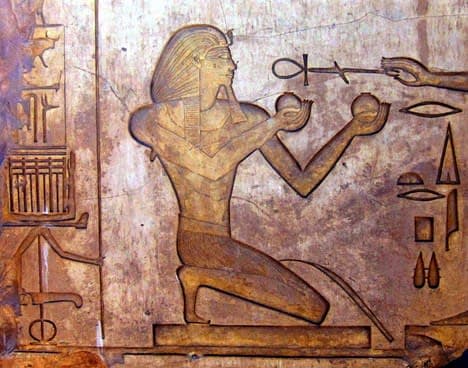

Thutmose II was the son of Thutmose I by his secondary wife Mutnofret. At the time of his father’s death, he was about 21 years old. Since his elder brothers, Amenmose and Wadjmose, had died before their father, Thutmose II became the legitimate claimant to the throne. However, his legitimacy required reinforcement: according to ancient traditions, he immediately married his half-sister, the young princess Hatshepsut, who at the time was no more than 15 years old.

This union was a political necessity. Hatshepsut, born to the Great Royal Wife Ahmose Hent-temehu, was considered the “pure-blooded” heir. Later, Hatshepsut claimed that this marriage had been concluded against the wishes of the late Thutmose I, who had allegedly intended his daughter to rule alone. These claims cast a shadow over the entire reign of Thutmose II: a certain coldness persisted between the spouses for many years, and their characters were complete opposites. Nevertheless, as the architect Ineni confirmed, Thutmose II became the full “Lord of the Two Lands” immediately after his father “ascended to heaven.”
Anthropological study of the mummy (No. 61065 in the Cairo Museum) reveals Thutmose II as an elegant and refined individual. Standing about 1.7 meters tall, he was broad-shouldered but lacked the harsh physical strength of his father. Experts describe his facial features as soft and even slightly androgynous. From his ancestors he inherited the characteristic family trait — protruding upper front teeth and a slightly receding chin. He had thick, wavy dark chestnut hair, which he apparently carefully curled, although by the time of his death at about 40 years old he had become almost completely bald.

The reign of Thutmose II began not with peace but with the sword. Only five weeks after his father’s death, in the first year of his rule, alarming news reached the palace: the “wretched land of Kush” had rebelled. The insurgents, led by relatives of a chieftain previously defeated by Thutmose I, began raiding livestock and threatening Egyptian fortresses.
The young king’s reaction was immediate and ferocious. An inscription on rocks between Aswan and Shellal states that Thutmose II “became enraged like a panther.” He swore by Ra and Amun that he would leave none of the rebels alive. A large army was assembled, which in a lightning campaign crushed the barbarians. The only member of the chieftain’s family spared was a child — brought to Egypt as a living trophy and cast at the pharaoh’s feet. This victory not only pacified Nubia but also extended Egyptian influence as far as Jebel Barkal (the region of the Fourth Cataract), where traces of his name have also been found.
Although Thutmose II ruled in relatively peaceful times, he did not neglect the northern frontiers. A campaign against the nomadic Shasu, who troubled the Syrian border, is known. The renowned warrior Ahmose-Pennekhbet recalled that in this campaign he captured so many prisoners that he “did not count them.” Moreover, the pharaoh’s name was found in the Farafra Oasis, indicating the subjugation of Libyan tribes of the Western Desert. In general, his foreign policy aimed to preserve the imperial status achieved by his father.
For a long time it was believed that Thutmose II ruled only briefly; however, the discovery of statue fragments in the temple of Wadjmose mentioning his 18th regnal year confirms Manetho’s statement that his reign lasted nearly 20 years. During this time he managed to:
Complete his father’s constructions at Karnak and lay the foundations for a new pylon.
Continue work on the mortuary temple at Medinet Habu.
Erect temples at Esna, Semna, and Kumma.
Build a temple at Buhen, where inscriptions already show Hatshepsut appearing on equal footing with her husband.


In marriage with Hatshepsut, the king had a daughter, Neferure, who was officially regarded as the heir to the throne. She was cared for by the finest figures of the time — the veteran Ahmose-Pennekhbet and the official Senenmut. Fate, however, decided otherwise. Thutmose II also had a son by a secondary wife named Iset (Isis). This boy, named Thutmose, was destined to become the greatest warrior in Egypt’s history — Thutmose III.

In the final years of his life, the king showed touching affection for Iset and their son. Anticipating his death and aware of Hatshepsut’s strong-willed nature, he resorted to a stratagem to secure the throne for his child. During a religious festival at Karnak, the priests staged an oracle: the statue of Amun “chose” the young Thutmose III by bowing before him. Thus the boy, having just reached adulthood (16 years old), was proclaimed heir by the will of the gods.
Soon after appointing his son as heir, Thutmose II suddenly died at about 40 years of age. The condition of his mummy indicates a severe illness: the body was covered with strange rashes or nodules, and Gaston Maspero described the skin as “loose and blotched.” Professor Elliot Smith suggested a fatal disease, although historians do not exclude the possibility of poisoning.
For a long time, the location of his burial remained a mystery. His mummy was found in the famous Deir el-Bahri cache, where priests of the Twenty-First Dynasty had moved it for protection. Only recently, in 2022, his true tomb — Wadi C-4 in the “Western Wadis” area — was discovered, with its identification finally confirmed by scholars in 2025.
Thutmose II died leaving behind a prosperous Egypt and a complex dynastic situation that would soon lead to the sole rule of Hatshepsut and then to the unparalleled greatness of Thutmose III.


