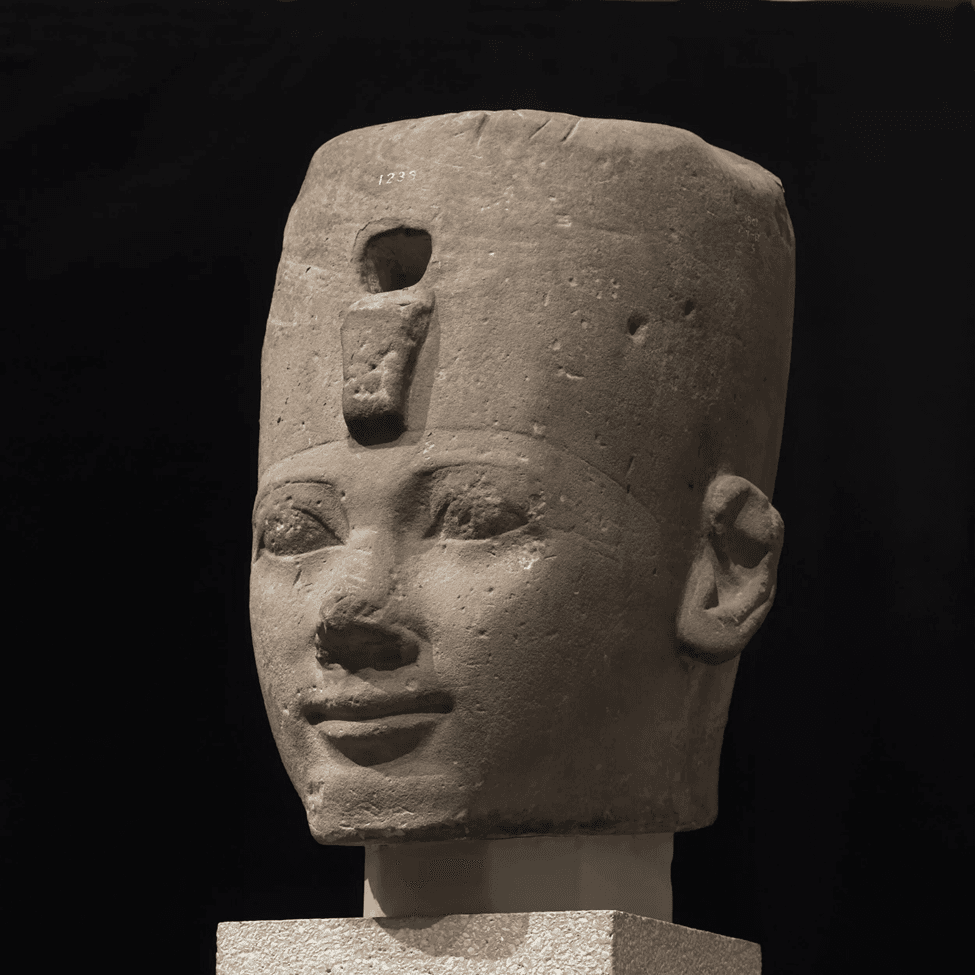

The accession of Thutmose I was the result not so much of direct inheritance as of a strategic choice. As the son of Ahmose I by a secondary wife, Senseneb, he was not considered the primary heir. However, the childlessness of his half-brother Amenhotep I and, likely, the patronage of the elderly queen Ahhotep allowed him to take the throne at about 45–47 years of age. To legitimize his rule, he married Princess Ahmose (daughter of the dynasty’s founder).
The mummy of Thutmose I presents the image of an energetic and perceptive ruler. He was a short (about 157 cm), stocky man with a narrow face and a characteristic family trait — protruding upper front teeth. His high forehead and slender nose suggest an intellectual disposition, while his military successes confirmed his reputation as the “Mighty Bull.”
Thutmose I entered history as a conqueror-pharaoh whose armies knew no defeat.
In the second year of his reign, Thutmose I marched south to suppress a rebellion. Chronicles (notably the records of the warrior Ahmose, son of Ebana) describe the pharaoh who “raged like a panther.” In the decisive battle, Thutmose personally slew the Nubian chieftain. The enemy’s corpse was hung upside down from the prow of the flagship — a terrifying symbol of triumph that accompanied the fleet all the way back to Thebes. The frontier was pushed far beyond the Third Cataract of the Nile, where a powerful fortress was established on the island of Tombos.


Having secured the south, Thutmose I turned his army northward. He marched through the entire Levant, passing Tyre and Sidon, and invaded the lands of Mitanni (Naharina). The Egyptians saw the Euphrates for the first time, which astonished them: unlike the Nile, it flowed “backward” — to the south. On its banks Thutmose erected a victory stela, proclaiming the northern limit of his dominion. He returned home with immense booty, including chariots and the first Asiatic horses.

The enormous wealth that poured into Egypt enabled Thutmose I to begin grand works at Karnak under the direction of the great architect Ineni.
Karnak: Two gigantic limestone pylons and two granite obelisks were erected. One of them still stands in the center of the temple, recalling the greatness of Akheperkare. A sacred barque 120 cubits long (over 60 meters) was also constructed for ceremonial processions.
Revolution in burial: Thutmose I became the first pharaoh to take the radical step of separating the mortuary temple from the tomb itself. Seeking to protect his body from robbers, he ordered Ineni to secretly cut his burial chamber into a remote valley that we now know as the Valley of the Kings.

“I oversaw the cutting of the tomb of His Majesty, I alone, no one else seeing or hearing,” Ineni proudly wrote.
The king’s personal life was overshadowed by the loss of his elder sons, Amenmose and Wadjmose, who died during their father’s lifetime. This placed the issue of succession in sharp dependence on political marriages.
His daughter Hatshepsut, born to the Great Royal Wife Ahmose, was his favorite and possessed “pure” royal blood.
His son Thutmose II, born to the secondary wife Mutnofret, was older than his sister but had weaker claims.
Thutmose I attempted to resolve this dilemma by marrying Hatshepsut to Thutmose II, thus uniting their claims to the throne.
Thutmose I died at about 60 years of age, having ruled only 13 years (according to Manetho) but accomplishing more in that time than many rulers did in decades. His death marked the completion of the formative phase of the empire. He departed leaving the country at the peak of its power, with borders stretching from the dusty banks of the Euphrates to the scorching cataracts of Nubia.
Even centuries later his memory was honored: his daughter Hatshepsut later reburied her father in her own magnificent tomb, and priests carefully preserved his mummy in a cache so that the stern visage of the great warrior would endure to the present day.


