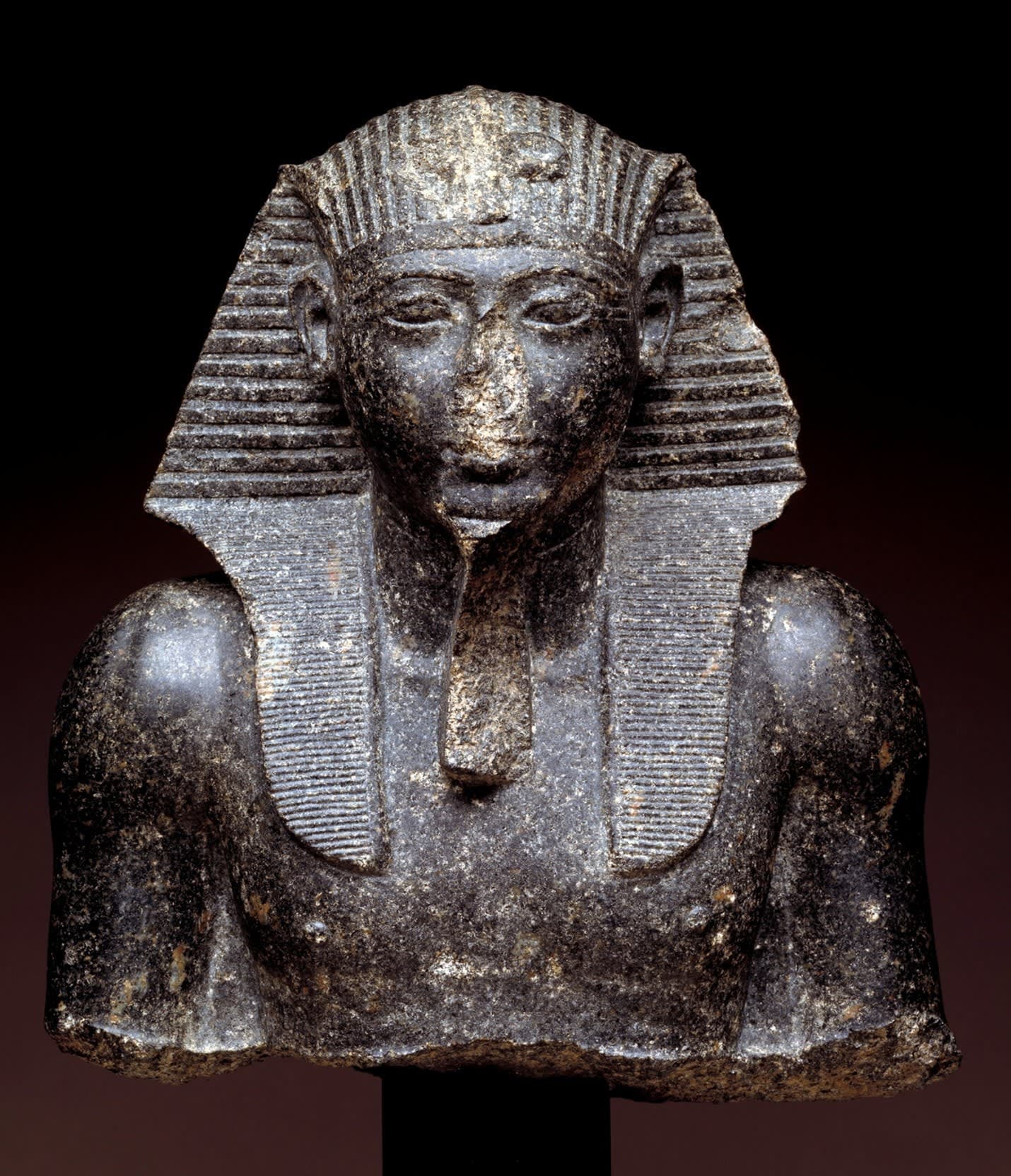

Seti I ascended the throne already a mature and experienced man. His very name — Seti (“Belonging to Set”) — carried a profound political and geographical connotation. The Ramesside lineage originated from Lower Egypt, from the vicinity of Avaris (the former capital of the Hyksos), where the god Set was revered as the patron of martial valor. However, in Upper Egypt, especially in sacred Abydos, Set was regarded as the murderer of Osiris and the embodiment of chaos.

This dualism Seti I resolved with the wisdom of a diplomat: on southern monuments he often replaced the name Seti with Merneptah (“Beloved of Ptah”) or called himself Usiri (likened to Osiris), so as not to offend the feelings of the faithful.
His wife was Tuya, the daughter of the commander of the chariotry. This union emphasized the military character of the new dynasty. They had at least two children: a daughter, Tia, and the great heir Ramesses II. The elder son, Nebchasetnebet, unfortunately died in childhood.
A loyal pillar of the pharaoh was the famous vizier (chati) Paser, whose sculptural portrait is considered a masterpiece of the age. Nubia, on behalf of the king, was governed by the viceroys Iuny and Amenemipet, ensuring a stable flow of resources from the south.
The principal task of Seti I was the restoration of Egyptian dominance in Syria and Palestine, lost during the Amarna period. His wars are immortalized in the grand “picture gallery” on the northern wall of the Hypostyle Hall at Karnak.
The pretext for war against the Shasu was the audacious advance of the Shasu Bedouins toward the borders of the Delta. Seti I personally led the army in a war chariot. He seized the strategic road along the Sinai coast, restoring wells and building outposts, many of which he named after himself. In the battle near Gaza (Pa-Canaan), the main enemy forces were destroyed. The inscriptions proclaim that the pharaoh was “fierce like a lion,” and that the streams of the enemies’ blood were to him “more pleasant than a day of rejoicing.”


Having pacified the south, Seti advanced into the Jezreel Valley in Lebanon. He captured Beth-Shean and Yenoam “within a day,” dividing the army into three corps: “Amun,” “Ra,” and “Set.” A crucial stage was the visit to the mountains of Lebanon. The local princes, trembling before the might of Egypt, were compelled to cut the famed cedars for the construction of the sacred barque of Amun and the gigantic masts of Egyptian temples.
Seti I became the first pharaoh after a long interval to enter into direct conflict with the Hittite kingdom. He defeated the Syrian principalities allied with the Hittites and temporarily captured Kadesh on the Orontes. Although the victory was not final, Seti succeeded in stabilizing the northern frontier and concluding a peace treaty with the Hittite king Muwatalli, securing for Egypt Palestine and part of Phoenicia.
In the west, Seti I fought against the Libyan tribes (Tjehenu). On this campaign he already took with him the young prince Ramesses. The Libyans, “hiding in caves like foxes,” were completely crushed.
The age of Seti I was a time of the highest flourishing of sacred architecture. His constructions are distinguished not only by scale but by the extraordinary quality of their reliefs.
The temple at Abydos, dedicated to seven deities, is one of the most mystical places in Egypt. It is here that the famous Abydos King List is located — a gallery of 76 cartouches of royal ancestors. Seti I skillfully used this list to legitimize his authority, deliberately “forgetting” to mention the heretic pharaohs of the Amarna period.


Adjacent to the temple stands the Osireion — a strange structure built of gigantic granite monoliths (weighing up to 65 tons each) in a megalithic style. Its austere appearance and deep placement (8 meters below the main temple) compel scholars to debate its true age.

Seti I continued his father’s project and transformed the Hypostyle Hall into one of the wonders of the world. The 134 columns, the central ones reaching 19.5 meters in height, create the impression of a “stone forest.” The walls of the hall are covered with reliefs totaling more than 24,000 m², which still preserve traces of their original coloring.

To finance the grand constructions, Seti I personally inspected the gold mines in the Eastern Desert. In the 9th year of his reign he ordered a well to be dug in Wadi Mia to provide water for the workers, which significantly increased gold production.
Around the same time, Seti officially proclaimed Ramesses II his co-regent. He crowned his son with the “Double Crown” during his own lifetime to ensure a smooth transition of power and avoid internecine strife.
Seti I died after approximately 11 years of reign (although Manetho attributes to him 21 years). His tomb in the Valley of the Kings, discovered by Giovanni Belzoni in 1817, is the longest and most elegant in the necropolis.
Scale: 100 meters in length, 6 staircases and 16 chambers.
Decoration: The walls are covered with the finest carving and vivid paintings illustrating the “Book of Gates” and the “Amduat.” The ceiling of the “Golden Hall” is adorned with a unique astronomical map.
Sarcophagus: The king’s alabaster sarcophagus, covered with magical texts, is today kept in London.


The mummy of Seti I itself was found in 1881 in the Deir el-Bahri cache. It is excellently preserved, presenting to us the visage of a majestic ruler with refined facial features.


