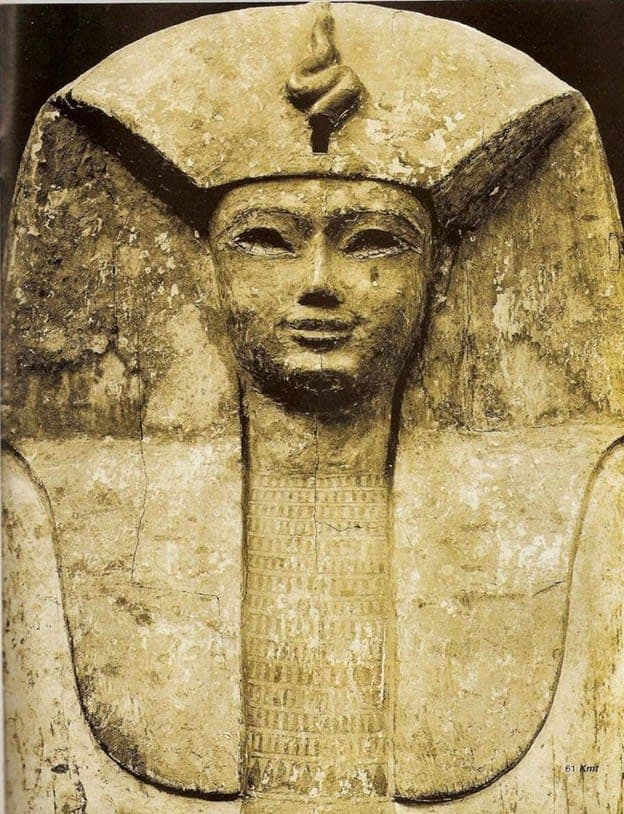
In Egyptology, there were long-standing debates about the number of rulers who bore the name Tao. The basis for these disputes lay in reports of officials from the Twentieth Dynasty (contained in the Abbott Papyrus), who during inspections of tombs mentioned “King Seqenenre, son of Tao” and “King Seqenenre, son of Tao-aa, the second King Tao.” However, modern scholarship tends to conclude that this was one and the same individual. The confusion likely arose from scribal errors or the similarity of throne names (for example, with his predecessor Senakhtenre).


The arguments in favor of the unity of Seqenenre Tao II’s identity are compelling:
Archaeological unity: Only one sarcophagus and one mummy bearing this name have been discovered.
Dynastic logic: In all sources, Tao’s consort is the legendary queen Ahhotep. It is difficult to imagine that two or three successive rulers would share identical names and the same wife.
The very title Seqenenre translates as “He Who Unites (or Inspires Courage in) the Sun God,” which in itself was a programmatic declaration. His personal name Tao (“Great of the Offering Bread”) probably indicated that he was a long-awaited child, prayed for from the gods through abundant offerings. Later, recognizing his achievements, descendants would call him Tao-aa (“Tao the Great”) or Tao-ken (“Tao the Victorious”).
Seqenenre belonged to a lineage whose roots lay in Khemenu (Hermopolis Magna), the center of the cult of the moon god Thoth. This explains the abundance of “lunar” names in the family: Ahmose (“Born of the Moon”) and Ahhotep (“The Moon Is Satisfied”). His mother was the famous queen Tetisheri, whose influence on the formation of Egypt’s new ideology was enormous. Seqenenre was likely the son of Pharaoh Senakhtenre, his predecessor.

The traditions of the time favored marriages within the royal family, and Seqenenre was no exception, marrying his sister Ahhotep. This union became the foundation for the country’s future greatness: their son Ahmose I would become the official founder of the Eighteenth Dynasty. The position of Kamose, Seqenenre’s successor, is noteworthy. Despite popular belief, he was most likely a brother rather than a son of Seqenenre. The age difference between Kamose and the young Ahmose was at least 20 years, and his name lacks the characteristic “lunar” element, suggesting his role as a temporary warrior-protector during the minority of the heir.
Seqenenre’s relations with the Hyksos king Apopi, who ruled from Avaris, are preserved in the folkloric yet historically significant Papyrus Sallier I. The story appears almost anecdotal: Apopi sent a messenger to Thebes complaining that the roaring of Theban hippopotamuses prevented him from sleeping in his capital. Considering that the cities were about 800 kilometers apart, the claim was absurd.


However, behind this caprice lay a harsh political ultimatum. The Hyksos sensed the growing power of Thebes and sought a pretext for humiliation or direct attack. Outraged by the invader’s insolence, Seqenenre convened a council of nobles. Although the ending of the papyrus is lost, the historical consequences are clear: the verbal confrontation escalated into a “prolonged and bitter war,” later described by the historian Manetho.
The most irrefutable proof of Seqenenre’s martial spirit is his own body. The pharaoh’s mummy, discovered in 1881 in the Deir el-Bahri cache, became the subject of detailed study by Gaston Maspero, Grafton Elliot Smith, and modern radiologists.
Research has shown that Seqenenre died a violent death between the ages of 35 and 40. His face still preserves an expression of rage and agony, and his teeth bit into his tongue at the moment of death. Five terrible wounds were recorded on the pharaoh’s head:
A horizontal fracture of the forehead (63 mm long), inflicted by an axe.
A second wound below the first, also from an axe, penetrating the bone.
A blow from a blunt object to the nose area, shattering bones and destroying an eye.
A deep cut to the left cheek from an axe, severing the jaw.
A puncture wound beneath the ear, inflicted by a spear or pike.
For a long time, a theory of palace conspiracy existed (that the king was murdered in his sleep, since his hands show no defensive injuries). However, modern examinations in the 1980s and in 2021 refuted this. The wounds on the forehead were inflicted by an Asiatic (Hyksos) axe, whose form is characteristic of that period.
The absence of wounds on the arms is explained by the possibility that the king fought — perhaps on horseback or with a shield — but at some point was stunned and overthrown. He was finished off while already on the ground, and there were at least two attackers. The hasty, almost careless embalming (the brain was not removed, and the body showed signs of decomposition at the start of the procedures) confirms that Seqenenre fell on the battlefield far from embalming workshops, and his body had to be prepared quickly for burial under campaign conditions.
Seqenenre Tao II was buried in Dra Abu el-Naga. Although his tomb was eventually lost (and his mummy later moved by priests to a safer location), his sacrifice was not in vain. He became the first pharaoh to shed blood in the war for independence. His death consolidated Egyptian society.
His wife Ahhotep and his sons continued the cause he had begun. Seqenenre remained in Egyptian memory not merely as a ruler but as a martyr whose battle-mutilated face became a symbol of an unbreakable will for freedom. Today his mummy is the oldest royal mummy housed in the Cairo Museum.


