Senusret’s path to sole rule began with a feat described in detail in The Tale of Sinuhe. As the eldest son and official co-ruler of his father during the first ten years, the young crown prince commanded the army in the Libyan Desert. It was there, in a night camp, that news reached him of a conspiracy in the capital and the death of Amenemhat I. Showing a swiftness his contemporaries compared to the flight of a falcon, Senusret abandoned the army and hurried to Itjtawy with a handful of loyal followers.


He arrived just in time: although there were other “royal children” in the army claiming the throne, Senusret managed to crush the rebellion at its inception. Sinuhe, a court official who became an unwilling witness to the intrigue, fled in terror to Asia, underscoring the atmosphere of danger in those days. Nevertheless, Senusret I retained power with an iron grip, preventing civil war.
To strengthen his authority, he not only systematized royal titulary, turning it into a canonical model for centuries, but also proclaimed continuity with great ancestors — Sahure (Fifth Dynasty) and Intef (Eleventh Dynasty) — emphasizing that his lineage stretched deep into antiquity some 600 years earlier.

Unlike his father, Senusret I shifted from defense to active conquest. His primary direction was southward. On stelae in Wadi el-Hudi he proudly styles himself “He who slays the Iuntiu” and “Star of the South.”
In the 18th year of his reign, the pharaoh organized a large-scale campaign to the Third Cataract of the Nile. The operation was commanded by the general Mentuhotep, who left in Wadi Halfa a grim inscription about burning enemy huts and destroying their grain. Egyptian influence spread to Kumma, and the region of Kush came to be regarded as a resource base.

The economic purpose of the war was clear: Sarenput I, nomarch of Elephantine, controlled the flow of Nubian tribute — gold, exotic goods, and labor. Under Senusret, Nubian mines became the primary source of gold for the treasury, enabling the pharaoh to launch an unprecedented building program.
To hold the conquered territories, Senusret I created a powerful line of fortifications. It was under him that the fortresses of Buhen, Ikkur, and Kuban were founded or greatly expanded. In Wadi el-Hudi a fortress was built to protect gold miners from Kushite raids. A new administrative division — the district “Head of the South” — was introduced, uniting the southern nomes under strict central control.
In the northeast, Senusret I relied on softer power. Inscriptions in Sinai testify to peaceful cooperation: Egyptian expeditions for turquoise and copper were often accompanied by local Asiatics. Egypt maintained close ties with Byblos, Ugarit, and cities of the Eastern Mediterranean. Royal envoys moved freely through Syro-Palestine, while Egyptian scarabs and ornaments have been found in Megiddo and Gaza. The pharaoh skillfully won over local rulers with gifts, turning them into loyal allies without resorting to force.
Senusret I revolutionized Egyptian architecture by initiating the systematic rebuilding of temples in stone.
Heliopolis: In his 3rd regnal year he founded a grand temple of Ra-Atum. Today only a single obelisk of pink granite remains — 20 meters high and weighing 121 tons, the oldest in Egypt. Its tip once shone with polished copper, pointing the way to the “House of the Sun.”

Karnak (Thebes): The pharaoh continued his father’s work, erecting the “White Chapel” of alabaster. This elegant structure, dismantled and reconstructed in the 20th century, contains unique lists of Egyptian nomes, becoming a key geographical document of the era.

Abydos: Here, under the direction of Vizier Mentuhotep, a temple of Osiris was built, adorned with lapis lazuli, silver, and copper.
Senusret’s successes rested on a cadre of outstanding officials.
Vizier Antefoker and his successor Senusret ensured law and order.
Treasurer Mentuhotep was effectively the second person in the state, overseeing construction projects and resource distribution.
Nomarchs (for example, Amenemhat of the Oryx nome) retained some autonomy but remained fully loyal to the crown, supplying recruits and gold.
Expeditions to Wadi Hammamat were astonishing in scale: one numbered 17,000 men and delivered to the Nile Valley 60 sphinxes and 150 statues.
For his burial, Senusret I chose a site 1.5 km from his father’s pyramid. His pyramid, Khenemsut (“Protected Place”), featured an innovative design: an internal framework of eight diagonal walls divided the structure into sixteen chambers filled with rubble and sand — cheaper than solid masonry but producing an impressive mass.
The complex was surrounded by two enclosure walls, the inner decorated with 100 reliefs bearing the pharaoh’s names. Nearby stood nine small pyramids for queens and princesses.
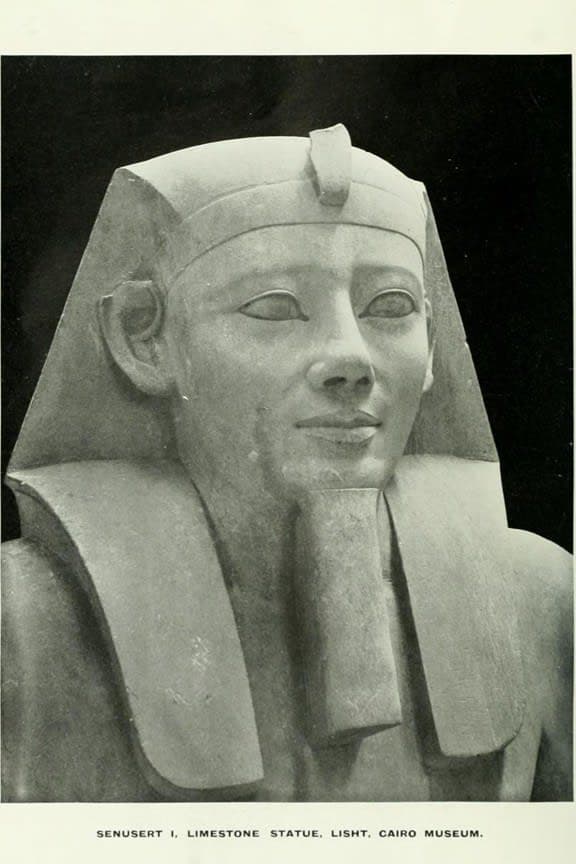
In the mortuary temple, archaeologists found ten magnificent seated limestone statues of the king, which for unknown reasons had been carefully buried in sand, preserving them in perfect condition. The burial chamber, like that of his father, remains inaccessible due to groundwater, keeping the secrets of Kheperkare beneath the Nile’s moisture.
Senusret I ruled for 45 full years (including co-regency). In his 43rd year, following his father’s example, he appointed his son Amenemhat II as co-ruler. He left behind a powerful, centralized state whose borders stretched far to the south and east. His reign laid the foundation for the future triumphs of the Twelfth Dynasty, turning Egypt into the undisputed hegemon of the ancient world.


