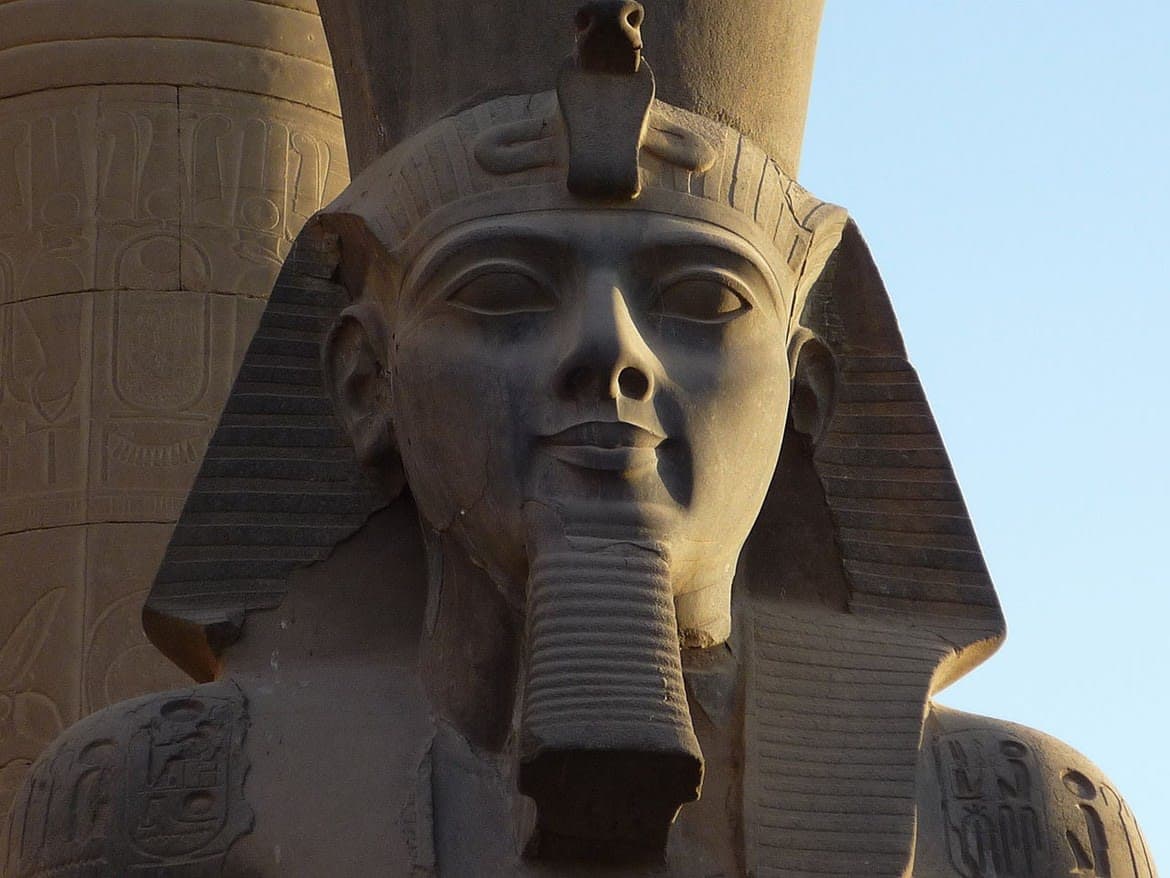
The path of the great ruler began on the 27th day of the third month of the season of Shemu, the Time of Drought, when the young Ramesses, who was around twenty years old, officially ascended the throne. Although the sources cover his long reign unevenly, the abundance of surviving documents — from magnificent stelae to humble honey jars from the settlement of Deir el-Medina — allows us to reconstruct the chronology of those years in considerable detail.
A transfer of power was always a moment of vulnerability, and conquered peoples often saw it as an opportunity to rebel. Ramesses had to prove his strength from the very first months of his reign. While depictions of Canaanite captives from the beginning of his rule may have been partly symbolic, the uprising in Nubia was serious enough to require the pharaoh’s personal presence. During the suppression of the revolt, particularly in the region of Irem, the Egyptian army acted with extreme severity: around 7,000 people were killed, leading to the complete pacification of the region. Success soon followed on the western frontiers as well, where Ramesses defeated the Libyans and reinforced his reputation as an invincible warrior.
One of the most remarkable victories of his early reign was his defeat of the Sherden, fearsome “Sea Peoples” who engaged in piracy. No later than the second year of his reign, Ramesses dealt them a crushing blow, catching them by surprise aboard their ships while they were asleep. Demonstrating strategic foresight, the pharaoh did not execute the prisoners but instead incorporated them into his army. These warriors, recognizable by their horned helmets, would later become an elite component of the Egyptian military, fighting in the front ranks in Syria and Palestine.


At the same time as he conducted military campaigns, Ramesses was also strengthening order within Egypt. In the very first year of his reign, he appointed the loyal Nebwenenef as High Priest of Amun, thereby securing the support of the powerful priesthood. In the third year of his reign, an event of enormous economic significance took place: water was discovered in Wadi Allaqi at a depth of only six meters, making it possible to dramatically increase gold production in the local mines.
Having secured his rear, Ramesses turned his attention northward, toward the borders of the Hittite Empire. His first campaign, in the fourth year of his reign, was preparatory in nature: the Egyptians consolidated their position on the Phoenician coast by capturing Berit, modern Beirut. The real test, however, came during the campaign of the fifth year. Ramesses assembled an enormous army by the standards of the time — more than 20,000 men — divided into four corps named Amun, Ra, Ptah, and Seth, and marched toward the fortress of Kadesh.

The Battle of Kadesh became the central event of Ramesses’ military career. Misled by Hittite spies, Ramesses, together with the Amun corps, advanced too far ahead of the main army and fell into a trap prepared by the Hittite king Muwatalli II. Hittite chariots rapidly scattered the Ra corps and surrounded the pharaoh’s camp. At this critical moment, Ramesses demonstrated extraordinary personal courage: leading his own guard, he organized a defensive perimeter.
Salvation came partly through chance — the arrival of a unit of “young warriors,” the Ne'arin, from the coastal region and the approach of the Ptah corps. Despite heavy losses on both sides, neither army was able to achieve a decisive victory. Ramesses withdrew with his honor intact, but strategically Kadesh remained under Hittite control.
The war with the Hittites continued for many years. In the eighth year of his reign, Ramesses captured the strategically important fortress of Dapur, and in the tenth year he once again fought for Tunip. By the 21st year of his reign, around 1258 BCE, however, the political situation had changed. The growing power of Assyria forced the former enemies to seek an alliance.


A Hittite envoy arrived in the capital, Pi-Ramesses, carrying a silver tablet on which the text of a peace treaty had been inscribed. It was one of the earliest surviving formal international peace treaties in world history. It guaranteed mutual non-aggression, military assistance, and the extradition of fugitives.
The alliance was further strengthened in the 34th year of Ramesses’ reign through his marriage to a Hittite princess, who received the Egyptian name Maathorneferure. Several years later, Ramesses also married a second daughter of the Hittite king Hattusili III. This peace brought the region an exceptional period of trade and political stability that lasted for decades.

Ramesses II entered history as one of the greatest builders of ancient Egypt. His new royal residence was the city of Pi-Ramesses, meaning “House of Ramesses,” in the Nile Delta, which became a symbol of his power. Yet some of his true architectural masterpieces were constructed farther south.
Abu Simbel: The Great Rock Temple in Nubia, with four colossal statues of the pharaoh approximately 20 meters high.

The Ramesseum: His mortuary temple at Thebes, where an enormous statue of the ruler weighing approximately one thousand tons once stood.
Karnak and Luxor: The completion of major architectural projects, including work connected with the Great Hypostyle Hall and the construction of additional pylons and monuments.
The pharaoh did not hesitate to reuse materials from older monuments for his own construction projects, although this was a common practice at the time. Toward the end of his life, Ramesses was officially worshipped as a divine ruler associated with the god Ra-Horakhty. He died in the 67th year of his reign, having outlived twelve of his sons. His successor was his thirteenth son, Merneptah.
The fate of Ramesses II’s body proved almost as remarkable as his life. Because of the activities of tomb robbers, his mummy was moved and rehidden several times. Eventually, it was placed in the royal cache at Deir el-Bahri, where it was discovered in 1881.
In 1976, the mummy even “flew” to Paris in order to undergo conservation treatment after fungal deterioration had been detected. Studies showed that Ramesses had been a tall and imposing man for his time, approximately 1.7 meters in height, with light skin and reddish hair, and was described by researchers as belonging broadly to a Mediterranean physical type.


