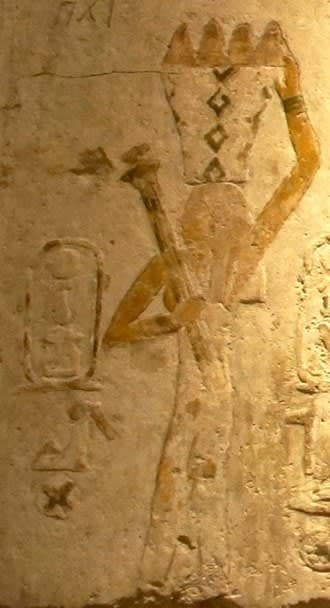

As in the case of his predecessors, the origin of Neferirkare is shrouded in a mystical aura. According to the famous Westcar Papyrus, he was one of three divine infants (under the name Keku) born to the wife of a priest of Ra named Reddedet by the Sun god himself. Historical reality, however, indicates that he was the son of the dynasty’s founder Userkaf and the great queen Khentkaus I, inheriting the throne after his brother Sahure.

At birth he received the name Kakai, which is preserved in the Abydos King List and on blocks from the tomb of the nobleman Ti. However, upon ascending the throne he adopted the throne name Neferirkare, which translates as “Perfect is the form of the soul of Ra.” His Horus name became Userkhau (“Mighty in his appearances”). The fact that these names refer to one and the same individual is confirmed by the identical names of his solar temple and pyramid complex in various sources.
The exact duration of his rule remains a matter of debate. Manetho assigns him 20 years, but the unfinished state of his grand constructions leads modern scholars to favor a more modest figure — about 10–12 years. The most important document of this era is the Palermo Stone, which preserved records of the king’s deeds:
In the first year of his reign, Neferirkare displayed unheard-of generosity by granting lands to the Divine Ennead and the spirits of Heliopolis. In the city of Meret-Snefru he ordered a statue of the goddess Hathor to be installed, made of electrum (an alloy of gold and silver).
In the ninth and tenth years, the chronicle records his devotion to the cult of the Sun. He built a sacred enclosure around the solar barque and commissioned two unique copper boats — the “evening” and the “morning” — each 8 cubits long (3.6 meters).
It is believed that under Neferirkare the work on the world’s first historical chronicle carved on the Palermo Stone was completed, although some researchers think it was supplemented by his successors.
The central project of Neferirkare was the solar temple Setibra (“Heart-desire of Ra”). Although this structure has not yet been found by archaeologists, it is considered one of the most significant sanctuaries of the Fifth Dynasty.
Thanks to the papyri from the Abusir archive, we know that the temple was a true administrative center. It housed the barques of Maat, storerooms, and halls for celebrating the Heb-Sed (royal jubilee). The temple stood at some distance from the pyramid, and supplies for the funerary cult were transported from it by boat. It is likely that the temple has not been found because it was built of mudbrick and over time simply blended into the desert landscape.


The most important legacy of his reign was the Abusir archive — the oldest body of administrative documents from the Old Kingdom. These papyri revealed to historians details of life at the time: from priestly duty rosters to inventory lists of property, demonstrating the complexity and efficiency of Egyptian bureaucracy.
Neferirkare’s tomb at Abusir, called Ba (“Soul”), was intended to become the most magnificent monument of the necropolis.
Original design: The pyramid was conceived as a six-step structure (52 meters high).
Scaling: Later the project was changed, deciding to transform it into a “true” pyramid. If completed, its height would have been 73.5 meters, with a base width of 104 meters.
However, the pharaoh’s sudden death interrupted the work. His heirs — Neferefre and Niuserre — completed the complex in haste and much more modestly. Stone casing was replaced with mudbrick, and the columns of the funerary temple were made of wood. Ironically, his successor Niuserre even “appropriated” Neferirkare’s valley temple and causeway, simply redirecting them toward his own pyramid.
Neferirkare Kakai entered history as one of the kindest and most noble rulers. Touching testimonies to his character, preserved in the tombs of his officials, sharply contrast with the image of the despotic kings of the Fourth Dynasty:
The Story of Rawer: During a ritual, the king accidentally struck the priest Rawer’s leg with his staff. In that era, contact with an object held by the “divine” pharaoh could mean death or disgrace. But Neferirkare immediately exclaimed, “You are safe!”, emphasizing that it was an accident and that the priest remained in great favor.
The Tragedy of Washptah: When his vizier and architect lost consciousness during an inspection of a new construction project, the pharaoh did not merely grieve. He summoned the best physicians, ordered chests with medical papyri to be brought, and personally prayed for his friend. After Washptah’s death, the king commissioned for him a coffin of precious black wood — an honor almost without precedent.
Mercy toward Ptahshepses: The nobleman Ptahshepses received a unique privilege — he was allowed to kiss the pharaoh’s feet instead of kissing the dust at them, as strict etiquette required.
These stories show that under Neferirkare the power of the pharaoh became more “human.” Although he exempted temples from obligations, somewhat weakening the influence of the royal court, he succeeded in creating the image of an ideal monarch-father whose nobility (in accordance with his name) was expressed not only in titles but also in deeds.


